Mars orbiter captures striking images of ‘chaos and craters’ carved by ancient floods

When you purchase through links on our articles, Future and its syndication partners may earn a commission.
Stunning new images from Europe’s Mars Express orbiter reveal a rugged Martian landscape sculpted by catastrophic floods that ravaged the Red Planet billions of years ago.
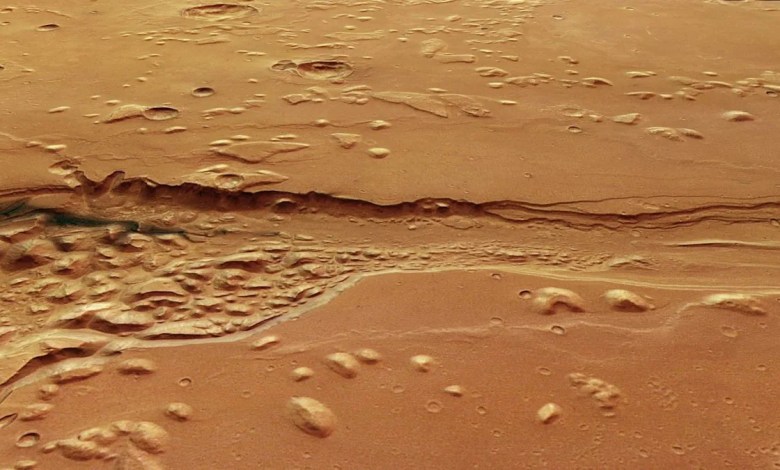
The new dramatic point of view, published by the European Space Agency (ESA) on May 13 highlights Shalbatana Vallis, a sprawling Martian canal system near the planet’s equator that stretches about 800 miles (1,300 kilometers, or about the length of Italy. The image was taken by Mars Express’s High-Resolution Stereo Camera (HRSC), highlighting what planetary scientists call “chaotic terrain,” according to a declaration of the space agency.
Chaotic terrain is characterized by fractured and disordered blocks of rock that would have formed when underground ice melted and caused the surface above to collapse. In Shalbatana Vallis, the landscape borders winding valleys carved out by immense floods that once swept over March about 3.5 billion years ago.
“This type of terrain is common on Mars and has already been captured by Mars Express,” ESA officials said in the statement.
Researchers believe that huge amounts of groundwater probably burst to the surface in a series of catastrophic floods that surged downward and rapidly carved out the water-worn valleys visible today. The main channel seen in the images is about 10 kilometers wide and plunges about 500 meters deep.

A new image from ESA’s Mars Express shows part of Shalbatana Vallis, a large channel in the equatorial region of Mars. | Credit: ESA/DLR/FU Berlin
The recent images also reveal layers of Mars’ complex geological past throughout the region, suggesting that Shalbatana Vallis may once have been even deeper before gradually filling in with sediment, ash and other material over time. Dark blue-black deposits scattered throughout the valley are believed to be volcanic ash redistributed by Martian winds, while impact craters, ridge ridges and isolated mesas provide evidence of repeated cycles of catastrophic floods, lava flows and erosion spanning billions of years.

Mars Express imaging of part of a small patch of chaotic terrain within Shalbatana Vallis, a large channel near Mars’ equator. | Credit: ESA/DLR/FU Berlin
Scientists are particularly interested in regions like Shalbatana Vallis because they preserve evidence that Mars was once distant. warmer and more humid than it is today. The channel flows toward Chryse Planitia, one of the lowest regions of Mars, where some researchers have proposed that an ancient ocean may have existed, according to the release.
Launched in 2003, Mars-Express remains one of the oldest missions still operating on Mars, with its HRSC mapping the Red Planet in color and 3D for more than two decades. During its mission, the spacecraft played a major role in discovering evidence of Mars’ aquatic pastmapping minerals formed in water, studying buried ice deposits, and even contributing to controversial discoveries suggesting possible liquid water beneath the planet’s south polar ice cap.


