Mayor Mamdani Offers a Progressive Vision for Small Businesses


February 10, 2026
If successful, his policy could offer a new strategy on a national scale.
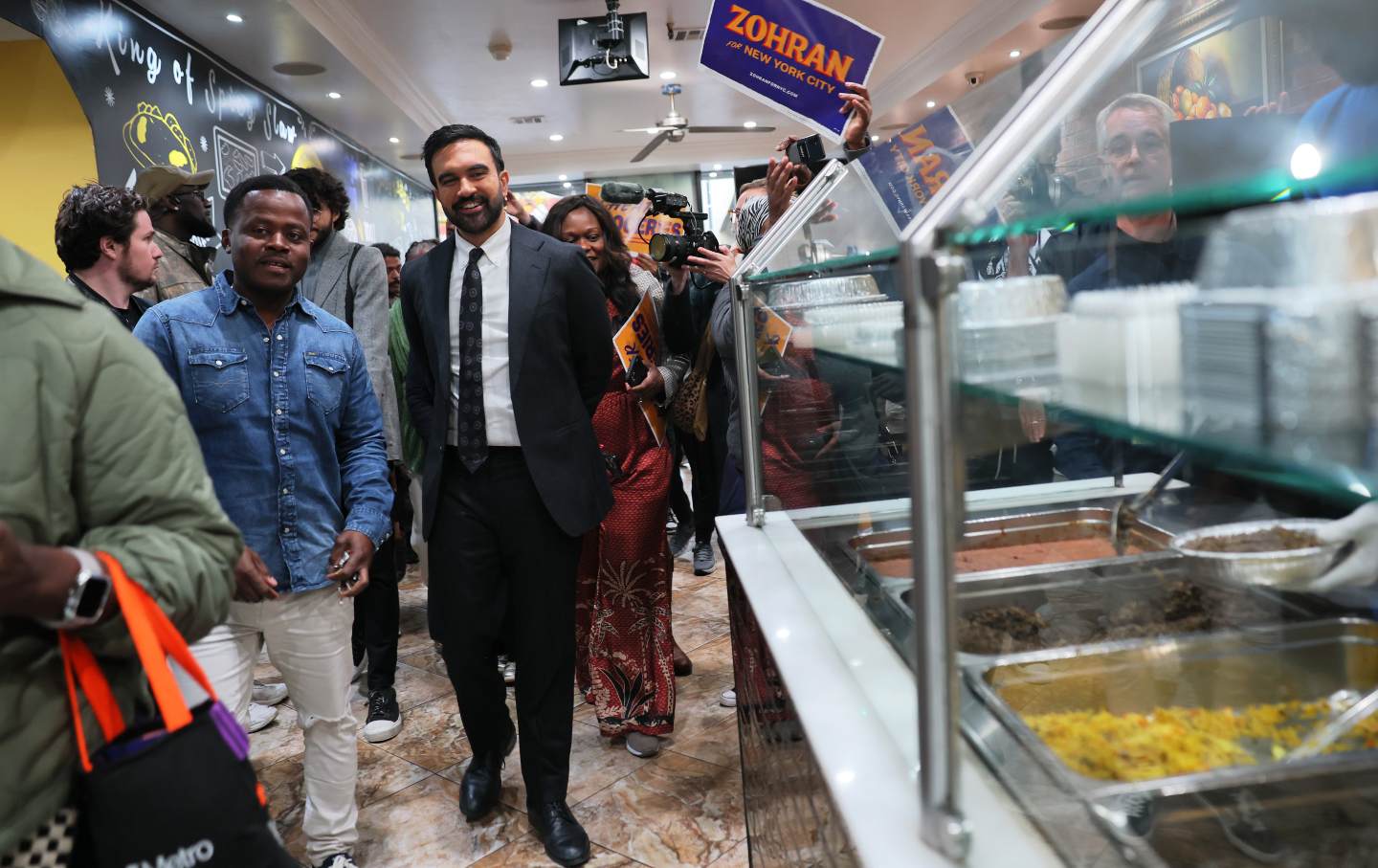
Cursy Saint Surin, owner of Kreyol Flavor, walks with Democratic mayoral candidate Zohran Mamdani inside Kreyol Flavor as he gives a neighborhood tour October 25, 2025 in the East Flatbush neighborhood of the borough of Brooklyn in New York. Mamdani was joined by Assembly Member Rodneyse Bichotte Hermelyn and City Council Member Farah Louis.
(Michael M. Santiago/Getty Images)
For the right, few words are more beloved than “deregulation.” Republican candidates often spend their campaigns raging against the bogeyman of regulatory bureaucracy, and once they take office, right-wing policymakers use their power to gut the safeguards protecting Americans’ health, environment and pocketbooks. From his first days in office, President Donald Trump has managed to surpass even the usual Republican enthusiasm for cutting red tape, by assigning federal agencies the ridiculous and arbitrary goal of repealing 10 regulations for every new regulation they enact.
In recent weeks, however, a much more sensible form of deregulation has found a surprising champion: New York City Mayor Zohran Mamdani. No, the new mayor is not making a shocking right turn. Instead, his administration is focused on easing the administrative burden on New York’s more than 183,000 small businesses.
Progressives have long and rightly condemned the deleterious effects of mega-corporations like Walmart and Amazon, whose tax-dodging, union-busting, and cost-cutting tactics undermine market competition and workers’ rights. But Mamdani combines left-wing criticism of big business with deregulatory measures that support small businesses. If successful, these policies will help give mom-and-pop stores a fighting chance against private-sector giants — and could also offer a new playbook for progressives nationwide.
After declaring in his inaugural speech that he would “free small business owners from the shackles of a bloated bureaucracy,” Mamdani signed an executive order earlier this month to do just that. It directs city agencies to review more than 6,000 rules governing small businesses and identify opportunities to simplify regulations and reduce the myriad associated fees and fines.
It’s a timely measure that could strengthen small businesses in the heart of America’s largest city. Although New York is the financial capital of the country and home to more Fortune 500 headquarters than any other U.S. location, 89 percent of its companies have fewer than 20 employees — and these small operations face significant pressures. In addition to navigating the city’s sprawling regulatory ecosystem, they must contend with rising rents, Trump’s scattershot tariffs and an affordability crisis that leaves middle-class Americans increasingly unable to engage in discretionary spending. Result: this spring, 8,400 businesses closed their doors in the city, while only 3,500 new ones opened their doors.
Of course, many prescriptions are essential; after all, few would want to eat at a restaurant that doesn’t answer to a health inspector. But in a strained economic landscape, Mamdani’s reinvention of the city’s regulatory structure could mean the difference between survival and closure for many of New York City’s struggling small businesses. After all, when the government throws too many hurdles at independent businesses, only the rich will be able to afford to jump through them.
Current number

Mamdani is by no means the first voice from the center-left – or even the first resident of Gracie Mansion – to attempt to take back the policy of deregulation from conservatives. More recently, the subject was at the heart of the political bestseller Abundance: how we build a better future. Journalists Ezra Klein and Derek Thompson argue that progressives have tolerated labyrinthine approval processes and regulatory apparatuses for too long. In doing so, the authors argue, well-meaning leftists have hindered the construction of housing, public transportation, and other social goods.
The abundance framework has been welcomed by centrist Democrats who are seeking a path out of the wilderness of the party’s disastrous defeat in the 2024 election — one that won’t ruffle corporate feathers, of course. And it has been roundly criticized by the left for its potential to provide cover for the kind of pro-business, deregulatory melee that libertarian fantasies are made of. However, the still-nascent Mamdani administration could prove that, combined with other progressive priorities, targeted deregulation can both serve American workers and have political resonance.
In one of the most acclaimed ads of his campaign, the then-distant candidate interviewed food cart operators about “halalflation.” They had applied for a permit, but found themselves stuck on a waiting list of nearly 10,000 potential sellers. The number of permits was strictly capped and between 2021 and early 2024, only 71 new permits were issued. So, to start their business, sellers paid exorbitant sums on the black market to lease existing permits, thus passing on their artificially inflated costs to customers.
In December, with Mamdani’s support, the city council passed a bill increasing the cap on street vendor permits. The benefits may not be just economic: Amid the Trump administration’s brutal immigration crackdown, which has seen even minor infractions used to justify harassment, detention and deportation, offering the city’s largely immigrant street vendors the opportunity to operate legally could help protect them from abuse.
And as part of its campaign for universal child care, Mamdani’s administration has pledged to collaborate with in-home daycares. Despite their vital role in supporting working families and the city’s economy, these small businesses were sidelined during previous preschool and kindergarten expansions, in part because they struggled to keep up with regulations that larger child care providers could more easily meet.
We are a far cry from the carnival of red tape cutting that the right aspires to and is distinct from the business-friendly vision of abundance espoused by Klein and Thompson’s most fervent supporters. Instead, as Mamdani put it, it is an “abundance program that puts the 99 percent above the 1 percent.”
For Democrats, who are historically less trusted by voters than Republicans when it comes to the economy, this is an opportunity to enact policy that turns a long-standing weakness into a new strength. The Trump administration’s gross economic mismanagement has cost the party much of its lead in voter confidence. The left now has a chance to maintain and even develop these gains, perhaps by revealing itself to be both a tamer of the excesses of big business and a champion of the success of small businesses.
More than The Nation
But Tom Homan is a liar and the work is not done. Plus, Gallup’s new polling policy (is the analytics company in Trump’s tank?), deepfake law, and more in the…
Elie Mystal
Even conservatives are fleeing the Republican Party as more and more Americans turn against Trump’s authoritarian project.
Column
/
Sacha Abramski
The administration’s crudely funded Freedom 250 project, which will oversee America’s half-century celebration, is a spectacle of right-wing extremism.
Toni Aguilar Rosenthal


