Measles Elimination Status Threatened in U.S. and Canada


November 3, 2025
4 min reading
The United States could soon lose its measles-free status
A meeting of the Pan American Health Organization this week will focus on the resurgence of measles in the Americas.
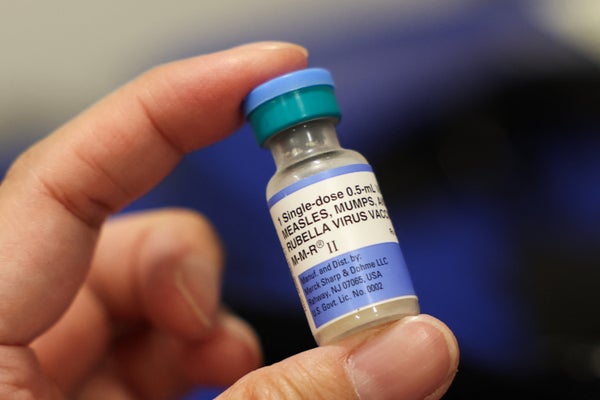
A vial of measles, mumps and rubella (MMR) vaccine. The United States could risk losing its status as a measles-free state if the current outbreak trend continues.
PATRICK T. FALLON/AFP via Getty Images
If current trends continue, North America could soon become a hotspot for permanent measles transmission. Canada could lose its measles-free designation this week, and the United States may not be far behind.
A key measles and rubella committee of the Pan American Health Organization (PAHO) will meet this week to discuss whether North American countries have lost their measles elimination status, meaning the measles virus has become endemic in those countries. A country is considered endemic for measles if there has been uninterrupted transmission from a single outbreak of the virus that lasted 12 months or more.
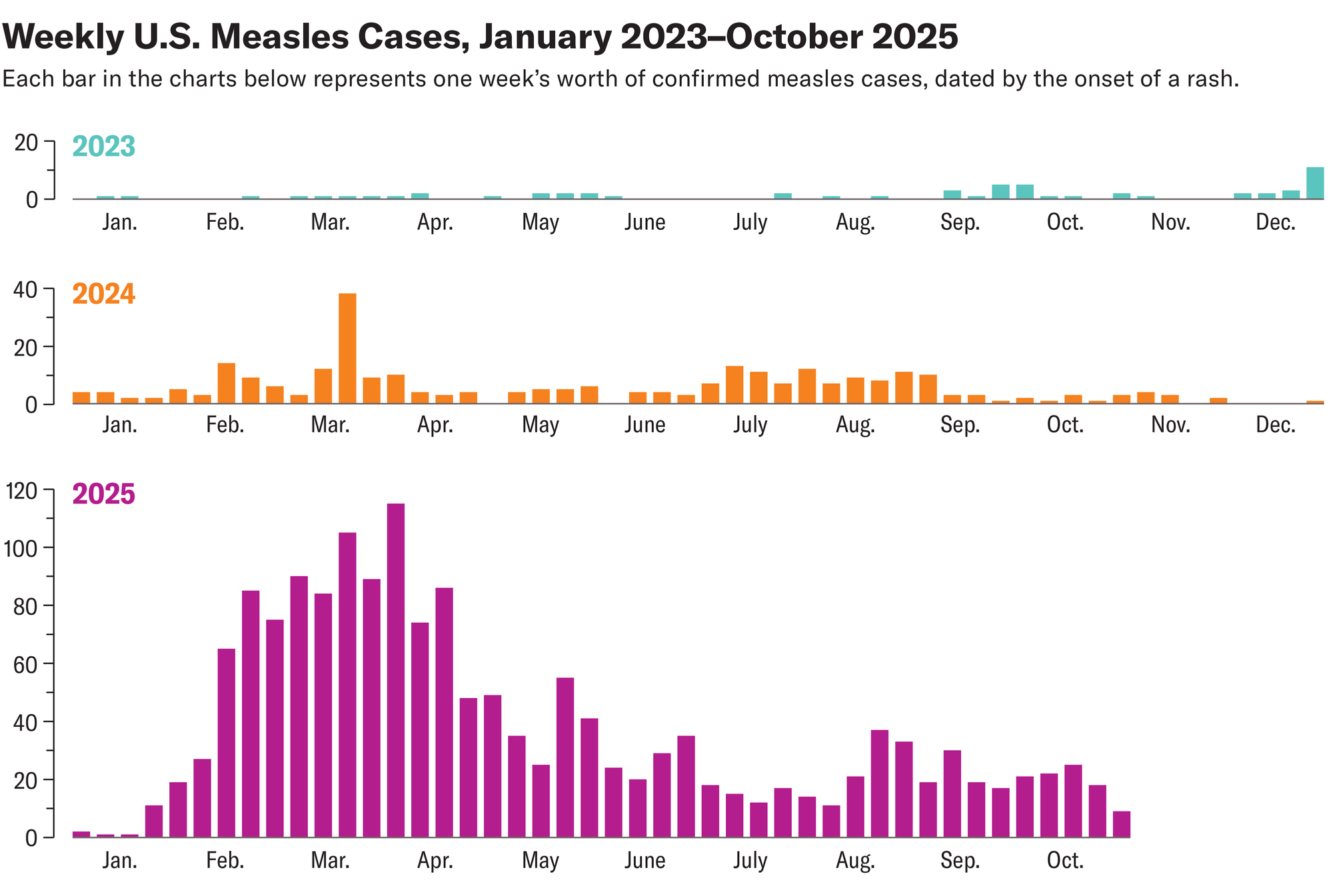
Canada has probably already taken this step; the country has experienced a single outbreak of more than 5,100 measles cases since October 2024, according to its health data. The United States is also on shaky ground. An outbreak of 762 cases in West Texas that began in late January 2025 was declared over on August 18. But health officials are investigating ongoing outbreaks in South Carolina and Utah. If the investigation successfully links these outbreaks to the original cases in Texas, and if health officials fail to bring them under control before January 2026, the United States could also lose its measles elimination status.
On supporting science journalism
If you enjoy this article, please consider supporting our award-winning journalism by subscription. By purchasing a subscription, you are helping to ensure the future of impactful stories about the discoveries and ideas shaping our world today.
“I expect we will lose our elimination status,” says David Higgins, a professor of pediatrics at the University of Colorado School of Medicine. “We’re heading straight toward that.”
Experts make these decisions by looking at epidemiological data on outbreaks, as well as molecular data that can determine whether individual viruses are in the same chain of transmission, says Jon Kim Andrus, chair of PAHO’s regional verification commission. The commission also examines a country’s vaccination coverage and its ability to detect measles cases. If there are areas where public health officials never report illnesses with rash and fever, for example, that’s a red flag that measles could be spreading undetected. The commission also examines each country’s capacity to strengthen its public health system and the sustainability of its programs. The process is “rigorous and detailed,” Andrus says.
Canada first eliminated measles in 1998, and the United States in 2000. In 2016, the entire Americas region declared the disease eliminated, but outbreaks in Venezuela in 2017 and Brazil in 2018 overturned that declaration. Last November, PAHO determined that the two countries had successfully interrupted transmission, making the Americas measles-free again.
Measles can have serious long-term effects, including hearing loss, reduced immunity from previous infections with other viruses, and pneumonia. One in 1,000 cases of measles causes encephalitis, which can lead to permanent brain damage or death, says Lisa M. Lee, an infectious disease epidemiologist at Virginia Tech and former head of the Centers for Disease Control and Prevention. The United States has recorded more than 1,600 cases and three confirmed deaths so far this year.
“Seeing this happening right now in the United States is truly heartbreaking,” Lee says.
Efforts to control measles are well worth the cost, says Kimberly Thompson, founder of Kid Risk, a nonprofit that focuses on pediatric risk analysis. Thompson’s work suggests that the net economic benefits of investments in measles and rubella vaccination in the United States are $310 billion and $430 billion in avoided measles and rubella treatment costs, respectively. This does not include additional gains in economic productivity from parents and children avoiding sick leave.
“This is a huge return on investment, not only financially, but also health-wise,” Thompson says.
The problem is that measles is absurdly transmissible. In an unvaccinated population, each case can lead to between 12 and 18 new cases, says Amy Winter, an epidemiologist and biostatistician at the University of Georgia. Winter and colleagues calculate that with 84 percent vaccination coverage, each case can still cause two to three new cases — a transmissibility similar to that of seasonal flu or the original COVID variant. This is why 95% vaccination coverage is the herd immunity threshold – the point at which a population has enough immune people to prevent the continued spread of disease.
Unvaccinated individuals are causing outbreaks in the United States, Winter says. The solution is to increase the number of children who are up to date on their measles, mumps, and rubella (MMR) vaccines. To achieve this, public health authorities can expand access to vaccination clinics and ensure that patients receive reminders when they are due to get vaccinated, says Higgins of the University of Colorado. Pediatricians and family doctors are on the front line responding to parents’ hesitancy and concerns regarding vaccination.
In the United States, the CDC is responsible for coordinating national public health responses to measles. The Trump administration has proposed cutting the agency’s budget by $5 billion, and more than 3,000 employees have been laid off or resigned since January. Most CDCs are currently closed, as is the rest of the federal government.
In this sense, the United States’ loss of measles elimination status could be a wake-up call that the country is losing its capacity to address public health threats.
“If you can’t stop the transmission of measles,” Andrus said, “how are you going to respond to the next pandemic?
It’s time to defend science
If you enjoyed this article, I would like to ask for your support. Scientific American has been defending science and industry for 180 years, and we are currently experiencing perhaps the most critical moment in these two centuries of history.
I was a Scientific American subscriber since the age of 12, and it helped shape the way I see the world. SciAm always educates and delights me, and inspires a sense of respect for our vast and beautiful universe. I hope this is the case for you too.
If you subscribe to Scientific Americanyou help ensure our coverage centers on meaningful research and discoveries; that we have the resources to account for decisions that threaten laboratories across the United States; and that we support budding and working scientists at a time when the value of science itself too often goes unrecognized.
In exchange, you receive essential information, captivating podcasts, brilliant infographics, newsletters not to be missed, unmissable videos, stimulating games and the best writings and reports from the scientific world. You can even offer a subscription to someone.
There has never been a more important time for us to stand up and show why science matters. I hope you will support us in this mission.


