Medicine Nobel Prize rewards peripheral immune tolerance research : NPR

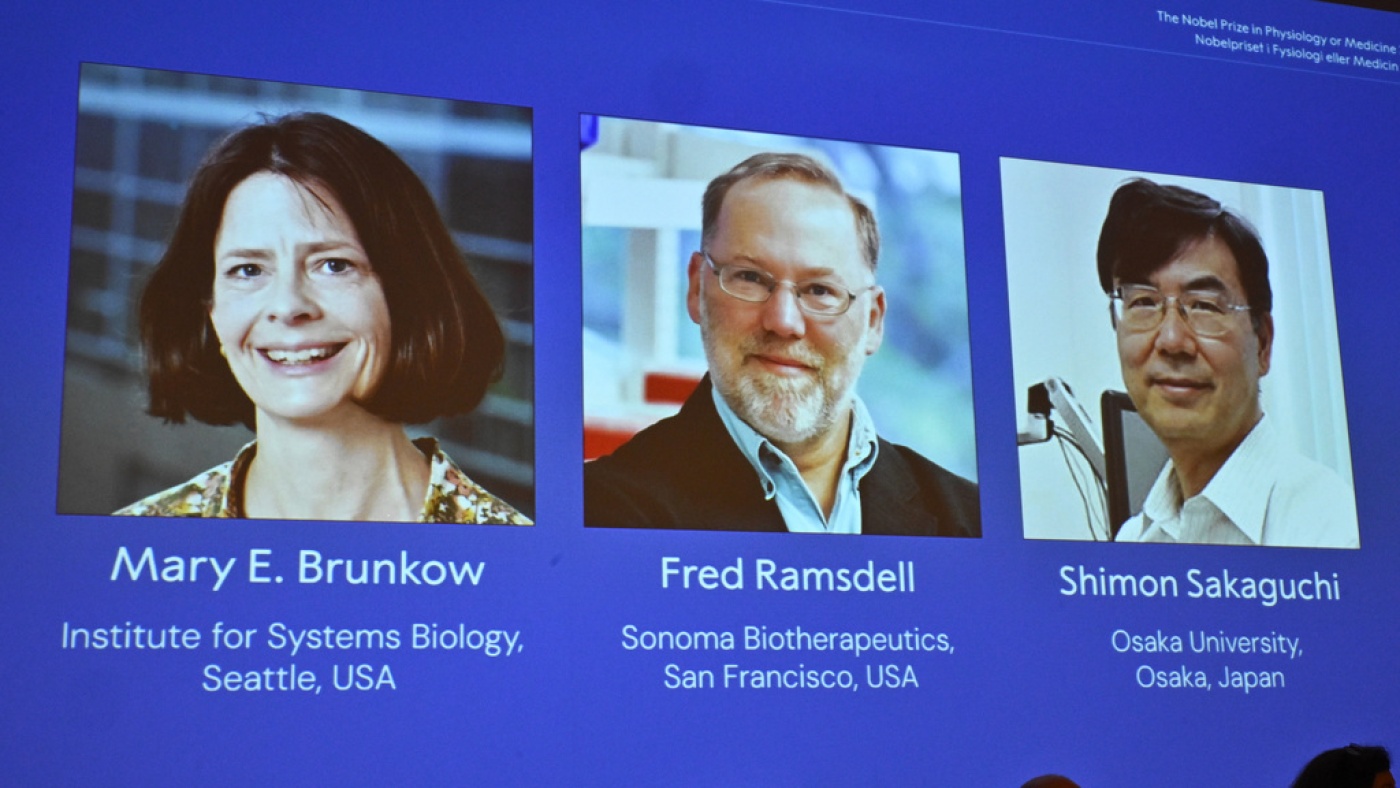

A screen showing the photos of Mary E Brunkow, Fred Ramsdell and Shimon Sakaguchi, who received the Nobel Prize for Medicine or Physiology on Monday at the Nobel Assembly of the Karolinska Institute in Stockholm, in Sweden.
CLAUDIO BRESCIANI / TT press agency
hide
tilting legend
CLAUDIO BRESCIANI / TT press agency
Stockholm – Mary E. Brunkow, Fred Ramsdell and Shimon Sakaguchi won the Nobel Prize in Medicine on Monday for their discoveries concerning peripheral immune tolerance.
Brunkow, 64, is main program director at the Seattle Systems Biology Institute. Ramsdell, 64, is a scientific advisor for Sonoma Biotherapeutics in San Francisco. Sakaguchi, 74, is a distinguished professor at the Immunology Frontier Research Center at the University of Osaka in Japan.
The immune system has many systems overlapping to detect and fight against bacteria, viruses and other bad players. The keys to immune warriors such as T cells are trained on how to identify bad actors. If some go rather in a bad way in a way that could trigger autoimmune diseases, they are supposed to be eliminated in the thymus -a process called central tolerance.
Nobel winners have unplugged an additional means for the body to keep the system in check.

The Nobel Committee said that it had started with the discovery of Sakaguchi in 1995 of a subtype of unknown T cells now known as regulatory T cells or REG.
Then in 2001, Brunkow and Ramsdell discovered a guilty mutation in a gene named Foxp3, a gene that also plays a role in a rare human autoimmune disease.
The Nobel Committee said that two years later, Sakaguchi linked the discoveries to show that the FoxP3 gene controls the development of these T -regs – which in turn act as a security guard to find and limit other forms of T cells which react excessively.
The work has opened a new field of immunology, said Marie Wahren-Herlenius, rheumatology professor at the Karolinska Institute. Researchers from around the world are now working to use regulatory T cells to develop treatments for autoimmune diseases and cancer.
“Their discoveries were decisive for our understanding of the functioning of the immune system and why we do not all develop serious autoimmune diseases,” said Olle Kämpe, president of the Nobel Committee.
Thomas Perlmann, secretary general of the Nobel Committee, said that he could only join Sakaguchi by phone on Monday morning.
“I grabbed him in his laboratory and he looked incredibly grateful, said it was a fantastic honor. He was quite taken by the news,” said Perlmann. He added that he had left the voice messages for Brunkow and Ramsdell.
The prize is the first of the announcements of the Nobel Prize 2025 and was announced by a panel from the Karolinska Institute in Stockholm.

Last year’s prize was shared by Americans Victor Ambros and Gary Ruvkun for their discovery of microarn, tiny pieces of genetic material that serve as switches inside and inside the cells that help control what cells do and when they do it.
Nobel ads continue with the physics prize on Tuesday, chemistry on Wednesday and literature on Thursday. The Nobel Peace Prize will be announced on Friday and the Nobel Memorial in economics prize on October 13.
The award ceremony will take place on December 10, the anniversary of the death of Alfred Nobel, which founded the awards. Nobel was a rich Swedish industrialist and the inventor of the dynamite. He died in 1896.


