This Is Not How Democracies Go to War. It’s How Dictators Do.


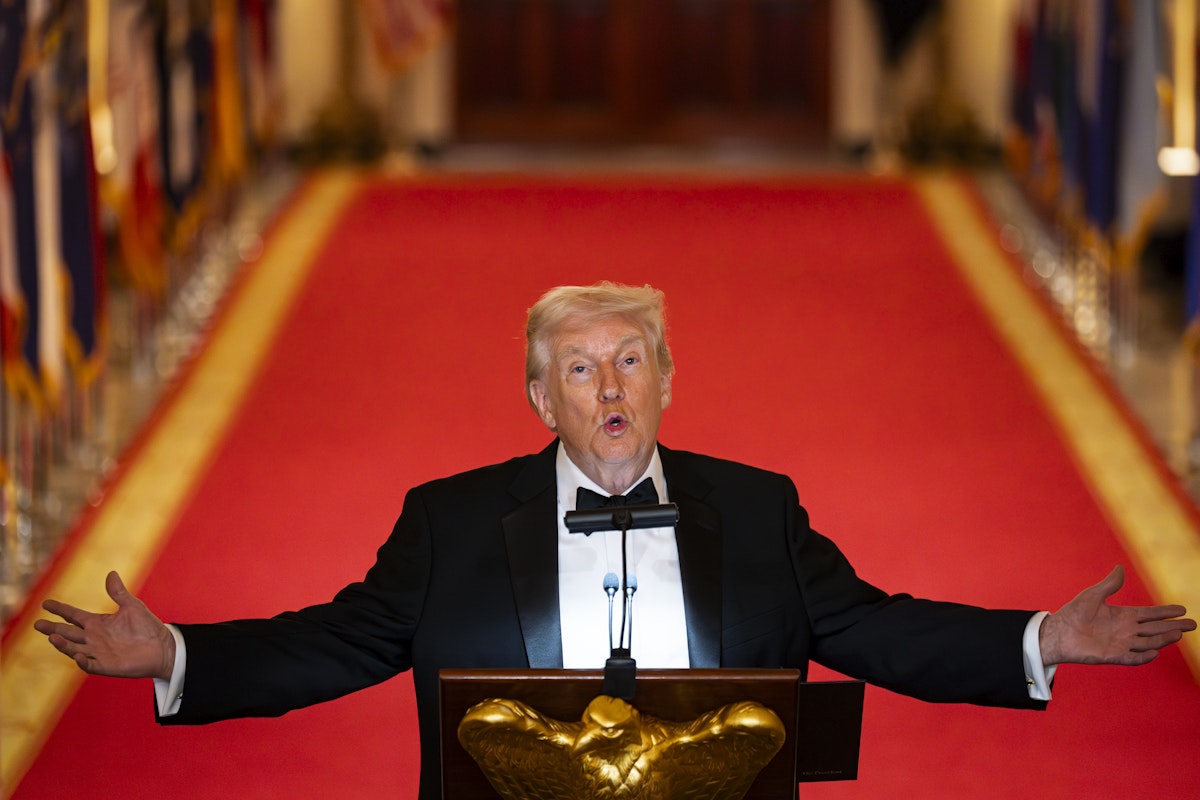
It’s not just that Donald Trump can’t explain why he’s about to start a war with Iran; The worst part is that he doesn’t even try.
Trump said virtually not a word about Iran last week, even in his State of the Union address. Congress is a spectator. There are no hearings, no debate, no public support. Yet whether America will engage in a major war, dangerous and unpredictable, seems to depend on the whims of one man.
Even King George needed the approval of the British Parliament before he could launch a war against the rebellious American colonies. Trump remained silent as he ordered the the largest military buildup in the Middle East since the invasion of Iraq in 2003.
The 2003 surge was accompanied by months of public campaigning by President George W. Bush, Secretary of Defense Donald Rumsfeld, and, most famously, Secretary of State Colin Powell, who attempted to convince the American public and the United Nations that Saddam Hussein was behind the September 11 attacks and possessed massive stockpiles of nuclear, chemical, and biological weapons that posed an imminent threat to the United States and the region. Not a word of that it was truebut the lies intimidated Congress and convinced the majority of Americans that we should invade.
There is none of that now. Neither the UN Security Council nor our global or regional allies support this war. European and Arab countries have refused to allow Trump to use their bases for his war.
There is one exception. As during the invasion of Iraq in 2003, Israeli Prime Minister Benjamin Netanyahu cheerleading for warhoping to realize his decades-long dream of overthrowing the Iranian government, while preparing Israel for the expected missile attacks in response.
Trump officials, however, remain rather discreet, putting forward scattered arguments about the repressive nature of the regime, the weakness of the regime, the danger of a medium-term threat from Iran. missiles Somehow reaching America and, surprisingly, the nuclear threat.
Surprisingly, because after 12 days of bombings and assassinations by Israel and the United States last June, Trump declared that Iran’s nuclear program was “annihilated.” Now Trump’s envoy for everything, Steve Witkoff, said Fox News said last weekend that Iran was “one week away from having industrial-grade bomb-making materials.”
Is this all just a bluff? Maybe that was the case originally, but the massive amount of weapons now assembled indicates that if it’s a bluff, it’s a very good bluff. By a single account, deployments represent 40 to 50 percent of all deployable U.S. combat aircraft worldwide. Countries don’t accumulate that kind of force if they don’t intend to use it.
Despite progress in talks with Iran – which Iran cleverly softened with offers let Trump, Witkoff and their friends enrich themselves through their investments in Iran’s oil and gas sector – the impetus toward war could be a force in itself. But the deciding factor may have more to do with domestic threats than foreign ones.
With none of Trump’s public justifications making sense, the most compelling reason to start a war appears to be to distract from the growing Epstein files scandal.
With his popularity plummeting, his MAGA coalition fracturing, and new revelations from the Epstein files coming every day that become more explicit about his possible involvement in sexual abuse, Trump needs to change the conversation. The war with Venezuela worked for a while, but now something bigger is needed. Sustained war can also help him declare a state of emergency that he wants to justify his interference in elections that he now risks losing.
What’s really scary is that Trump himself may not know what he wants. He does not care about the cost of these deployments, the toll on sailors and air crews, the damage the strikes will cause to innocent Iranian civilians, or the turmoil a prolonged war will cause in the region and in global economies. He could still decide to accept an apparent offer from the Iranians to suspend and severely restrict their uranium enrichment.
But it’s a decision that he and he alone will make. This is how dictators wage war.
Finally, on Thursday, some members of Congress rediscovered their constitutional responsibilities. House Democratic leaders, joined by two Republicans, will force a vote on bipartisan bill from California Democratic Rep. Ro Khanna and Republican representative from Kentucky Thomas Massiéwhich would require Trump to obtain congressional approval before launching strikes. With the Republican Party strongly opposed to the bill and Israel supporters pressuring Democrats to vote against it, the measure is likely to fail.
This is likely, unless the overwhelming opposition to war with Iran – seven in ten voters – I don’t want this war– becomes more tangible. It will take a wave of public arguments against the war and a massive wave of calls and emails to Congress to convince Trump that this war is too politically risky. Even for an aspiring dictator.