Michigan’s emphatic NCAA tournament win over Alabama reinforces Big Ten’s takeover of SEC’s mantle

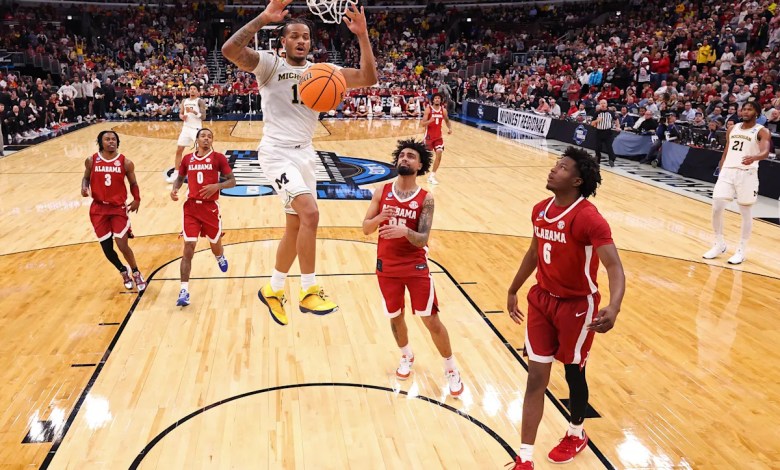
CHICAGO — Off the field, the future of college athletics is being shaped by the ongoing battle of wills between the SEC and Big Ten. From the College Football Playoff format to what the rules around NIL and tampering should be, there are significant disagreements, hurt feelings, and massive egos that won’t give an inch.
But on the playing fields that matter most, there is no doubt who will win the battle in the new era of college athletics.
Advertisement
This is the world of the Big Ten. And in this NCAA Tournament, they pay homage to the once mighty SEC.
Just like football.
“College basketball has always been cyclical,” Michigan basketball coach Dusty May said after his team beat Alabama by a second-half knockout and won 90-77 in the Midwest Region. “I hope it’s a long cycle for us in the conference. I think now the playing field has been leveled as far as finances and things like that…”
May, who spent three years in the SEC as an assistant at Florida, hasn’t quite finished her thinking.
He didn’t have to.
Advertisement
As the SEC grew into the nation’s dominant sports conference during the first two decades of the 2000s, the Big Ten had little ability to respond beyond complaining and coping. Its insistence on being the league that plays by the rules — barring the occasional scandal at Ohio State — would allow college presidents to congratulate each other. But when championships were on the line, it didn’t mean much when Big Ten fans and players were serenaded with chants of “SEC! SEC!”
Times have changed.
After three straight football titles won by Michigan, Ohio State and Indiana, the Big Ten now has basketball bragging rights as well. The Big Ten is 4-0 against the SEC in this tournament, is assured of at least one Final Four berth when Iowa plays Illinois in the South Region and could offer two more if Purdue can upset Arizona in the West final and Michigan can beat Tennessee in Sunday’s Elite Eight game.
“Man, it means a lot,” said Michigan forward Yaxel Lendeborg, who was a wrecking crew against Alabama with 23 points, 12 rebounds and seven assists. “These guys are always a powerhouse conference in basketball, football, whatever. These guys are very important. But this year I feel like the Big Ten could have been the best conference in the country and by being in a dogfight every game, the Big Ten has really prepared us for times like this.”
Advertisement
Lendeborg is probably a good avatar of why this change happened. For two seasons before this one, he was arguably the best player in Conference USA at UAB – right in the heart of SEC country, less than an hour’s drive from Tuscaloosa.
Maybe the entire SEC was asleep at the wheel and ignoring NBA-level talent right under their noses. More likely, they couldn’t pay what Michigan did to get him. Lendeborg, for what it’s worth, told the Associated Press a few weeks ago that Kentucky offered him between $7 million and $9 million to transfer. Kentucky coach Mark Pope ultimately denied the number, but it’s clear the Wildcats made a serious effort to get him out of the transfer portal.

Michigan’s Roddy Gayle Jr. throws the ball against Alabama during Michigan’s Sweet 16 victory Friday in Chicago. (Photo by Michael Reaves/Getty Images)
(Michael Reaves via Getty Images)
Now that the financial factor in recruiting is a (somewhat) legal reality (for now), it should come as no surprise that Michigan could outbid an SEC blue blood for an elite athlete. This happens all the time, in a variety of sports.
Advertisement
For decades, the SEC’s advantage was proximity to talent, climate and passion. This situation has been upended by Big Ten schools that have been around longer and, therefore, have larger and wealthier alumni bases. According to Almabase.com, seven of the 10 largest alumni associations in the country reside in Big Ten country.
No wonder the SEC and Commissioner Greg Sankey are beginning to threaten to break away and play by their own rules if Congress doesn’t do something to rein in the currently ungovernable NIL environment.
“Yeah, it means something to us,” said Michigan guard Nimari Burnett, who spent two years at Alabama before transferring in 2023-24. “Seeing the teams we faced in the Big Ten succeed [in the tournament]this shows us that our conference is probably the best in the country.
The Big Ten has been shut out of the men’s basketball national title since Michigan State in 2000, but May made an interesting point about why this might be the year that changes.
Advertisement
For a long time, the Big Ten had a reputation for playing ball with big bodies that could win a wrestling match but not a track meet. That’s no longer the case, especially after the league added UCLA, USC, Oregon and Washington in the last expansion cycle.
“I think we’re developing a different type of basketball identity with the West Coast schools joining us, and I think some of the new coaches have brought a different flavor,” May said. “I think sometimes it felt like the Big Ten was kind of copy-paste. You turned on one game and it looked pretty much like the other three that were going on at the exact same time. I know our league is incredibly tough. The coaches are off the charts, but I want to give the administrations a lot of credit. There are a bunch of well-run athletic departments in the Big Ten.”
To be fair, just a year ago the SEC earned a record 14 NCAA Tournament bids, including seven in the Sweet 16 and two in the Final Four, including national champion Florida.
This year, however, the SEC was clearly overrated. Although it received 10 offers — the most of any league — it will have just one Elite Eight team, No. 6 seed Tennessee. And aside from regular-season champion Florida’s loss to No. 9 seed Iowa in the second round, none of those results looked like a fluke.
Advertisement
Hey, maybe Kentucky’s offer for Lendeborg of $7-9 million was overblown. But after watching him destroy Alabama in Michigan blue rather than Kentucky blue, perhaps Pope should have offered even more. While much of college athletics has spent this week laughing and shaking their heads at LSU for luring Will Wade to Baton Rouge with huge NIL promises on the heels of Lane Kiffin’s alleged $40 million listing for the football team, at least the Tigers have a clear eye on how the game is being played.
As May said Friday night when asked what advantages the Big Ten had now that the rules had changed: “You’d have to catch me off the record to answer that question.”


