Microgravity on International Space Station Alters Coevolution of Bacteriophages and Their Hosts


In new experiments aboard the International Space Station (ISS), microbiologists from the University of Wisconsin-Madison and Rhodium Scientific Inc. have discovered that the near-weightless environment of space can dramatically reshape the way bacteriophages – viruses that infect bacteria – interact with their hosts.
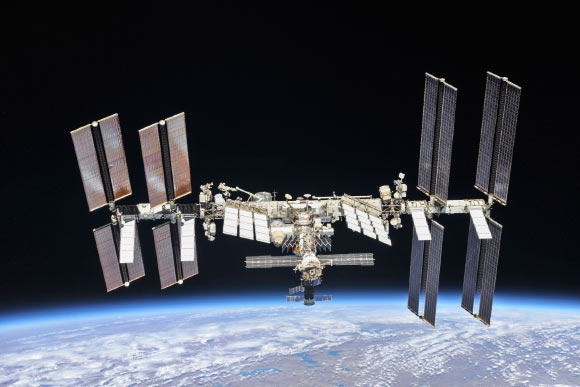
The International Space Station is seen with Earth in the background. Image credit: NASA.
In a systematic study of bacteriophage-host dynamics in microgravity, researcher Phil Huss of the University of Wisconsin-Madison and colleagues examined the interaction between phage T7 and Escherichia coli bacteria during incubation on the orbiting laboratory.
Their experiments found that microgravity delayed the virus’s ability to infect and kill the bacteria, but did not permanently prevent infection.
Under terrestrial conditions, T7 phages infect and lyse normally Escherichia coli within 20 to 30 minutes.
But in microgravity, the researchers observed no measurable growth of bacteriophages during the first hours of incubation.
After 23 days, however, the bacteriophages had successfully spread and reduced bacterial populations, indicating that bacteriophage activity finally overcame the initial delay caused by the microgravity environment.
The physical characteristics of microgravity, including reduced fluid convection and altered bacterial physiology, are thought to alter how bacteriophage particles encounter and infect their bacterial hosts.
In the absence of gravity, the normal mixing of fluids that brings virus particles into contact with bacteria is disrupted, which could slow the early stages of infection.
To better understand the evolutionary and molecular consequences of these altered interactions, scientists sequenced the genomes of bacteriophages and bacteria after long-term incubation.
They discovered many newly emerging mutations in the viral and bacterial genomes, indicating that both organisms have adapted to the conditions encountered.
Distinct patterns of mutations were observed in microgravity compared to those evolved under Earth’s gravity, suggesting that the space environment imposed unique selective pressures on both the bacteriophage and the host.
Other analyzes focused on the bacteriophage receptor-binding protein, a key component that determines how effectively a virus recognizes and infects its bacterial target.
Using extensive mutational analysis, the authors identified substantial differences in the mutational landscape of this protein between microgravity and terrestrial experiments, reflecting underlying changes in host adaptation and selection.
In a notable discovery, they used libraries of receptor-binding protein variants shaped by microgravity selection to produce bacteriophage variants that were more effective at infecting certain strains of drug-resistant bacteria. Escherichia coli on Earth – a result that highlights the potential of space research to inform terrestrial biotechnology.
“Our study offers preliminary insight into how microgravity influences phage-host interactions,” the researchers concluded.
“Exploring phage activity in non-terrestrial environments reveals new genetic determinants of fitness and opens new avenues for engineering phages for terrestrial use.”
“The success of this approach helps lay the foundation for future phage research aboard the ISS.”
The study appears online in the journal PLoS Biology.
_____
P. Huss and others. 2026. Microgravity reshapes bacteriophage-host coevolution aboard the International Space Station. PLoS Biol 24 (1): e3003568; doi: 10.1371/journal.pbio.3003568