Dozens injured in mosque blast in Indonesia high school : NPR

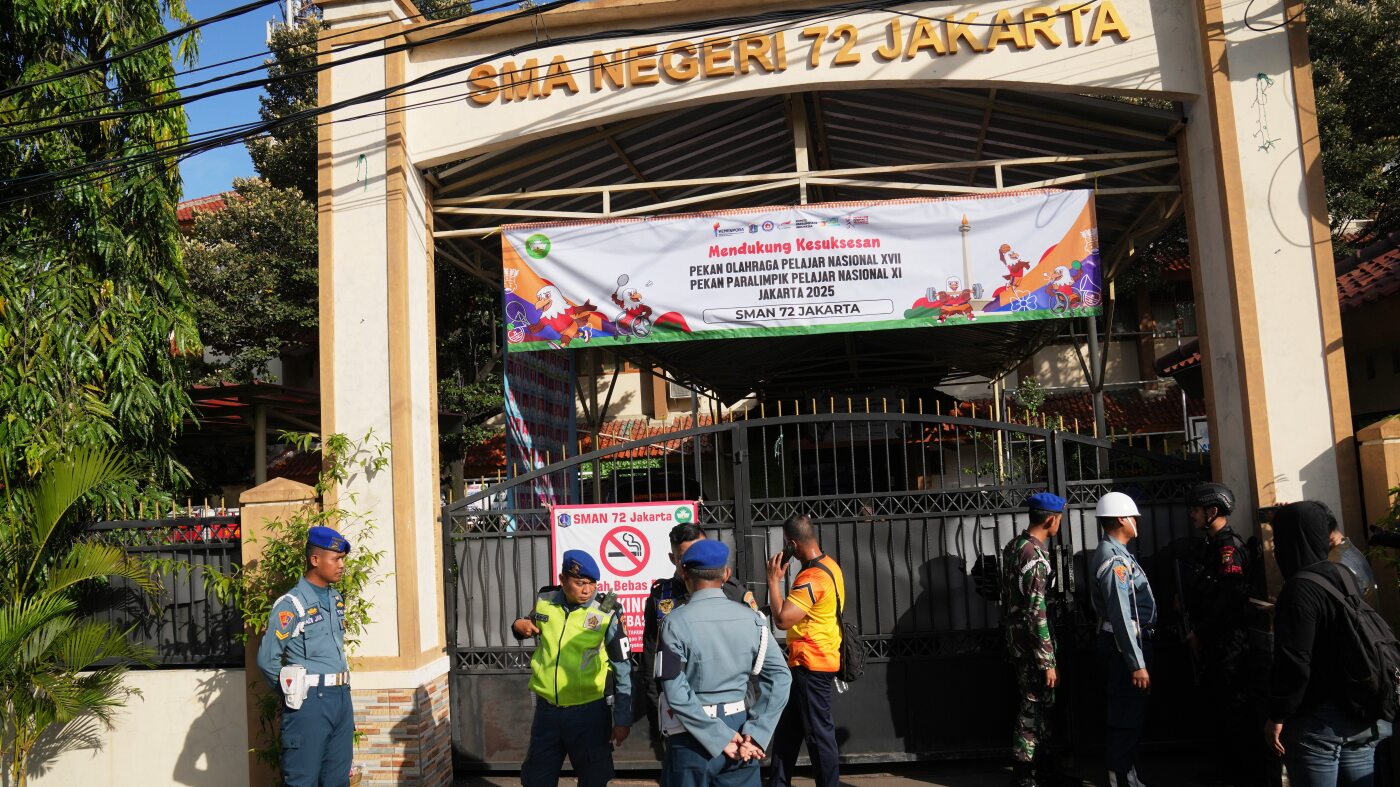

Police and soldiers stand guard at the entrance to a school where explosions reportedly took place in Jakarta, Indonesia, on Friday.
Dita Alangkara/AP
hide caption
toggle caption
Dita Alangkara/AP
JAKARTA, Indonesia — Indonesian authorities say they have identified a 17-year-old boy as the suspected perpetrator of an attack that shook a high school mosque during Friday prayers in the Indonesian capital Jakarta, injuring at least 55 people, most of them students.
Police have so far dismissed rumors that it was a terrorist attack, saying they are continuing their investigation.
Witnesses told local TV stations that they heard at least two loud explosions around midday, coming from inside and outside the mosque, just as the sermon began at the mosque of SMA 72, a public high school located in the Navy compound in the Kelapa Gading district of North Jakarta.
Students and others ran out in panic as gray smoke filled the mosque.
“The information I have is that the suspect is undergoing surgery,” House Deputy Speaker Sufmi Dasco Ahmad told reporters after visiting the student victims at a hospital. “The suspect is a 17-year-old student,” he said, without giving further details.
National Police Chief Listyo Sigit confirmed during a press conference at the Presidential Palace in Jakarta that the suspect was one of two students who were undergoing surgery due to serious injuries caused by the explosions.
“We have identified the alleged perpetrator,” Sigit said after attending an event with President Prabowo Subianto at the palace. “Our staff is currently conducting a thorough investigation to determine the identity of the suspect and the environment he lives in, including his home and other people.”
Sigit said police investigators are still collecting all the information needed to determine the motive, including how the suspect was able to assemble a toy machine gun that had words like “14 words. For Agartha” and “Brenton Tarrant: Welcome to Hell” written on it.

People watch as soldiers stand guard near a school where explosions reportedly took place, in Jakarta, Indonesia, on Friday.
Dita Alangkara/AP
hide caption
toggle caption
Dita Alangkara/AP
“14 words” generally refers to a white supremacist slogan, while Brenton Tarrant is the perpetrator of a 2019 mass shooting at a mosque and Islamic center in Christchurch, New Zealand, that killed 51 people and injured dozens more.
“We found that the weapon was a toy gun with specific markings, which we are also investigating to understand the motive, including how he assembled it and carried out the attack,” Sigit said, adding that the teenage suspect was a student at the school.

Most of the victims were injured by shards of glass and burned. The cause of the explosions was not immediately known, but they came from near the mosque’s loudspeaker, according to Jakarta police chief Asep Edi Suheri.
He added that the injured were rushed to nearby hospitals and that 20 students were still hospitalized with burns, including three seriously injured.
“Police continue to investigate the scene to determine the cause,” he said, dismissing speculation that the incident was an attack before the police investigation was completed.
Videos circulating on social media showed dozens of uniformed students running in panic across the school’s basketball court, some covering their ears with their hands, apparently to protect themselves from the loud explosions.

Some of the injured were carried on stretchers to waiting cars.
Shocked relatives of the students gathered at the centers set up at Yarsi and Cempaka Putih hospitals to seek information about their loved ones. Parents told TV stations their children were injured after being hit on the head, feet and hands by sharp nails and pieces of explosive objects.
Indonesia, the world’s most populous Muslim-majority country, was hit by a major militant attack in 2002 when al-Qaida staged bombings on the resort island of Bali that killed 202 people, mostly foreign tourists.
In subsequent years, smaller, less deadly strikes were carried out against the government, police and counterterrorism forces, as well as against those considered infidels by militant groups.
Friday’s attack was not the first attack on a mosque. In 2011, a Muslim activist blew himself up at a mosque in a Cirebon police compound packed with officers during Friday prayers, injuring 30 people.
In December 2022, a Muslim activist convicted of making bombs and released from prison the previous year blew himself up at a police station in West Java, killing a police officer and injuring 11 people.
Since 2023, the Southeast Asian country has experienced what authorities call a “zero attack phenomenon,” crediting the government for the stability of its security situation.