Astronomers witness a newborn planet emerging from the dust around a sun-like star: Space photo of the week


Rapid facts
What is: A potential planet around the HD 135344B star
Where is it: 440 light years, in the constellation lupus
When it was shared: July 21, 2025
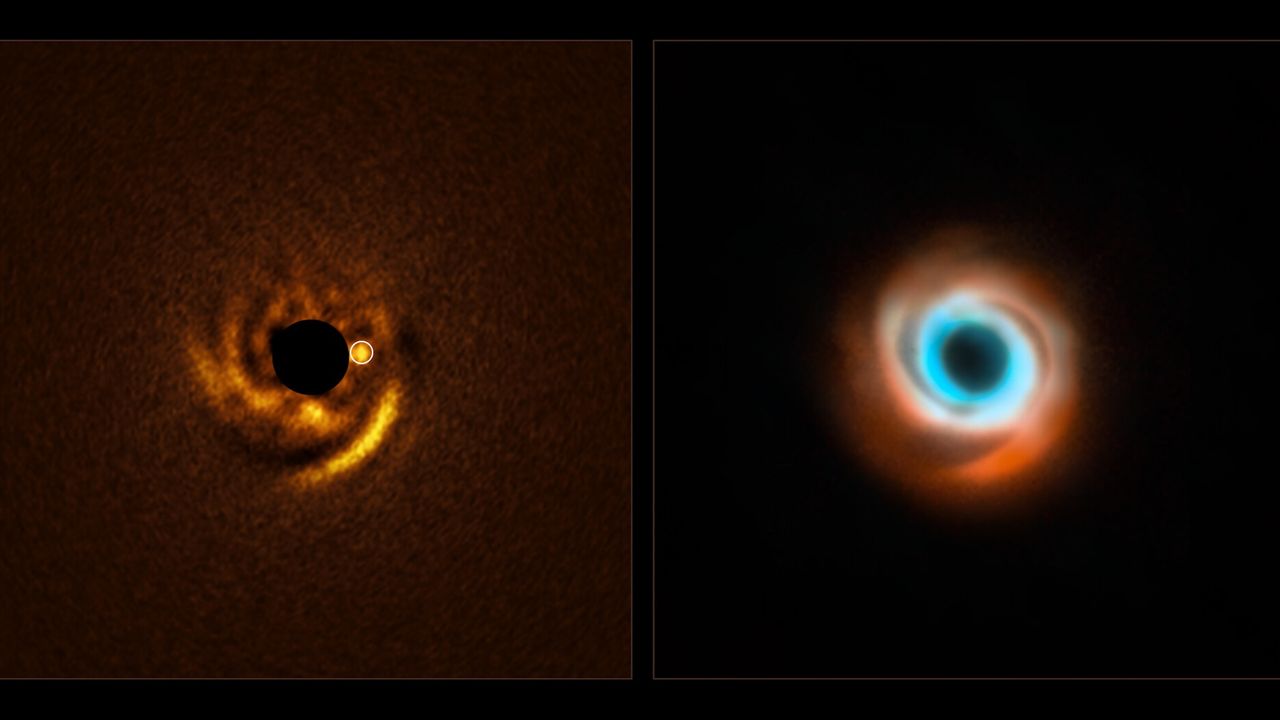
At the bottom of a swirling disc of gas and dust around the HD 135344B star, a young planet seems to sculpt complex spiral arms around its stellar host. It is the first time that a planet has been found integrated inside a spiral of dust around a star, actively shaping its environment.
The discovery is also proof that the constituent elements of the planets emerge from the protoplanetary disks – giant discs and in shape Nasa.
It was found that these dense and rotary clouds around young stars have rings and spirals suspected of being caused by the presence of Baby Planets, but it is the first direct proof. In fact, the protoplanetary disc sculpted around the host star, HD 135344B, had been seen before by astronomers using the instrument of research of contrast contrast contrast exoplanets) on the very large telescope of the Southern European Observatory in Chile.
However, using a new instrument called the improved resolution imaging and spectrograph (ERIS), scientists finally discovered a planetary candidate. The planet is nestled at the base of a spiral arm – exactly where the models predicted that a planet would be necessary to generate such a characteristic – and it is believed that the size of Jupiter was twice as important. It is about as far from its host star as Neptune du Soleil, or about 30 times the distance from the earth to the sun.
“What makes this detection potentially a turning point is that, unlike many previous observations, we are able to directly detect the protoplanet signal, which is always highly incorporated into the disc,” said Francesco Maio, doctoral researcher at the University of Florence and study describing the discovery, says in a statement.
In relation: 32 extraterrestrial planets that really exist
The existence of many exoplanets – planets that orbit a star other than the sun – is deducted from other information, such as the drop in the brightness of a star which is supposed to be caused by a planet. The observation of the own light of the planet – the reflected light of its host star – gives the discoverers of the Proto -Planète a much higher level of confidence in its existence.
“We will never witness the formation of the earth, but here, around a young star at 440 light years, we can watch a planet exist in real time,” said Maio.
Eris had an equally decisive role in another Recent discovery. Using Eris, astronomers have found an object-perhaps a brown dwarf, an object halfway between a giant planet and a small star-in the protoplanetary disc around the young star V960 Mon, located at 5,000 light years, in the constellation monoceros.
For more images of sublime space, consult our Archives week space photo.