Moldovans cast ballots in a tense election plagued by Russian interference claims

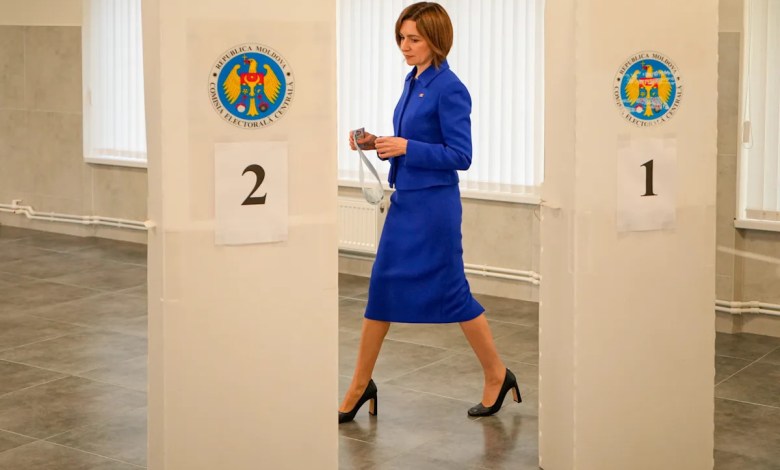
Chisinau, Moldova (AP) – The Moldavoans head for the ballot boxes to make voting bulletins during a tense parliamentary election in the grip of affirmations of Russian interference, a vote considered as a choice between integration with the European Union or a drift in the fold of Moscow.
The Sunday’s Pivot vote will elect a new Parliament of 101 seats, after which the president of Moldova appoints a Prime Minister, generally of the main party or block, which can then try to form a new government. A proposed government then needs parliamentary approval.
The surveys opened at 7 a.m. (0400 GMT) and will end at 9 p.m. (1800 GMT). The Central Electoral Commission reported more than 400,000 people, or about 14% of eligible voters, had voted at 11 a.m.
The pro-Western and Pro-Russian parties strike it
The outstretched race corresponds to the pro-Western action party and the solidarity, or AP, which has held a large parliamentary majority since 2021, but risks losing it, against several convivial opponents in Russia, but none of the viable pro-European partners, leaving an uncertainty about the potential results and the geopolitical course that the country will follow.
After launching his ballot, Pro-Western President of Moldova, Maia Sandu, reiterated the long-standing claims that Russia “interfered massively” during the elections, claiming that it had voted to “maintain peace” and that the future of his country lies in the EU.
“Russia is a danger to our democracies. Our democracy is young and fragile, but that does not mean that states with longer democracies are not in danger. We want to live in a democracy,” she said. “Today, in our country, democracy is in the hands of Moldovans – only they can save the Republic of Moldova.”
Moldova is landlocked between Ukraine and Romania in the European Union. The country of around 2.5 million people have spent the last years on a path in the west and has acquired a status as a candidate in the EU in 2022, shortly after the launch of a large -scale invasion of Ukraine.
Fears of Russian interference
A few days before the vote on Sunday, Prime Minister Moldovan Dorin Remean warned that Russia spent “hundreds of millions” euros in the context of an alleged “hybrid war” to try to seize power, which he described as “the final battle for the future of our country”.
“I call all the Moldavians at home and through Europe: we cannot change what Russia does, but we can change what we do as a people,” he said. “Turn the concern in mobilization and in thoughtful action … help stop their patterns.”
The alleged Russian strategies include a large-scale voting purchase operation, cyber attacks on critical government infrastructure, a plan to encourage mass riots around elections and an online sprawling disinformation campaign to reduce support for the pro-European riding party and ignition-to-moscow-to-electors.
Russia has repeatedly denied interference in Moldova and rejected allegations last week as “anti-Russian” and “without foundation”.
The authorities warned that the day of the Moldova ballot could be targeted by false threats to the bomb, cyber attacks, temporary power outages and street violence by trained individuals. In a repression before the vote, police officers made hundreds of raids, in which scores were detained.
“The state is doing everything to ensure that people are safe and that the vote is protected,” Sandu said after voting on Sunday.
The importance of voters of the diaspora
The Great Diaspora of Moldova should play a decisive role in Sunday results. In the presidential runoff of last year – which was also considered a choice between the East and the West – a record number of 327,000 voters voted abroad, more than 82% of which favored Sandu and finally obtained its re -election.
A key opponent of the PAS in Sunday elections is the pro-Russian Patriotic Electoral Bloc, a group of political parties who want “friendship with Russia” and “permanent neutrality”. Others include the populist our party, which wants a “balanced foreign policy” between the east and the west, and the Alternativa block, which claims to be pro-European, but the criticisms say that the links with Moscow are narrower.
Igor Dodon, former president and member of the Patriotic Electoral Bloc, said that the election of Sunday “was the day when people are not afraid, but others are afraid of the people”.
“We go out and vot. We choose a country where the fear of people will disappear,” he said. “We choose a normal life for citizens – we believe in Moldova.”
In recent years, when the country has gone from the crisis to the crisis, the Moldovans have faced rampant inflation, the instability of the war next to it, the increase in life costs and high poverty rates, which could have reduced the support of the pro-European ruling party, which Sandu founded in 2016.
Most local polls indicate that the APs will earn the most votes, but they do not include the large diaspora of Moldova, and about a third of the voters remain undecided. During the legislative elections in 2021, the participation rate was just over 48%.
Iulian Groza, executive director of the Institute for European policies and reforms the reflection group, says that the higher the participation rate, the more likely it is that the step can obtain a majority.
“Everything in the government has tended to erode in public support, and in the past four years, Moldova has experienced several crises,” he said. “After four years … Despite various crises we have had, I think we can very clearly say that Moldova resisted this Russian attack.”


