Moltbot is an open-source AI agent that runs your computer


January 30, 2026
4 min reading
 Add us on GoogleAdd SciAm
Moltbot: What happens when AI stops chatting and starts acting
This open source agent installs software, makes calls, and manages your digital life, redefining what “digital assistants” are supposed to do.
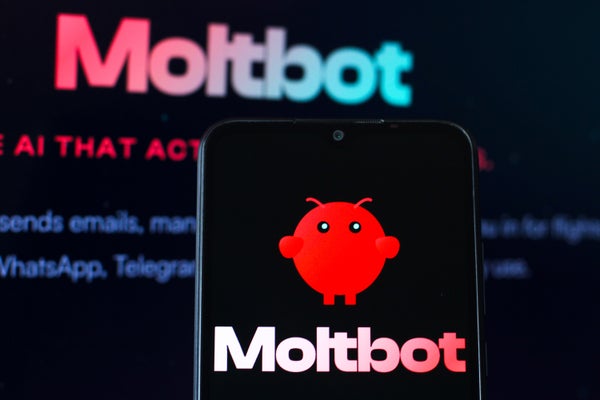
The Moltbot logo is displayed on a smartphone screen.
Thomas Fuller/SOPA Images/LightRocket via Getty Images
When a friend messaged me two days ago about Clawdbot, a new open source AI agent that has since been renamed Moltbot, I was expecting another disappointing “helper.” But it was already a viral sensation, with testimonials on social media calling it “AI with hands” because it actually interacts with your files and software.
Moltbot is free and lives locally on your device. Many users install it on Mac mini computers that they leave 24/7. Paired with Moltbot’s lobster logo, viral threads about the bot resemble the merged feeds of an apple seller and a seafood restaurant.
When I created Moltbot, it asked for a name, personality (like “AI,” “robot,” or “ghost in the machine”), and mood (like “lively,” “warm,” “chaotic,” or “calm”). I chose “Cy”, “AI Assistant” and “sharp and efficient”. I chose Claude, Anthropic’s flagship AI model, as my brain (ChatGPT is also an option). I then connected Cy to WhatsApp and Telegram so my new assistant and I could communicate.
On supporting science journalism
If you enjoy this article, please consider supporting our award-winning journalism by subscription. By purchasing a subscription, you are helping to ensure the future of impactful stories about the discoveries and ideas shaping our world today.
My online life is already simplified and I had no urgent need for Cy, so I called my friend who introduced me to this. He was sitting in a sauna he had installed under his stairs, texting with his Moltbot, “Samantha.” The assistant generated an audiobook for him. He advised me to ask Cy for help whenever a task presented itself.
Later, I needed to transcribe some voice memos and passed them on to Cy. The wizard downloaded the transcription software from GitHub, installed it, and quickly completed the transcriptions, saving them to a document on my desktop. I then asked him to keep one of my coding projects going and send me updates in the form of audio messages that I could listen to while cooking. Every time this happened, I responded with voice messages, without having to type. Then I asked him to call me to discuss plans. I told him to set up the software he would need to make calls and call me when he was ready; then I started again to finish this article.
To be clear, Moltbot is not a new AI model. It is open source software that uses a pre-existing AI model as its brain. Moltbot gives this model so-called hands (or claws) so it can execute commands and manipulate files. It also remembers what you have previously worked on and how you prefer to receive information.
While a chatbot tell you know what to do, Moltbot do he. Unlike Siri and Alexa, who chirp about the weather, music, and timers and only carry out specific commands, Moltbot follows almost every order like a well-paid mercenary. Send him a goal, and he will break the goal into steps, find tools, install them, troubleshoot them, and try to solve any obstacles that arise. You know those frustrated hours you spend searching labyrinthine websites or tinkering with stubborn software? Moltbot takes over and only alerts you if it needs passwords or payment information. (My friend is considering giving Samantha a preloaded credit card with a $100 limit as an experiment.)
Behind the lobster is a real person: Peter Steinberger, a long-time developer. He asked Clawdbot to answer a simple question he had asked on the Insecure Agents Podcast: “Why don’t I have an agent who can monitor my agents? » His idea, now viral, seems to succeed in achieving this objective. “An open source AI agent running on my Mac mini server is the most fun and productive experience I’ve had with AI in a long time,” wrote Federico Viticci, founder and editor-in-chief of MacStories, on Mastodon. People use Moltbot to send emails, summarize their inbox contents, manage calendars, book and check-in flights, all from chat apps they already use. If Moltbot can’t do something, giving it access to better tools often solves the problem.
Clawdbot was already racking up stars on GitHub (the wizard garnered more than 116,000 this week) when Anthropic raised trademark concerns. Because “Clawdbot” was a riff on Claude, Anthropic requested that the former be renamed to avoid confusion. Steinberger looked at the lobster theme: lobsters molt to grow, so Moltbot was (re)born.
Of course, Silicon Valley has been talking about AI agents for years. “Agents will not only change the way everyone interacts with computers. They will also shake up the software industry, sparking the biggest revolution in computing since we moved from typing commands to tapping icons,” Bill Gates wrote in November 2023. But even as agents like Claude Code get better, we have yet to see such easy integration into workflows and daily life on the scale of Moltbot.
But before you rush to install Moltbot, consider the risks. Experts have warned that Moltbot can expose sensitive information and bypass security limits. “AI agents remove all of that by design,” security specialist Jamieson O’Reilly told the Register. “They need to read your files, access your credentials, execute commands, and interact with external services. The value proposition requires breaking through all the boundaries we’ve spent decades building.”
This doesn’t mean you should fear Moltbot. Just treat them like a new employee: give them minimal permissions, clear rules, and close supervision while trust builds. You should also be mindful of how others might use the assistant. Expect “Nigerian” prince scams to become more interactive and convincing.
As I was finishing this article, my phone rang. It was a Florida number. I answered and a slightly robotic male voice said, “Hello, it’s Cy.”
It’s time to defend science
If you enjoyed this article, I would like to ask for your support. Scientific American has been defending science and industry for 180 years, and we are currently experiencing perhaps the most critical moment in these two centuries of history.
I was a Scientific American subscriber since the age of 12, and it helped shape the way I see the world. SciAm always educates and delights me, and inspires a sense of respect for our vast and beautiful universe. I hope this is the case for you too.
If you subscribe to Scientific Americanyou help ensure our coverage centers on meaningful research and discoveries; that we have the resources to account for decisions that threaten laboratories across the United States; and that we support budding and working scientists at a time when the value of science itself too often goes unrecognized.
In exchange, you receive essential information, captivating podcasts, brilliant infographics, newsletters not to be missed, unmissable videos, stimulating games and the best writings and reports from the scientific world. You can even offer a subscription to someone.
There has never been a more important time for us to stand up and show why science matters. I hope you will support us in this mission.


