Mosquitoes Show a Clear Preference for Human Blood after Deforestation


January 15, 2026
2 min reading
 Add us on GoogleAdd SciAm
Mosquitoes show clear preference for human blood after deforestation
Mosquitoes caught in remnants of Brazil’s Atlantic Forest mainly fed on humans rather than other animals, new study finds
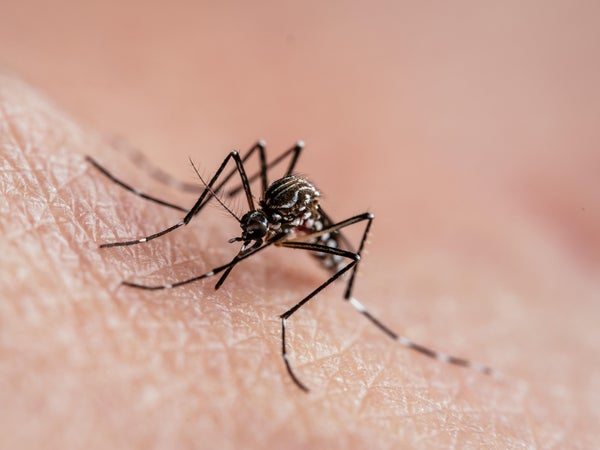
Mosquitoes are nature’s opportunists. They eat everything from plant nectar to the blood of chickens, rats, alligators, frogs, and, of course, humans. And now, a new study reveals that when humans encroach on wild spaces, these insects may develop a particular taste for human blood, more than any other food source.
Brazilian researchers analyzed blood samples from mosquitoes collected in nature reserves in the Atlantic Forest, a heavily deforested region of Brazil. Several of the species collected showed “a clear preference for feeding on humans,” Jeronimo Alencar, a biologist at the Oswaldo Cruz Institute in Brazil and author of the paper, said in a statement.
The findings are consistent with previous evidence that deforestation puts humans in increased contact with creatures that spread deadly diseases. Mosquitoes can transmit Zika, dengue fever, malaria and encephalitis, to name just a few diseases, all of which are harmful to human health and can kill.
On supporting science journalism
If you enjoy this article, please consider supporting our award-winning journalism by subscription. By purchasing a subscription, you are helping to ensure the future of impactful stories about the discoveries and ideas shaping our world today.
The results were published Thursday in Frontiers of ecology and evolution.
According to researchers, the Atlantic Forest is home to around 270 species of mammals, 850 species of birds and around 570 reptiles and amphibians. The forest once spanned 1.3 million square kilometers across Brazil, an area larger than Texas and California combined. But it has been reduced to less than a third of that size thanks to agricultural and residential development.
The study has several limitations. On the one hand, he only analyzed the blood of 145 female mosquitoes, and not all of these samples could be identified. It is therefore difficult to know to what extent the results can be applied. It is also unclear how mosquito preferences have changed since the Atlantic Forest was completely intact.
Still, the study could help researchers better understand the complex relationship between deforestation and disease. Man destroys around 10 million hectares of forest per year. “Deforestation reduces local biodiversity, causing mosquitoes, including pathogen vectors, to disperse and seek alternative food sources,” the authors write. And it turns out those sources could be us.
It’s time to defend science
If you enjoyed this article, I would like to ask for your support. Scientific American has been defending science and industry for 180 years, and we are currently experiencing perhaps the most critical moment in these two centuries of history.
I was a Scientific American subscriber since the age of 12, and it helped shape the way I see the world. SciAm always educates and delights me, and inspires a sense of respect for our vast and beautiful universe. I hope this is the case for you too.
If you subscribe to Scientific Americanyou help ensure our coverage centers on meaningful research and discoveries; that we have the resources to account for decisions that threaten laboratories across the United States; and that we support budding and working scientists at a time when the value of science itself too often goes unrecognized.
In exchange, you receive essential information, captivating podcasts, brilliant infographics, newsletters not to be missed, unmissable videos, stimulating games and the best writings and reports from the scientific world. You can even offer a subscription to someone.
There has never been a more important time for us to stand up and show why science matters. I hope you will support us in this mission.