I’m tired of failing smart home systems, so I’m building my own


Maybe it was the view of Sengled users left literally in the dark by their unnecessary Wi-Fi bulbs, maybe it was another price hike, or just a general feeling that my smart devices were not really under my control. Whatever the reason, I had developed an increasing desire to create an intelligent house configuration which was not a hostage for the cloud.
More specifically, I am talking about an intelligent house configuration accommodated locally, and I am currently creating one. And even if I am an intelligent home expert thanks to my six years of experience here in Techhive, I quickly realize how much I don’t do it Know that I attack the steep learning curve of a DIY smart house.
It is not a step -by -step guide on how to build your own intelligent house system – which could come later – but more from a newspaper on where I am in my travel of a self -heberged intelligent house, where I started and what I hope. If you have similar thoughts and my story gives you an inspiration, so much the better.
I was a complete novice of the smart house when I started here at Techhive; I have been writing to computers and technology for 20 years, but I had never installed a smart bulb before, even less a smart center. Over time, my apartment has become filled with smart devices, Alexa speakers and Google displays with Philips Hue bulbs and even a video doorbell. My stupid house quickly became smart.
What me doesn’t As it was the way the intelligent systems that had accustomed me changed when a manufacturer or another would randomly rethink an application, throwing my workflow at smart home in chaos. I also did not like the occasional server breakdowns which left me unable to control my devices, nor the features that were placed without ceremonies behind the Walls. Oh, and don’t forget the price increases.
Tribute in the Self-Hébeled Small House
I fell into the world of the smart house self-heberged by accident. I expressed with a unused Raspberry Pi a few years ago (it was before I ended up with four of the diminutive computer cards operating on my network) and I noticed an option to install something called home assistant. It seemed a little cool, so I tried it, and I was amazed to run a home assistant body in a few minutes.
Easy, right? Not quite. Of course, obtaining the assistant at home – an open source smart house platform which offers dozens of integrations and has hundreds of passionate contributors – UP and the race is not a big problem. Get it configuredHowever, Takes fat, experimentation and patience, this last quality being among those that I could use more.
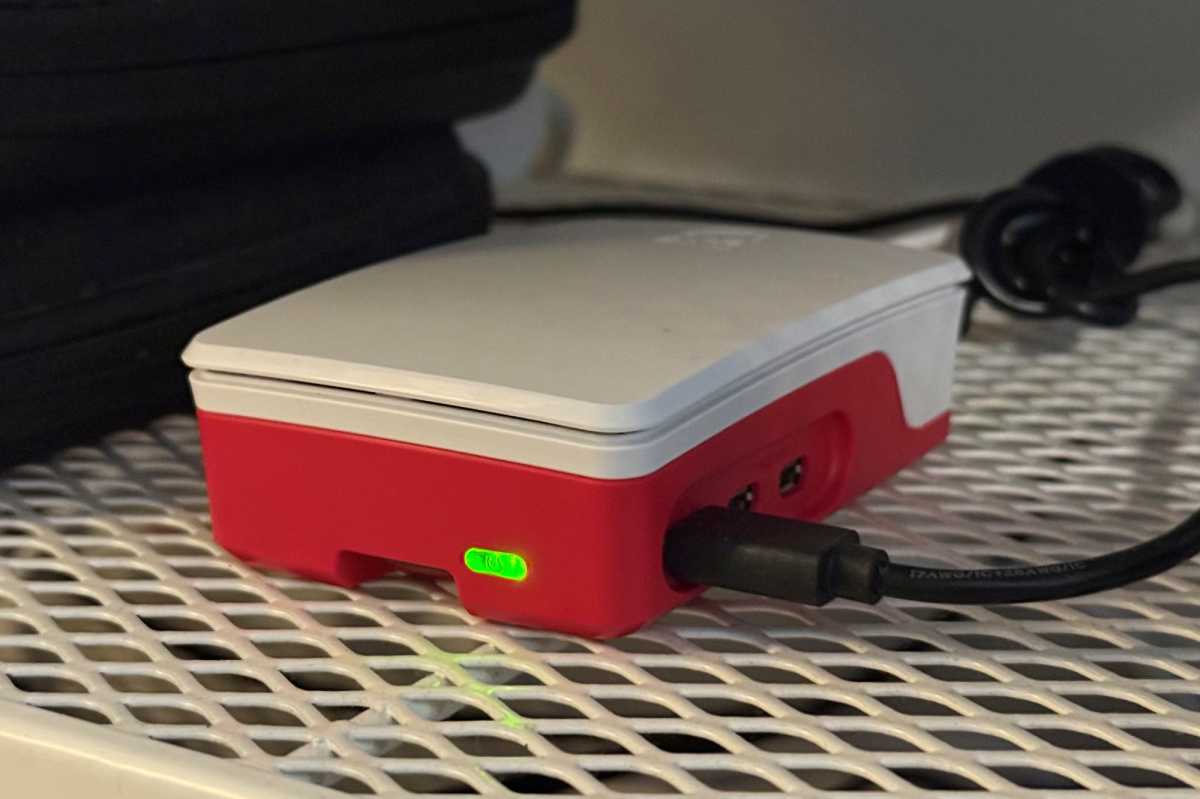
Instead of depending on the cloud, my current house configuration in progress works on this small Raspberry Pi card.
Ben Patterson / Foundry
You see, the home assistant is good enough for pinging your local network and see which devices, intelligent or other, can be set up on the platform. But once you have added all these products to a default home assistant dashboard, it’s up to you to organize them and work together. The home assistant gives you tons of freedom to organize your devices in almost all the ways that suit you, but the massive range of options – without mentioning dozens of menus and drop -down settings with arcanic labels – can be intimidating.
Facing the learning curve
This is why every few months approximately, I would give another assistant at home, tinkering on a personalized dashboard, but ultimately arrive at nowhere. An intelligent owner ecosystem like Philips Hue, on the other hand, is incredibly intuitive and child’s play to set up. The disadvantage of the shade, the ring and other closed platforms is that you are subject to their constant evolution whims, while your home assistant configuration belongs to you – you can install it.
In recent weeks, however, things have started to speed up. I recently migrated my home assistant body to a more powerful Raspberry Pi 5 (my old Pi 3 simply did not have the power or the ram to keep the assistant at the stable house), and later I acquired Z wave equipment which essentially transformed my pi into a Hub with Z waves.
Then, I shot a material server on the PI and I started to control my thread devices directly on the home assistant, next to my Z-Wave products. For the moment, my configuration of thread depends on an Apple Homepod Mini and its wire border router, which requires a connection to my Apple account; Finally, I plan to add a module of thread dedicated to my home assistant platform to cut this link with the cloud.
Just a little help from my friends (ia)
Finally, it was time to treat this annoying dashboard again, but this time I brought reinforcements – you guessed it, we are talking about chatpt. I nourished the chatbot a long list of all the devices recorded on my home assistant body, and the AI conscientiously spit a brut Yaml configuration file. (Yaml is a programming language, and the acronym means Yaml Ain’t Bualip Language).
I connected the code, and that’s it – a multiple dashboard appeared with most of my carefully displayed devices and automated. Chatgpt work was not perfect; There is a tab filled with errors of poor configuration, and some of the tabs are not arranged exactly as I wish. But it is a starting point – and more importantly, I can study the work of Chatgpt and learn to do it for myself.
Make the next step
So what is the next step? A zigbee module, for beginners – and then, if I am really ambitious, I could deactivate my Hue Phillips lights of the Hue Bridge (which, of course, depends on a cloud connection) and redrigate them directly to the local zigbee hub. This would mean losing all additional features in the Hue application – more more clever animations, for example, and so long synchronized musical – but that would also mean that it does not worry about whether the shade servers are at the top or below. (To be fair, Philips Hue servers rarely suffer from hiccups at all, or at least not according to my experience.)
A more steep hill to climb is to use a vocal assistant powered by local AI to control my devices. Home Assistant offers integrations for all major AI suppliers, including Openai and Google Gemini, as well as Olllama, an application that allows local equipment to run large -language AI models.
But the configuration of local LLMs to manage dozens of intelligent home devices has been a surprisingly delicate task. My locally hosted AI models have systematically smothest the most 100 entities exposed to my home assistant body, so my next task will be to reduce and subdivide this total into parts of the size of a bite, as well as create a system prompt that will help IA reliable the meaning and intention of my typical commands. (Vocal speech control over the home assistant requires local treatment, which is enormously for my local equipment, an optional cloud subscription of $ 6.50 / month.)
So yes, an intelligent house system hosted locally like the home assistant is not for everyone. For an easier experience, think of Hubitat, an intelligent house system hosted locally but closed that has a large group of fans. (I have never tried it, but our criticism judged it “impracticable” in its evaluation in 2021. We are late for another glance, as well as some other new centers.)
But if you have already shaken your fist with a manufacturer of smart houses to rethink its application, increase the subscription fees or brick permanently one of your devices, a self-hosted intelligent house system is the best revenge.
This story is part of the in -depth coverage of Techhive of the best intelligent house systems.


