New Mexico Senate committee weighs economic toll of new law as counties fear ICE detention closures

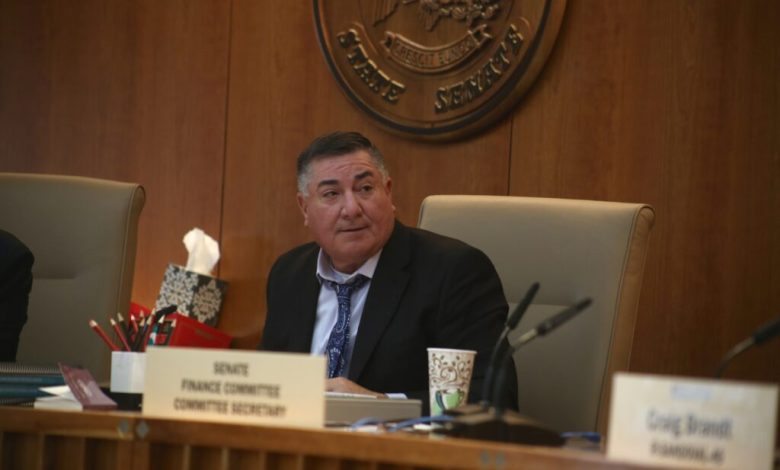
Senate Finance Committee Chairman Sen. George Muñoz (D-Gallup) is overseeing efforts to address the economic impacts of House Bill 9, known as the Immigrant Security Act. The recently signed law prevents New Mexico government agencies from entering into detention contracts with ICE. (Danielle Prokop/Source NM)
Like the Immigrant Security Act passed both rooms from the New Mexico Legislature and went to the governor’s desk, efforts failed to amend the bill and require the state to reimburse counties where ICE detention centers would close.
Today, the Senate Finance Committee is taking action. But time is running out and some key details remain elusive.
The 30-day legislative session is scheduled to end at noon on Feb. 19. At a Senate Finance Committee hearing Monday, Chairman Sen. George Muñoz (D-Gallup) seemed exasperated at times as he discussed the situation with officials from New Mexico’s three affected counties. Why, he asked, did they not tell the committee how many detention center employees would be out of work if it closed?
Amid the uncertainty, one thing remains clear: Detention centers vary in size across Cibola, Torrance and Otero counties and will therefore each receive a specific economic development plan before the legislative session adjourns late next week. Any plan, Muñoz said, would have to consider the short-term impact of loss of facilities and the long-term impact of loss of jobs.
That work would prove difficult, he said, without accurate employment figures in each county. “We’re not just going to spend money to solve a problem,” he said.
Governor Michelle Lujan Grisham sign The Immigrant Security Act passed Thursday and expressed sympathy for the potential job losses it could create in rural New Mexico counties.
Lawmakers from both sides expressed similar concerns Monday. Democrats, however, argued that these communities seemed too dependent on a single employer.
“I think it’s unfortunate that we’ve built a community on incarceration. I think it’s unfortunate that there hasn’t been more economic development for all intents and purposes that has happened within this committee,” said Sen. Linda Trujillo (D-Santa Fe). “How can we fill the void so that there is some breathing room to figure out what kinds of other activities — not just trading jail for jail.”
Some Republicans, however, pushed back. Sen. Steve Lanier (R-Aztec), who represents the Four Corners region of the state, recalled how the 2019 ballot Energy transition law led to the closure of the San Juan coal-fired power plant and eliminated around 450 jobs.
“When they shut down our power plant, it killed our community…that’s my grief with all of this,” Lanier said. “We chose to live in these [rural] areas. It’s up to us to do it. We have not chosen to close these factories.
Unlike the closure of the San Juan Power Plant, it remains unclear what effects HB9 will have on these local economies.
Otero County has issued bonds for its ICE detention center, and County Executive Pamela Heltner told the Senate committee Monday that those bonds won’t be repaid until 2028. If the county defaults, she said, the facility will face foreclosure and a subsequent auction. She said a closure would eliminate 284 jobs with combined salaries of nearly $21 million.
Details in Torrance and Cibola counties, where private prison operator CoreCivic owns detention centers, were less clear. Although HB9 prohibits New Mexico governments from entering into ICE detention contracts, it does not prohibit a company like CoreCivic from renewing an ICE contract.
However, if the centers were to close, Torrance and Cibola county officials said it would still result in a loss of revenue and jobs. Torrance County Deputy Executive Michelle Jones told the committee it would cost her community about $3 million a year. The Torrance County Commission I met for a few minutes the day before Lujan Grisham signed HB9 and voted to extend a deal making it easier to detain immigrants.
Cibola County Executive Kate Fletcher said she spoke with CoreCivic as recently as Monday morning and didn’t get much clarity on the company’s plans for a post-HB9 New Mexico.
A CoreCivic spokesperson said in an email to Source NM that the company is “in close contact with our government partners to determine how to best meet their needs moving forward.”
“Our priority is to continue to care for every person in our facilities with respect and humanity,” wrote company spokesperson Ryan Gustin.


