I’m sticking with Windows 10 even after it dies next month. Here’s how


On October 14, 2025, Microsoft will officially end Windows 10 support, announcing the early promise of the company that Windows 10 was going to be “the latest version of Windows”. Instead, six years after its launch in 2015, Microsoft published Windows 11.
It has been four years now that the version of Windows 11 and Microsoft are tired of waiting for users to pass. In September 2025, Windows 11 and Windows 10 are still elbow with regard to the global market share, and Microsoft clearly wants to push things.
But what does this mean that the management of Windows 10 ends next month? Well, let me explain! Not only that, but I will tell you why I stick to Windows 10 and how I plan to do it.
Time is exhausted for Windows 10
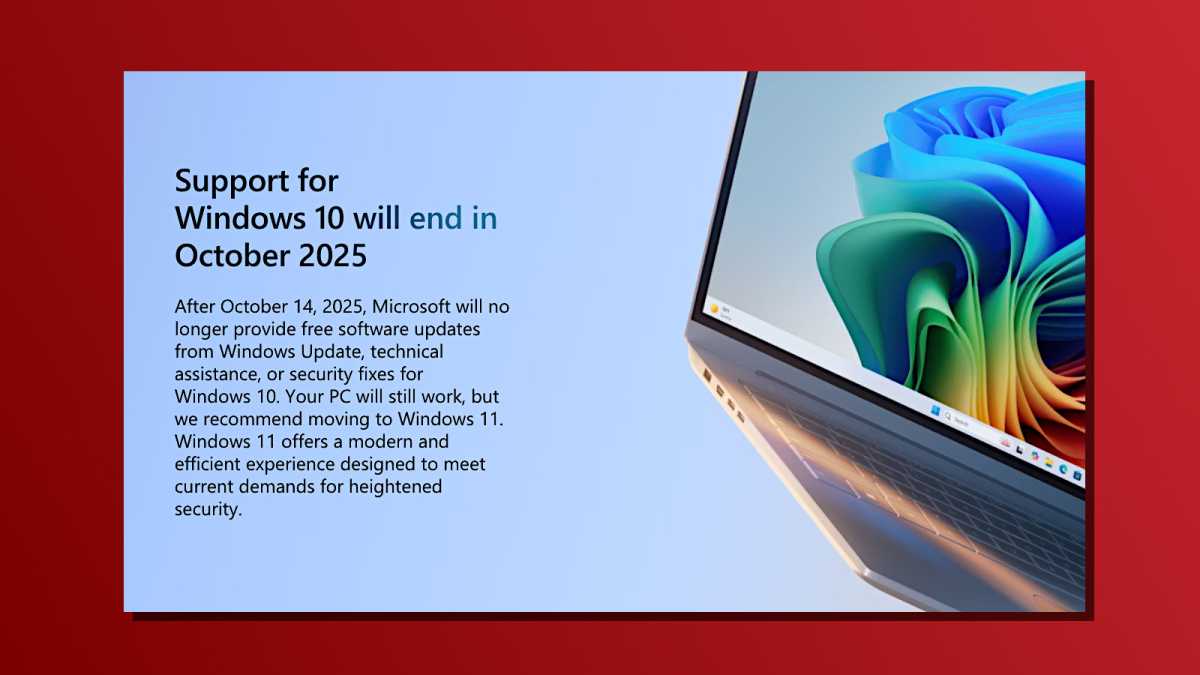
Once October 14 takes place, Windows 10 PC will no longer receive safety updates or bug corrections, not to mention new features. This means that the more you continue to use it, the more malicious software and malicious hackers will become (because they will exploit still unlocked safety defects which will not be corrected on your PC). And if you encounter system problems with your PC, Microsoft will not provide technical support.
Dave Parrack / Foundry
As it stands, this has frightened many users to finally take the plunge and go to Windows 11, by launching a Windows update or by buying a new machine with preinstalled Windows 11. But statistics from StatCounter market shares show that hundreds of millions of users still refuse to upgrade, included.
I knew that the end of the management of Windows 10 has been coming for some time, but I have been enough to upgrade and I always have no intention of upgrading. I stick to Windows 10. Yes, I am aware of the risks, but I have means to get around them. (More things about it below.)
My current PC is not good enough
Microsoft is desperate for holdouts like me to go from Windows 10, but the figures suggest that too many people refuse Windows 11 for various reasons.
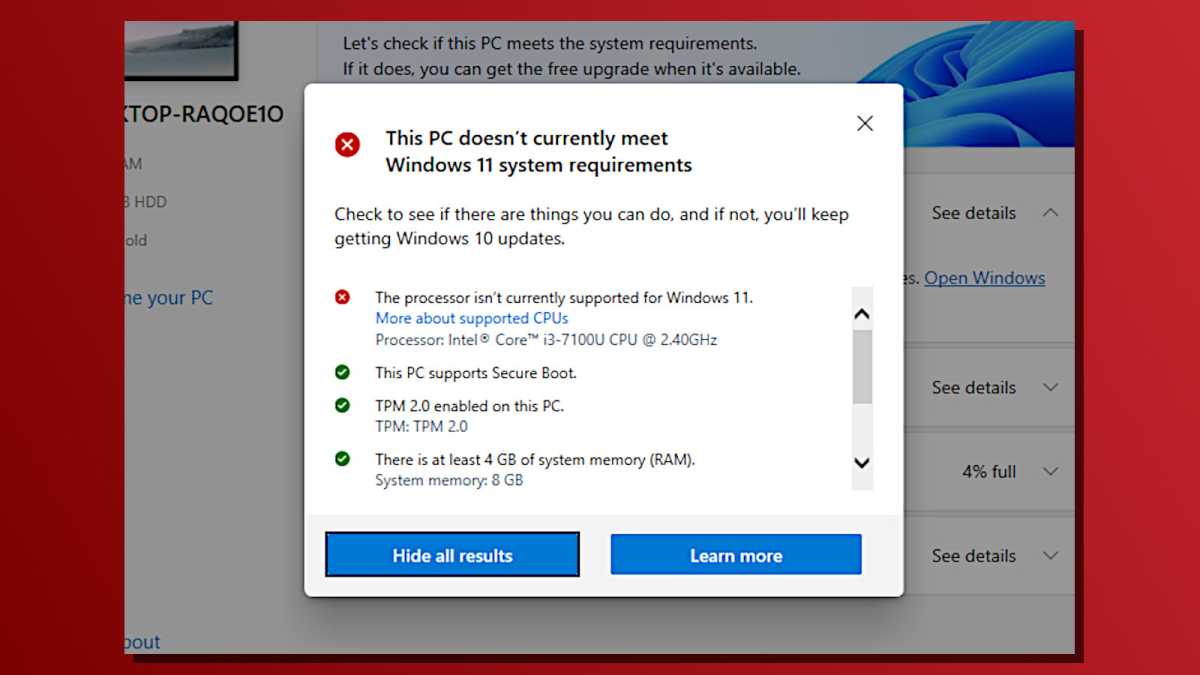
Why am I I Stay on Windows 10? The main reason is that my PC is apparently not eligible for Windows 11. I directed the Windows PC Health Check application and I noticed that my Intel Core i3 (on my seven -year laptop) is not supported by Windows 11. To upgrade, I should either buy and install a new processor (no thanks) or buy a new PC (no thanks). Why spend useless money when my current PC works very well?
Dave Parrack / Foundry
Why does my processor not qualify for Windows 11? Who knows. I doubt Microsoft even has a good answer. Maybe my laptop would choke on Windows 11 because it is much more inflated, or maybe it would work as well as Windows 10. Maybe Microsoft just wants to give me a reason to abandon the ship and buy a new laptop.
But my laptop works well! And this is the knot of the question for me. It’s more than capable of doing everything I need, and I’m not a Power Windows user, so I don’t need anything more. It looks like planned obsolescence for me … and I hate it. It is a waste of a perfectly good laptop and I refuse to transform it into electronic waste. I am not impressed either by Microsoft’s potential exchange program for Windows 10 PC.
Dave Parrack / Foundry
As for Windows 11, I don’t care. I have used it several times on the PCs of others and it does not honestly look like a big upgrade. Of course, there are notable improvements, but none of them is large enough and revolutionary enough to justify the establishment of hundreds of dollars on new equipment.
And I would be neglected if I have not mentioned the insects and the problems that tormented Windows 11 since 24h2! There is no way to submit to this kind of frustration.

Dave Parrack / Foundry
It doesn’t help it either, as I have already written, I use a Chromebook for most of my daily activities. This means that my Windows 10 PC was a little pushed towards the key, only there for the moments when I need instead of my Chromebook.
Do I get older?
A concern that crossed my mind is perhaps everything is just a thing of age. While I approach 50, could it be that I reach this stage of life where I prefer to stick to familiar technology and not want to worry about “the next thing”? I do not remember having these same feelings when I had to go from Windows XP to Vista or Windows 7 to 10. It could very well be (at least in part) a “problem of me” here.
However, I cannot deny that Microsoft makes me feel in a corner and wanting to repel, continuing with the equipment that I have been using for several years. I am stiff that this company of several billion dollars forces me to buy a new computer and to go to a lower operating system instead of working Windows 11 in a product so good and desirable that it returns me to want To change.
Don’t get me wrong. I don’t think there is something bad About Windows 11. It simply did not give me any imperative reason to upgrade. If I could upset myself freely without the need for a new PC, of course, I might do it. But with that coming with a real cost, I choose to stick to Windows 10.
How to stick to Windows 10 (for now)
If you are in a position similar to me and want to continue using Windows 10 even after the end of the support date, you have some different options to go safely and safely. Whatever you do, do not continue to use it in its unrealized condition. Without a continuous source of security updates, you would just ask for problems.
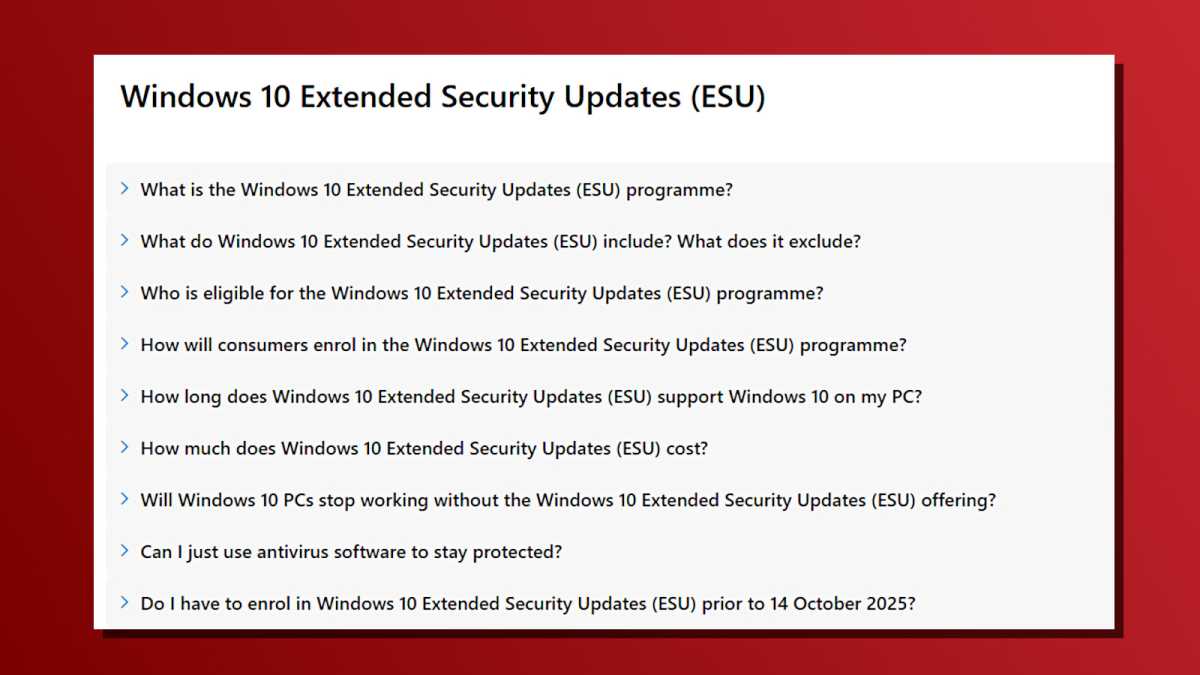
Instead, you will want to register for Microsoft Security Updates (ESU) program. By registering your PC in the ESU program, you will get an additional year of Windows 10 security updates.
Microsoft
There are actually three ways to join the Windows 10 ESU program. A valid Microsoft account is necessary for the three options:
Option n ° 1: Pay $ 30. It is a punctual fee that unlocks the additional year of Windows 10 security updates without any other attached channel (in addition to needing a Microsoft account). The price may vary if you are outside the United States.
Option # 2: Activate Windows backup. Windows backup is a free feature that supports the selected files, folders and settings on OneDrive so that you don’t lose them even if your PC dies, gets lost or stolen. After activating Windows backup, your Windows 10 PC receives extended updates.
Option # 3: Spend 1,000 Microsoft Rewards points. Instead of paying $ 30, you can rather register for Microsoft Rewards and start winning points by doing things like search on Bing, playing games selected on Xbox One, buying stuff on the Microsoft store, etc. The points can then be exchanged for extended security updates.
If one of these options sounds good, you should be able to register your PC in the Windows 10 ESU program via a banner in the upper right corner of your Windows update settings page.
There is also another unofficial option
If none of Microsoft’s official ESU options seem good to you – maybe you don’t want to create a Microsoft account at all – then there is still one thing you can try, but this path has warnings.
There is a free third-party tool called updowntool which would provide several additional years of support for Windows 10. How does it work? By converting your PC to Windows 10 LTSC (“long -term service channel”), which is a special cutting version of Windows 10 which is not intended for PC for general use. Windows 10 LTSC benefits from regular support until January 12, 2027 as well as prolonged support until January 13, 2032.
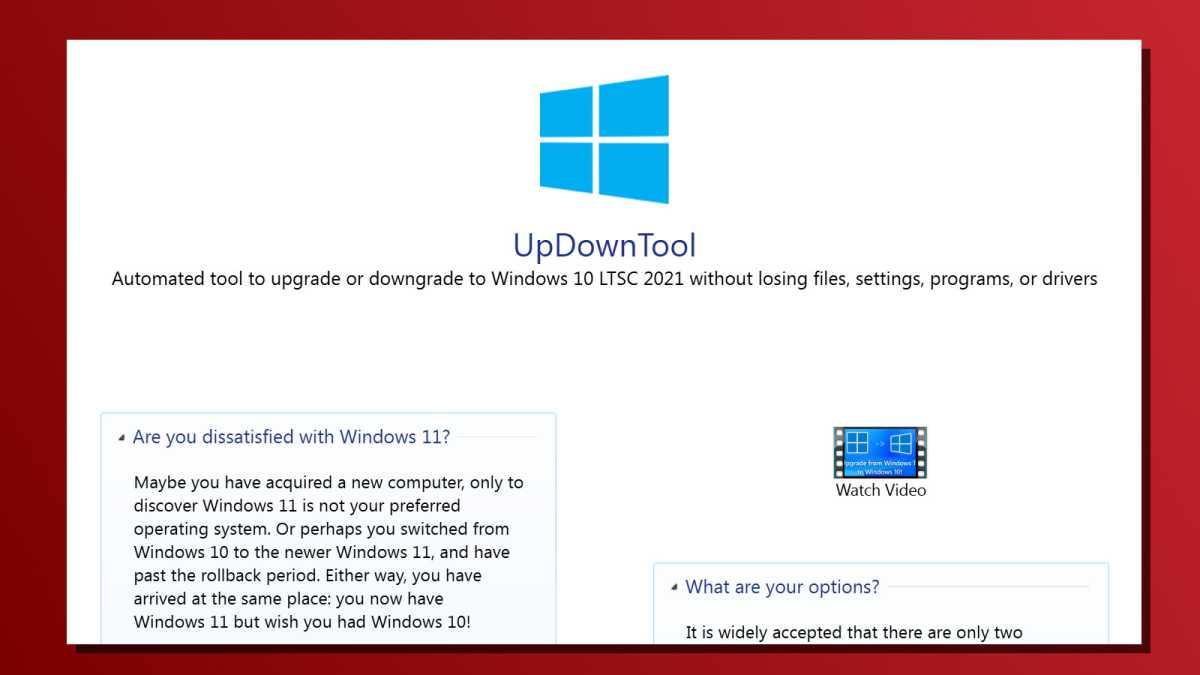
Updowntool
Updowntool is actually intended for Windows 11 users who regret the upgrade and want to return to Windows 10. However, it can always be used by Windows 10 people (or any other version of Windows) to go to Windows 10 LTSC.
By going to Windows 10 LTSC, you will end up with a PC which runs mainly on Windows 10, except without any of the usual Bloatware or in one of the caughtling contextual windows on upgrade to Windows 11. The warning is that Windows 10 LTSC does not obtain the updates of features, does not take charge of the Microsoft Store, and does not support applications that are regularly maintained via the Microsoft Store, such as the Microsoft edge.
Again, Updowntool is a third-party tool that is not officially supported by Microsoft, so use it as your own risks if you choose this path.
It’s always Windows 10 for me
I will probably register my PC in the Windows 10 ESU program by activating the Windows backup before the deadline of October 14, which will keep my PC safe and protected until October 13, 2026.
Beyond that, I am undecided on the way I will move forward. I can finally bite the ball on a new PC which comes with Windows 11, but I am also tempted to completely abandon Windows in favor of Chromeos – and if I end up doing it, Microsoft will only have to blame.
Read more in -depth: The best chromebooks that are actually great


