My toothache led to a grim discovery: The dental care system is full of cavities as you age

I recently had a nagging toothache, and it led me to an even more painful revelation.
If you took an x-ray of the state of oral health care in the United States, especially for people 65 and older, the picture would be full of cavities.
“It’s probably worse than you can imagine,” said Elizabeth Mertz, a professor at UC San Francisco and Health Force Center researcher who studies barriers to dental care for older adults.
Mertz once called the broken-toothed, gap-filled oral health care system — which isn’t really a system at all — a “mess.”
But back to my toothache, while I’m taking painkiller. This had been bothering me for a few weeks, so I went to see my dentist, hoping for the best and preparing for the worst, after having two extractions in less than two years.
Let’s make it a winning trio.
My dentist told me a molar needed to be pulled due to cellular breakdown called resorption, and a periodontist at his office recommended a bone graft and possibly an implant. The whole process would take several months and cost about the price of a nice vacation.
I’m fortunate to have a great dentist and excellent dental coverage through my employer, but as anyone with a private plan knows, dental insurance barely qualifies as insurance. It’s perfect for cleanings and basic preventative routines. But for more complicated and expensive procedures – which multiply with age – you can pay half the cost, if you have coverage at all, with annual payment caps in the range of $1,500.
“The biggest reason dental care is delayed,” Mertz said, “is out-of-pocket costs. »
So I wondered if it wouldn’t be better, from a cost perspective, to drop my medical and dental coverage and switch to a Medicare plan that costs more – Medicare Advantage – but includes dental options. Almost in unison, both of my dentists recommended against this, because Medicare supplement plans can be very limited.
Sorting through it all can be confusing and time-consuming, and no one warns you in advance that getting older itself is work, that benefits are poor, and that the specialist care you’ll need most – dental, vision, hearing and long-term care – isn’t covered in the basic package. It’s as if Medicare was designed by pranksters, and we’re paying the price now as the percentage of the population 65 and older explodes.
So what are people supposed to do when they get older and their teeth become loose?
A retired friend told me that she and her husband didn’t have dental insurance because it cost too much and covered too little, and it turns out they’re not alone. By some estimates, half of U.S. residents age 65 and older lack dental insurance.
It’s actually not a bad option, Mertz said, considering the cost of insurance premiums and co-payments, as well as the caps. And even if you have insurance, many dentists don’t accept it because reimbursements stagnate as their costs rise.
But without insurance, many people simply don’t go to the dentist until they have to, which can be dangerous.
“Dental problems are very clearly associated with diabetes,” as well as heart problems and other health problems, said Paul Glassman, associate dean of California Northstate University’s school of dentistry.
There is another option, which Mertz referred to as dental tourism, saying Mexico and Costa Rica are popular destinations for U.S. residents.
“You can get a week of vacation and dental work and still get an advance on what you would pay in the United States,” she said.
Tijuana dentist Dr. Oscar Ceballos told me that about 80 percent of his patients are from north of the border, coming from as far away as Florida, Wisconsin and Alaska. He has patients in their 80s and 90s who have been coming back for years because in the United States their insurance was expensive, coverage limited and out-of-pocket costs unaffordable.
“For example, a dental implant in California costs between $3,000 and $5,000,” Ceballos said. At his office, according to details, the same service “costs between $1,500 and $2,500.” The cost is lower because staff, office rent and other overhead costs are cheaper than in the United States, Ceballos said.
As we spoke on the phone, Ceballos looked around his waiting room and said three patients were from the United States. He handed his cell phone to one of them, San Diegan John Lane, who said he had been going south of the border for nine years.
“The main reason is the quality of care,” said Lane, who told me he describes himself as 39 years old, “with almost 40 more years” on the clock.
Ceballos is “conscientious and he has a facility as clean, sterile and medically up-to-date as anything you can find in the United States,” said Lane, who had driven his wife from San Diego for a new crown.
“The cost is 50 percent less than it would be in the United States,” Lane said, and sometimes the savings are even greater.
This summer, Lane may see even more Californians in Ceballos’ waiting room.
“Proposed funding cuts to the Medi-Cal Dental program would have devastating impacts on our state’s most vulnerable residents,” said dentist Robert Hanlon, president of the California Dental Assn.

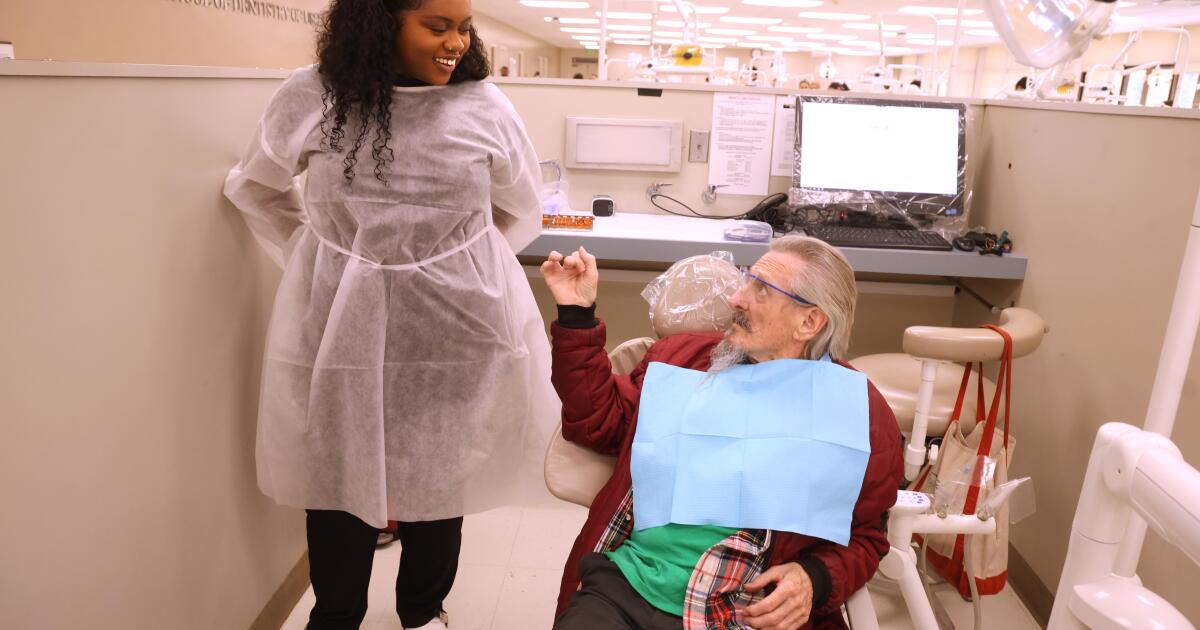
Dental student Somkene Okwuego smiles after finishing work on patient Jimmy Stewart, 83, who is receiving affordable dental care at the Ostrow School of Dentistry of USC on the USC campus in Los Angeles on February 26, 2026.
(Genaro Molina/Los Angeles Times)
Under the 2016 Tobacco Tax Proposition 56, additional reimbursements to dentists were put in place, but those increases could be reversed by a proposed budget cut. Only about 40 percent of dentists in the state accept Medi-Cal payments as is, and Hanlon told me that a CDA survey indicates that half would stop accepting Medi-Cal patients and many others would accept fewer patients.
“It is appalling that as the cost of health care is at an all-time high, the state is considering reducing funding for the program to 1990s levels,” Hanlon said. “These cuts…will force patients to forgo or delay basic dental care, leading to completely avoidable emergencies in already overcrowded emergency departments.” »
Somkene Okwuego, who as a child in South Los Angeles was an occasional patient at the clinic at USC’s Herman Ostrow School of Dentistry, will graduate from the school in just a few months.
I first wrote about Okwuego three years ago, after earning an undergraduate degree in gerontology, and she told me a few days ago that many of her dental patients are elderly and have Medi-Cal insurance or no insurance at all. She also worked at a Skid Row dental clinic and plans, after graduation, to work at a clinic where dental care is free or discounted.
Okwuego said “fixing smiles” for his patients is a privilege and boosts their self-image, which can help them “when they’re trying to get a job.” When I visited her on Thursday, she was with Jimmy Stewart, an 83-year-old patient.
Stewart, an Army veteran, told me he had trouble getting dental care at the VA and went years without seeing a dentist before a friend recommended Ostrow’s clinic. He said he underwent superior extractions and restorative care at USC, with the work covered by his Medi-Cal insurance.
I told Stewart there could be medical cuts happening this summer.
“I’d be screwed,” he said.
Him and many other people.
steve.lopez@latimes.com

.jpg?w=390&resize=390,220&ssl=1 "Best Bob Haircut Ideas 2026: 42 Styles to Try")


