Nanoplastics Make Up Most of the Ocean’s Plastic Pollution


Most of the ocean plastic is invisible and deadly
Nanoplastics – particles smaller than human hair – can go through cell walls and enter the food canvas. New research suggests that 27 million metric tonnes of nanoplastics are spread over the upper layer of the North Atlantic
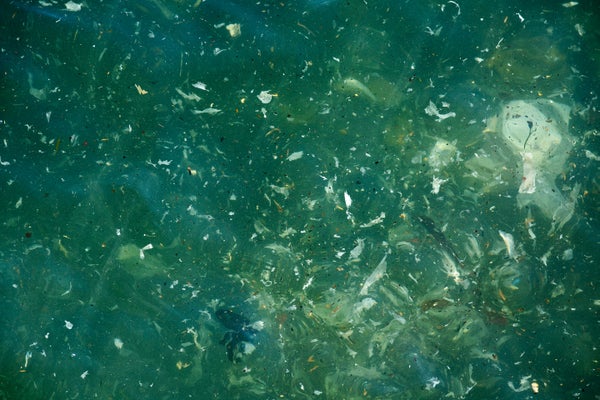
Sergi Escribano / Getty Images
The marine plastic litter tends to make the headlines, with images of sea birds or suffocating bottles along the coasts. Increasingly, researchers have found tiny microplastic fragments in all environments, from the most densely populated cities to virgin summits, as well as in human tissues, including the brain and the placenta. A published study today reveals another hidden source of this deadly waste: particles on the scale of nanometers are literally everywhere, explains the co-author Dušan Materi & Cacute; an environmental analytical chemist with helmholtz center for Environmental Research in Leipzig, Germany.
Materi & Cacute; And his colleagues sampered water with three depths representative of different environments in the North Atlantic Ocean. Throughout the water column, they found three types of nanoplastics: polyethylene terephtaplate (PET), polystyrene (PS) and polyvinylchloride (PVC). These were present at average concentrations of 18 milligrams per meter in cubes, which results in 27 million tonnes of nanoplastics distributed over the upper layer of the temperate to the subtropical North Atlantic. “Nanoplastics constitute the dominant fraction of pollution of marine plastic”, Materi & Cacute; said. In all of the world’s oceans, it is estimated that there are about 3 million tonnes of floating plastic pollution – excluding nanoplastics.
What are plastic nanoparticles and to what extent are they different from microplastics?
On the support of scientific journalism
If you appreciate this article, plan to support our award -winning journalism by subscription. By buying a subscription, you help to ensure the future of striking stories about discoveries and ideas that shape our world today.
The smallest parts of plastic, nanoplastics are defined by researchers as having a diameter of less than a micrometer (a thousandth of a meter). Microplastics are between a micrometer and 5 millimeters in diameter. On the smaller scale of nanoplastics, the materials behave differently. Materi & Cacute; And his colleagues found that the particles were distributed throughout the water column, rather than settle in the bottom. The movement of nanoplastic particles was not dominated by gravity, but by the random movement called Brownian movement and by collisions with water molecules.
How did the team find nanoplastics?
Scientists took water samples during a cruise in November 2020 on research ships Pelagiawhich belongs to the Royal Netherlands Institute of Sea Research in Texel. They sampled at 12 locations: 5 in the circular current system called the Northern Atlantic Subropical Gyre; 4 in the open ocean; and 3 of the coastal areas on the European continental plateau. With each location, they gathered samples at depths of 10 meters and 1,000 meters below the surface, then 30 meters from the bottom of the ocean.
Nanoplastics were detected using a technology called mass mass spectrometry of reaction of thermal protons. “We have been confronted with several challenges,” explains Materi & Cacute;, including the need to delete contaminants other than nanoplastics. Each sample of 10 millililiters has been executed through a filter with micrometer pores to remove microplastics. The samples were then slowly heated, releasing any organic matter and making it possible to identify the remaining plastics.
Everything was not as planned. “We faced a great mystery,” explains Materi & Cacute;. A large class of plastics, polyethylene (PE), lacked in the data, even if the fragments almost certainly enter the ocean. The fragments are probably transformed into something else, or could fall into the sea bed, explains Materi & Cacute; “This suggests that nanoplastic cycling PE in the oceanic environment follows an unusual route – either rapid chemical alteration or mineralization, or rapid sinking.”
Should we be surprised that nanoplastics are a neglected source of plastic pollution? Should we worry?
“It doesn’t surprise me, because I have been aware of the extent and the extent of the problem for some time,” said Tony Walker, an environment scientist at Dalhousie University in Halifax, Canada. “Nanoplastics, unlike microplastics, are able to go through cell walls, which means that they are already incorporated into the ocean phytoplankton which serve as the basis of the maritime network and can be transferred via the maritime network,” he explains.
The omnipresence of nanoplastics means that they must be taken seriously, explains Materi & Cacute; “Given their toxicological potential, they can represent the most problematic plastic fraction of plastic for the life of the ocean,” he said. Walker agrees: “It should be alarm clock for all of us,” he said. “The extent to which nanoplastics can infiltrate each ecosystem and living cell on the planet is even much worse than what we already know about microplastics and the greatest plastic pollution.”
What can we do to alleviate pollution?
The next and probable last end of negotiations for a legally binding United Nations treaty on plastics pollution will start in August in Geneva, Switzerland. On the table is a limit to the manufacture of the future plastic, but this is resistant to certain countries, including those which depend on oil and gas exports to fuel their savings.
“One of the best strategies to mitigate the future pollution of nanoplastics or release in the environment is to cap plastic production,” explains Walker. “Turn off the tap.”
This article is reproduced with permission and was first publication July 9, 2025.