Naple’s panettone story : NPR

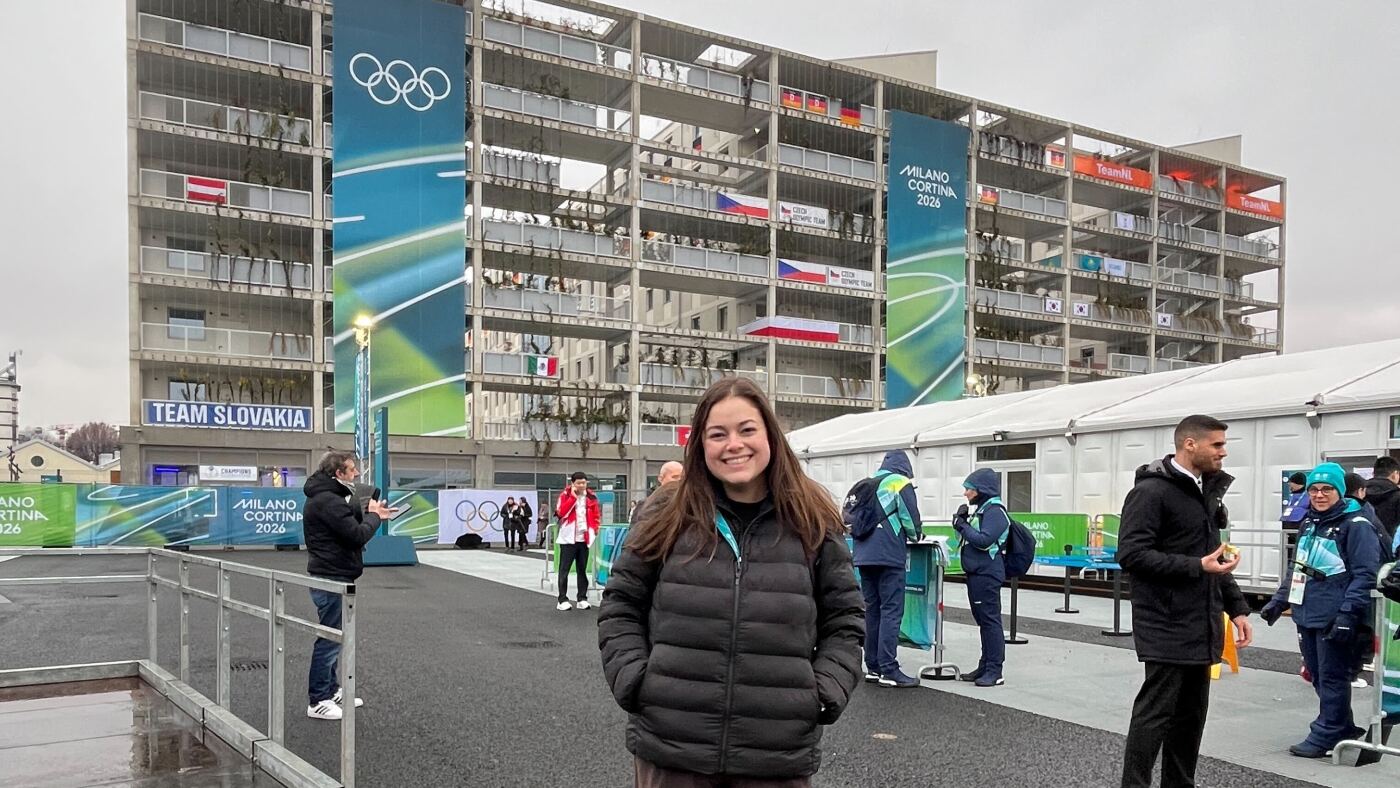

NPR reporter Rachel Treisman, about to explore the Olympic Village.
Rachel Treisman/NPR
hide caption
toggle caption
Rachel Treisman/NPR
You read the Rachel is going to the Games newsletter — a look behind the scenes at the Winter Olympics in Italy. Subscribe here to receive it in your inbox.
I was among the lucky journalists who got to peek around Milan’s Olympic Village the week of the opening ceremony, taping a “media” armband around my jacket and slipping into a sea of journalists, volunteers and Olympians from around the world.
The village is a collection of modular buildings and high-rise apartments, with the flags and banners of the countries of residence hanging from the balconies and windows. All around are prominent landmarks such as the Olympic Rings statue, a fitness center with cardio machines and weight racks, and a mindfulness room with trainers, yoga mats, and tables for coloring and writing postcards. And the dining room, obviously.
My teammate Pien Huang and I sat with Daniel Smith, the U.S. team’s Olympic village director, on the ground floor of the seven-story building the U.S. shares with Japanese athletes.
Smith said about 70 U.S. Olympians will remain here throughout the Games — remember, only speed skating, figure skating and ice hockey compete in Milan — along with about 40 U.S. support staff. In total, the village will welcome some 1,500 athletes and team members from all over the world for three weeks.

Smith explained that many decisions about daily life in the Village — from what athletes eat to what time they sleep to choosing a roommate — depend on specific sports and individuals. But he and other U.S. Olympic and Paralympic Committee staff are there to “mitigate distractions,” whether that means facilitating transportation or helping athletes who can’t access their rooms.
“I think the feedback we’re getting is a lot of gratitude,” said Smith, who is competing in his third Games.

The cafeteria, where the food is deliberately bland.
Rachel Treisman/NPR
hide caption
toggle caption
Rachel Treisman/NPR
Just 72 hours after opening, it was too early to tell what aspect of the village might go viral. So far, Smith hasn’t seen any of the Olympics-themed condoms that were all the rage in Paris in 2024, nor heard anyone indulge in specific desserts like they did with chocolate muffins (“We’re waiting for desserts to have a little bit of traction”).
In fact, the food doesn’t really make waves — which Smith says is on purpose. Around lunch time, the only real line we noticed was for pasta with meat sauce. While yogurt, meats, vegetables, pasta, pizza, and bread seemed like pretty standard cafeteria fare to me (definitely NOT an athlete), Smith says the food is blander than it looks.
“We are here in Italy, in one of the world capitals of gastronomy, but here, in the Olympic Village, the food is very careful. [be] “Sport specific,” adds Smith. “So not a lot of condiments, not a lot of flavor. You kind of have to flavor your own food.”
What I eat

Panettone, warm out of the oven.
Rachel Treisman/NPR
hide caption
toggle caption
Rachel Treisman/NPR
A few weeks ago, while researching unusual experiences for this newsletter, I came across an interesting tidbit: In Milan, it’s a tradition for people to eat their leftover panettone — the Christmas fruit cake with raisins associated with the city — on February 3.
It is the feast of San Biagio (Saint Blaise). The patron saint of throat diseases, among other things, is credited with saving the life of a young boy who was choking on a fish bone – but he obviously took on the role of protector against all manner of throat-related ailments, including sleep apnea and angina.

According to several local English-language publications, many Milanese households set aside a piece of panettone at Christmas to eat later, to protect against illness during flu season. This appears to be the result of another apocryphal legend, according to which a peasant woman brought a panettone to a priest for the Christmas blessing, but forgot to collect it until several weeks later.
Anyway, I took note of all of this, but woke up yesterday not knowing if I had the time and/or resources to investigate the state of expired panettone in the city. But in an exciting turn of events, a group of us decided to share dessert at dinner and guess what was on the menu! Our server immediately recommended the panettone and also confirmed that the tradition was real. Ours was no leftover from Christmas though – it was soft, warm and absolutely delicious.
In Olympic news

Spaniard Tomàs-Llorenç Guarino Sabaté competes at the European Figure Skating Championships in the United Kingdom on January 15. He will be allowed to wear his Minion suit at the Olympics this month.
Yuan Tian/NurPhoto via Reuters
hide caption
toggle caption
Yuan Tian/NurPhoto via Reuters
We need to talk about Miniongate.
In case you missed it: Spanish Olympian Tomàs-Llorenç Guarino Sabaté confirmed earlier this week that he was forced to change the music of his Despicable Me-themed short program – a nightmare, so close to the biggest competition of his career – due to a last-minute licensing dispute.
The internet caught wind and rallied behind Sabaté in hopes that he could finally don his overalls, in the name of fantasy and all things fun. Yesterday, the skateboarder posted on Instagram that Universal Studios had reconsidered and granted him the rights for this special occasion, to which everyone responded: BANANA!
Music licensing has become an increasingly thorny issue in figure skating, which is why many older shows on YouTube now lack their original scores. A group of American pairs skaters were sued — and ultimately settled — for allegedly using an unauthorized cover during the 2022 Beijing Olympics, and Team USA’s Alysa Liu had to abandon her original Lady Gaga routine earlier this season because she couldn’t secure the YouTube cover rights. She launched her revamped program in January, and I’m sure you’ll hear about it later.
Before leaving

Katie Uhlaender of the United States after completing a women’s skeleton race in March. After an appeal, she was denied the chance to compete in her sixth Winter Games.
Al Bello/Getty Images
hide caption
toggle caption
Al Bello/Getty Images