Narendra Modi Learns That Not Even Trump Respects a Bootlicker


The Indian Prime Minister discovers that the largest tyrant in the world considers that weakness.
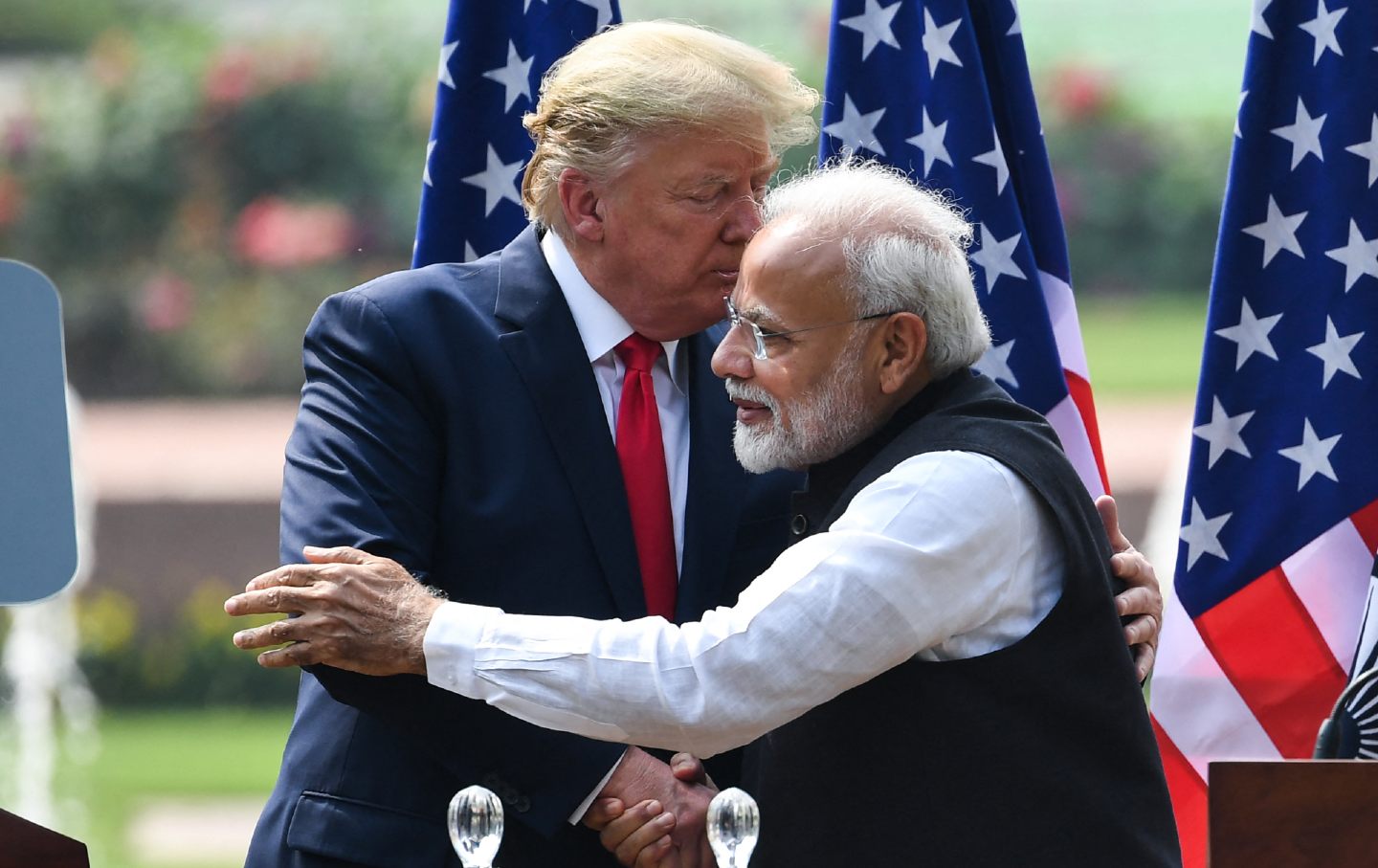
President Donald Trump shakes hands with Indian Prime Minister Narendra Modi at a joint press conference in New Delhi on February 25, 2020.
(Prakash Singh / AFP via Getty Images)
Donald Trump has created a new golden age of sycophance. The White House now looks like Versailles under the absolutist monarchs or the prohibited city of Beijing under the emperors. The CEOs and foreign leaders queue to butter the American president. On Thursday, Tim Cook, Apple CEO, presented Trump exactly the kind of brilliant object that tickles his fantasy: a glass plate on a 24 -carat gold stand, which Cook described as “a unique unit of one”. Although the plate is undoubtedly an expensive gift, it was a small price to pay to keep the special price exemptions that Trump offered to Apple. Thanks to the abdication of the congress of his constitutional duty, Trump essentially has the unilateral power to set prices, and he uses this authority to threaten businesses and nations. To avoid the president’s anger, they offer compliments and simple balls.
Few world leaders have played the toad game for Trump as assiduously as Indian Prime Minister Narendra Modi. In 2019, Trump and the Indian leader met in Houston for the huge rally “Howdy Modi”, which attracted more than 50,000 participants. The meeting was both a campaign event (designed to help Trump win the US Indian vote) and a chance to cement the links between the two countries. During this gathering, Modi described Trump as “real friend in the White House”. The following year, Trump visited India for an even larger event called “Namaste Trump”, which attracted at least 100,000 people. These events have been designed to forge both personal and ideological links. Modi is often described as a counterpart from India to Trump. The two men are authoritarian populists who have built their coalitions by attacking migrants and minority groups. In the style of governance, the two men are working workers, with strong faith in their ability to establish personal ties that can overcome diplomatic disputes. In February, Modi was one of the first foreign leaders to visit the White House and spoke with passion about his “great friendship” with Trump. During this meeting, Trump and modified promised to double trade between the two countries.
On Wednesday, Modi and the Indian government learned how much friendship with Trump was worth it when the president went to social networks to announce his intention to impose high prices of 50% on India. Time Stresses that it is “among the steepest American samples of any nation”. This injury was combined with an insult which is particularly likely to sting in India, an emerging power with an elite which is aware of the way they are perceived by the wider world. The immediate pretext of the prices was that India bought Russian oil. With a passive-aggressive spite, Trump wrote on Truth Social: “I don’t care what India does with Russia. They can bring their dead savings together, for everything I care about. ”
Current number
The Indian government replied that this criticism is applied selectively and capriciously. It is true that the country buys Russian oil, but it is something it was encouraged to do by the United States as recently as last year, because it would help stabilize the world energy market. In addition, the European Union continues to be more trade with Russia than India.
The Indian government is on solid land by arguing that it is chosen by the Trump administration as an easy target. Trump was under pressure from NATO allies to do more to help Ukraine, and India, as an intermediate level power, made a practical punching bag.
By continuing India, Trump gives up decades of efforts to build closer ties between the two largest democracies in the world. During the Cold War, India and the United States had fresh relations because the United States supported Pakistan as a bulwark against communism while the subcontinent has pursued a policy of independence and neutrality. But from the 1990s, the United States adopted a bipartite policy to get closer to India, now considered a potential Asian counterpart of a rising China.
Trump’s tour against India has less to do with Russia than with the personal spikes of a president who is easy to take offense when he feels that his insatiable love was insulted. India and Pakistan had a brief military confrontation in May. After the two countries reached a ceasefire, Trump tried to claim credit as a peace broker. This is in accordance with its habit of wanting to be considered as an essential world leader, but India has considered it an insult to its national sovereignty. Modi and Trump had a long telephone conversation on the issue on June 17, which Bloomberg Described as “tense”.
Bloomberg reports other reports:
Although the United States has never made a direct request to recognize the role of Trump in the ceasefire, India has seen a change in the white house after this telephone call, according to New Delhi officials. Once Trump started to publicly attack India, they added, it was clear that the episode marked a turning point in the broader relationship.
Mercurial diplomacy based on the personality of Trump should lead to long -term cooling of relations with India. Some in India contrast Trump’s instability with the much calmer relationship than India appreciated with Russia for many years. The New York Times Note that Modi National “faces a storm of criticisms on the treatment of India by the Trump administration”. Navdeep Suri, who had been the High Commissioner of India in Australia, said Bloomberg“The relationship of Russia is old, tested in time. All these days when the United States dropped New Delhi, including the United Nations, Moscow was held behind India as a rock. Oil is a small part of the current history. India will not like to be considered to be capitulating under pressure.”
A consequence of Trump’s slap in front is that the Indian government intensifies its efforts to improve links with China, although it has fought a border confrontation with this neighboring country as recently as 2020. Significantly, Xu Feihong, the China Ambassador to India, used Trump’s latest tariff hike to learn a lesson Mile. “
Xu’s comments come to the heart of the question. Trump is a tyrant. Its pricing policy, although dressed in rhetoric on reshaping and national security, has little or no strategic basis. It is designed only to feed the ever -satisfied ego of Trump. Although Trump Flatte has become a favorite strategy of many nations, there is little evidence that it works. In fact, like many intimidators, Trump is more respectful of those who retaliate. China, which has taken a firm line to defend its national interests, does better in trade negotiations with the United States than India.
For an average power like India, the best way to deal with Trump is neither flattery nor false bonhomie. Trump has no real friends, only abject friends. A better way is to resolve trade agreements with other major economies such as China, Brazil or South Africa. Such a policy would be up to the strategy of India’s Cold War to build a non -aligned block. Moreover, even nominal American allies such as Canada, Mexico and the European Union should think of creating such a block. The only way to beat the intimate is to create a counter that can grow back. In the Trump era, flattery will not take you anywhere.
At this time of crisis, we need a unified and progressive opposition to Donald Trump.
We are starting to see a form in the streets and in the ballot boxes across the country: from the campaign of the candidate for the town hall of New York, Zohran Mamdani, affordable, to communities protecting their neighbors from ice, to senators opposed to arms expeditions to Israel.
The Democratic Party has an urgent choice to make: will he embrace a policy that is based on principles and popular, or will it continue to insist on losing elections with the elites and the outside contact consultants that brought us here?
HAS The nationWe know which side we are on. Each day, we assert a more democratic and equal world by defending progressive leaders, lifting movements fighting for justice and by exposing oligarchs and societies benefiting at the expense of all of us. Our independent journalism informs and empowers progressives across the country and helps to bring this policy to new readers ready to join the fight.
We need your help to continue this work. Are you going to make a donation to support The nationIndependent journalism? Each contribution goes to our reports, our award -winning analyzes and comments.
Thank you for helping us face Trump and building the right company we know is possible.
Sincerely,
Bhaskar Sunkara
President, The nation