NASA abruptly changes its roadmap to putting boots back on the moon

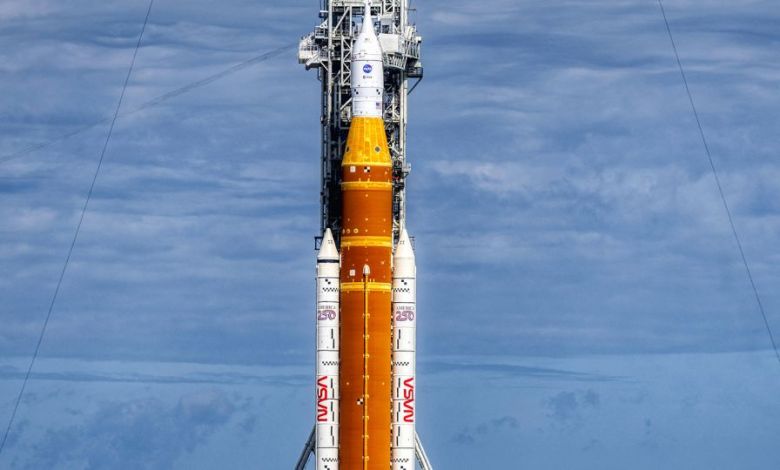
NASA announced a dramatic change Friday in its strategy to return astronauts to the lunar surface, choosing to add an additional crewed test flight before attempting to land.
Space agency officials said “Artemis III” — the mission name that was previously used to refer to a moon landing planned no earlier than 2028 — will now be a completely different mission, one that will involve launching a crewed NASA capsule into Earth orbit to dock with at least one prototype lunar lander made by SpaceX or Blue Origin. NASA Administrator Jared Isaacman said he hoped the mission would launch in 2027.
The moon landing mission, still planned for 2028, will now be called “Artemis IV”. Isaacman said the agency is actually looking at up to two moon landings in 2028.
However, those responsible for monitoring have already expressed serious doubts about the possibility of obtaining this calendar.
Isaacman presented the move as an effort to accelerate the pace at which NASA launches Artemis-related missions. For context, the program’s first uncrewed test flight, called Artemis I, launched in November 2022 – putting more than three years between that test flight and the Artemis II mission, the first crewed Artemis flight test planned to carry four astronauts on a slingshot trip around the moon.
“We didn’t go straight to Apollo 11,” Isaacman said. “We had a whole Mercury program, Gemini – a lot of Apollo missions before we landed properly. Now our program is basically set up with an Apollo 8 and then goes straight to the Moon. That is, again, not a path to success.”
The news comes as NASA continues to work to get Artemis II off the ground. That mission, which involves sending four astronauts on a test flight that will loop around the Moon but not land on its surface, was initially targeting launch windows in February.
But those plans failed due to problems with NASA’s Space Launch System rocket. Specifically, a series of hydrogen leaks and then an unexpected problem getting helium to the top of the launch vehicle led to a series of delays and ultimately the decision to roll the rocket back from its launch pad.
Artemis II – which will use NASA’s Space Launch System rocket and the Orion spacecraft, but will not involve a lunar lander – is now expected to launch no earlier than April.
The landing problem
While Artemis II is designed to serve as an exploration mission for a moon landing, whether NASA will be able to achieve a real Moon landing within this decade remains a question. While SLS and Orion are designed to take astronauts from Earth to lunar orbit, the agency decided long ago to outsource development of a lunar lander to the private sector. Such a vehicle is needed to transport astronauts from the Orion spacecraft to the surface of the Moon.
Elon Musk’s SpaceX and Jeff Bezos’ Blue Origin both have fixed-price contracts with NASA to develop lunar landers. SpaceX plans to use its Starship megarocket — a gargantuan rocket system that Musk originally billed for the trip to Mars — for the task. Starship is still in the early stages of development, and over the past year, prototypes have exploded during brief suborbital test flights.
Meanwhile, Blue Origin is building a lunar lander that looks more like a traditional Apollo-style vehicle. But the company has not yet launched a test flight.
NASA’s assertion that it could still pursue a moon landing in 2028 — and accelerate and modify the Artemis III mission into a 2027 training exercise in low Earth orbit — comes as watchdog officials have become increasingly skeptical of the reported timelines.
The NASA program overseeing the development of lunar landers by Blue Origin and SpaceX is called HLS, or Humans Landing System.
“Over the past year, programmatic and technical risks related to these systems have continued to emerge and impact the overall Artemis III schedule and risk management,” according to a recently released report by NASA’s independent oversight group, the Aerospace Safety Advisory Panel. “This is particularly evident with the HLS, given its complex operational design, complex concept of operations, and the challenges posed during its ongoing flight test program. Taken together, these difficulties cast doubt on the current Artemis III schedule and the feasibility of the Artemis III mission objectives.”
Given that monitoring officials were skeptical that the landers would be ready for a Moon landing in 2028, it also remains doubtful that either vehicle could be ready to fly a crewed test mission to low Earth orbit by next year.
Asked about NASA’s ASAP report, Isaacman said, “I think what we’re doing is directly consistent with what ASAP asked us to do.” »
“There has to be a better way, consistent with our history. Again, we didn’t just jump straight to Apollo 11,” he said. “We should not be comfortable with the current pace.”
It’s also unclear how NASA will fund the new mission, although Isaacman said top lawmakers on Capitol Hill are on board with the idea.
Changes to NASA’s Moon Rocket
In another notable change of direction, NASA said it no longer plans to develop an upgraded version of the SLS rocket, called “Block 1b.” This iteration of the rocket was supposed to include a larger, more powerful segment for use in the vacuum of space, which could allow SLS to carry large chunks of cargo to the Moon alongside crew.
“The idea is we want to reduce complexity as much as possible,” Isaacman said.
Although some stakeholders have suggested that a more powerful rocket segment is needed to help achieve NASA’s long-term goal of creating a permanent moon base, some policymakers have indicated they hope the space agency will consider cheaper alternatives. Although the precise cost breakdown is unclear, a 2024 inspector general report suggested that Block 1b development is expected to reach $5.7 billion by 2028.
Boeing has been named the prime contractor for the SLS rocket’s upgraded upper stage, also known as the exploration upper stage.
When reached for comment, Boeing did not specifically address its role in the next stage of exploration, but said, “Boeing is a proud partner of the Artemis mission and honored to support NASA’s vision for American space leadership with the Space Launch System.” »
Instead of moving toward a beefed-up version of the rocket, Isaacman said the agency would work to better standardize the SLS rocket, with the goal of making it more reliable.
A Senate version of a NASA authorization bill, a piece of legislation that outlines the space agency’s policies and goals, would grant Isaacman the authority to make such a change, according to a copy obtained by CNN.
NASA’s Artemis program is sending humans into deep space for the first time in more than five decades. Sign up for the Countdown newsletter and receive updates from CNN Science on extraordinary expeditions as they unfold.
For more CNN news and newsletters, create an account at CNN.com


