As Nov. 30 WNBA CBA expiration date nears with no news, status quo period is likely


The WNBA’s current collective bargaining agreement expires Sunday at 11:59 p.m. ET, and there has been no announcement from the league or the Women’s National Basketball Players Association regarding a new CBA or extension.
Although the WNBPA released a statement Sunday evening announcing it was offering a six-week extension, it is unclear whether the league will agree to those terms. With only hours remaining before the current collective agreement expires, four options remain on the table. Let’s quickly review them.
A new collective agreement
It is unlikely that the two sides will announce a new collective agreement on Sunday evening.
Earlier this month, the WNBA made a new offer to players that included substantial pay raises, including a new minimum salary (more than $220,000) that would be higher than the regular 2025 maximum salary ($214,466), according to the Associated Press. However, the players did not believe this offer moved negotiations forward, according to ESPN.
While players want more money, their top priority is a new revenue sharing model, not just higher salaries.
As new WNBA CBA deadline approaches, players and league remain at odds over what ‘transformational change’ means
Lindsay Gibbs
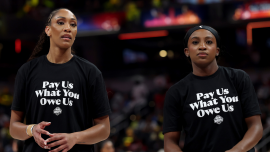
“If you and I don’t want to go to a nice restaurant, who cares what we order as an appetizer?” said Kelsey Plum, senior vice president of the WNBPA, earlier this year. “First, second, third, there’s the salary part (and) the salary. So when I say we keep proposing and the counter-proposals that come back are further away from what we thought they were going to be, that to me – and I think a lot of players agree as a union – is literally meat and potatoes.”
However, under the current collective bargaining agreement, the salary cap – and therefore players’ salaries – increases at a fixed rate of 3% per year. The actors are demanding a new model where salaries increase with the company.
Currently, players would only receive about 9 percent of all revenue, a far cry from the 49 to 51 percent of basketball-related revenue that NBA players receive. Although the current CBA has a clause to trigger revenue sharing if the WNBA meets certain goals, these have never been met, largely due to the COVID-19 pandemic.
ESPN’s report on player response to the WNBA’s latest offer came out 10 days ago, and it’s been radio silence since. If the two sides were moving closer to a deal, we likely would have heard rumors of progress in recent days.
Another extension of the current collective agreement
The current collective bargaining agreement was originally set to expire on October 31, but both sides agreed to a 30-day extension on October 28, setting November 30 as the new expiration date.
The WNBPA released a statement Sunday evening saying it had proposed a six-week extension. “We expect substantial movement from the league during this window,” the WNBPA wrote. It is unclear whether the league will accept this extension.
A period of status quo
If 11:59 p.m. ET passes without a new collective agreement or other extension, there will not be an automatic work stoppage. Instead, both sides would enter a period of status quo, which appears to be the most likely next step.
According to the Cornell Law Review: “Courts have developed the ‘status quo’ doctrine from the Katz prohibition of unilateral changes. This doctrine requires employers “to maintain, during the negotiation period, the status quo concerning the conditions of employment in order to avoid committing [a violation of the duty to bargain in good faith].'”
The main difference between the status quo and an extension is that either party could announce a work stoppage at any time during the status quo, whereas an extension would lock in the current collective agreement until a set date (or until a new collective agreement is agreed).
A work stoppage
At any time during a status quo period, either party may order a work stoppage. This would most likely come from owners locking out players, although players could also go on strike.
In the event of a lockout, all league activities would cease and players would not be able to access team facilities. That would mean no expansion draft, no free agency, no trades, no 2026 WNBA Draft, nothing until a new CBA is in place. Depending on the length of the lockout, it is possible that the 2026 season could be delayed or, in the worst case scenario, canceled.
The WNBA has never lost a game because of a work stoppage.


