NASA Hubble Helps Detect ‘Wake’ of Betelgeuse’s Elusive Companion Star


Using new observations from NASA’s Hubble Space Telescope and ground-based observatories, astronomers tracked the influence of a recently discovered companion star, Siwarha, on the gas around Betelgeuse. Research carried out by scientists from the Center for Astrophysics | Harvard & Smithsonian (CfA), reveals a trail of dense gas swirling through Betelgeuse’s vast and expansive atmosphere, shedding light on why the giant star’s brightness and atmosphere changed in strange and unusual ways.
The results of the new study were presented Monday at a news conference at the 247th meeting of the American Astronomical Society in Phoenix and are accepted for publication in The Astrophysical Journal.
The team detected Siwarha’s wake by carefully tracking changes in the star’s light over nearly eight years. These changes show the effects of the previously unconfirmed companion as it passes through Betelgeuse’s outer atmosphere. The discovery solves one of the biggest mysteries about the giant star, helping scientists explain its behavior and evolution while opening new doors to understanding other massive stars at the end of their lives.
Located about 650 light years from Earth in the constellation Orion, Betelgeuse is a red supergiant star so large that it could contain more than 400 million Suns. Due to its enormous size and proximity, Betelgeuse is one of the few stars whose surface and surrounding atmosphere can be directly observed by astronomers, making it an important and accessible laboratory for studying how giant stars age, lose mass, and eventually explode as supernovae.
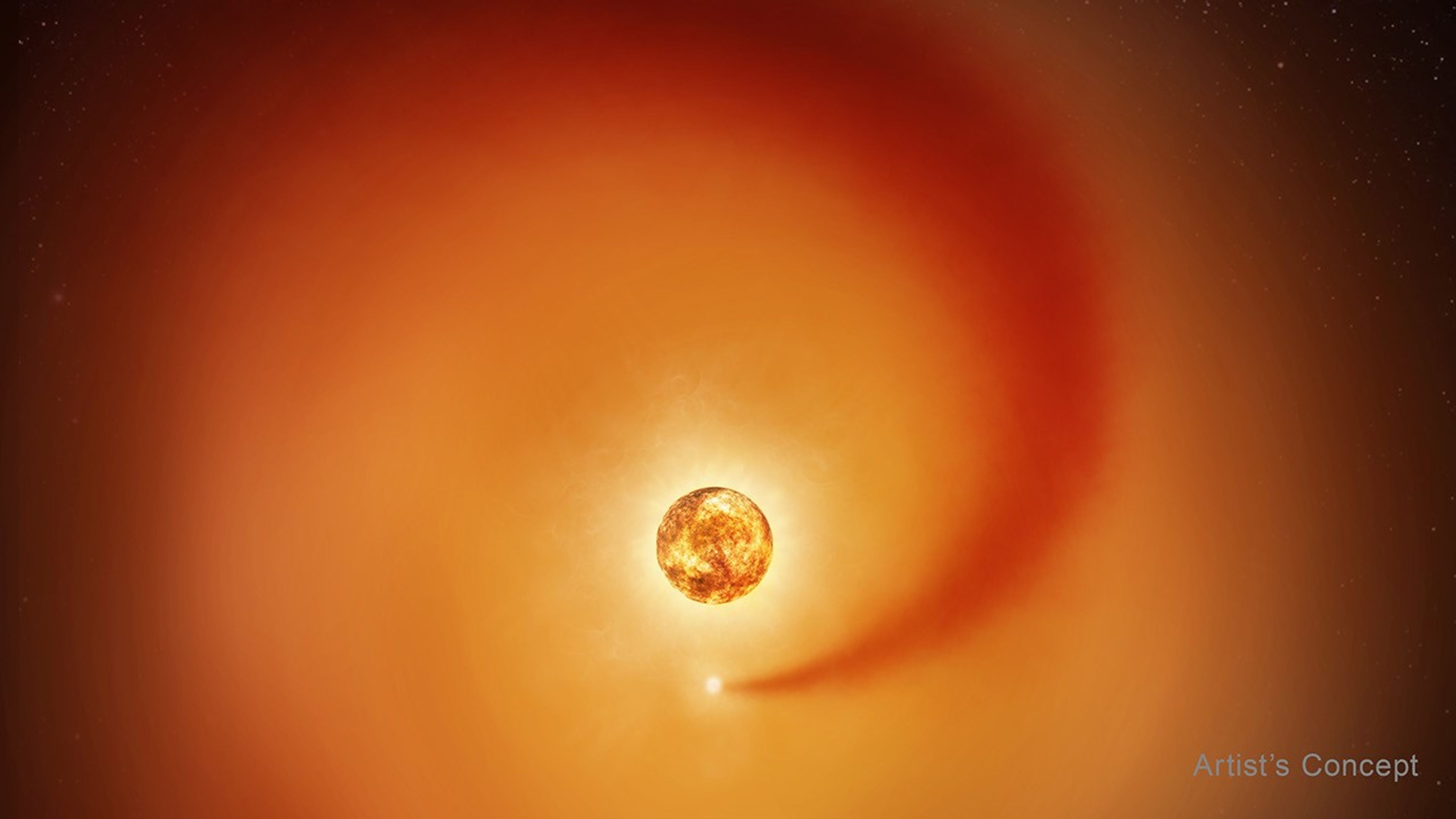
This artist’s concept shows the red supergiant star Betelgeuse and an orbiting companion star. The companion, which rotates clockwise from this perspective, generates a dense wake of gas that extends outward. It is so close to Betelgeuse that it passes through the supergiant’s extended outer atmosphere. The companion star is not to scale; it would be a pinprick compared to Betelgeuse, which is hundreds of times larger. The distance from the companion to Betelgeuse is scaled relative to the diameter of Betelgeuse.
Illustration: NASA, ESA, Elizabeth Wheatley (STScI); Sciences: Andrea Dupree (CfA)
Using Hubble and ground-based telescopes at NASA’s Fred Lawrence Whipple Observatory and Roque de Los Muchachos Observatory, the team was able to observe a pattern of changes in Betelgeuse, which provided clear evidence of the existence of a long-suspected companion star and its impact on the red supergiant’s outer atmosphere. These include changes in the star’s spectrum, or in the specific colors of light emitted by different elements, as well as in the speed and direction of gases in the outer atmosphere due to a trail of denser material, or wake. This track appears just after the companion passes Betelgeuse every six years, or about 2,100 days, confirming the theoretical models.
“It’s a bit like a boat moving on water. The companion star creates a ripple effect in Betelgeuse’s atmosphere that we can actually see in the data,” said Andrea Dupree, an astronomer at CfA and lead author of the study. “For the first time, we observe direct signs of this wake, or gas trail, confirming that Betelgeuse actually has a hidden companion that shapes its appearance and behavior.”
For decades, astronomers have tracked changes in the brightness and surface characteristics of Betelgeuse in hopes of understanding why the star behaves the way it does. Curiosity intensified after the giant star appeared to “sneeze” and unexpectedly faded in 2020. Two distinct periods of variation in the star were particularly puzzling to scientists: a short 400-day cycle, recently attributed to pulsations within the star itself, and the long secondary period of 2,100 days.
Scientists used NASA’s Hubble Space Telescope to search for evidence of a wake generated by a companion star orbiting Betelgeuse. The team discovered a noticeable difference in the light displayed in the left peak when the companion star was at different points in its orbit.
Illustration: NASA, ESA, Elizabeth Wheatley (STScI); Sciences: Andrea Dupree (CfA)
So far, scientists have considered everything from large convection cells and dust clouds to magnetic activity and the possibility of a hidden companion star. Recent studies concluded that the long secondary period was best explained by the presence of a low-mass companion orbiting deep in Betelgeuse’s atmosphere, and another team of scientists reported a possible detection, but until now astronomers lacked evidence to prove what they thought was happening. Now, for the first time, they have irrefutable proof that a companion is disrupting the atmosphere of this supergiant star.
“The idea that Betelgeuse has an undetected companion has gained popularity in recent years, but without direct evidence, it was an unproven theory,” Dupree said. “With this new direct evidence, Betelgeuse gives us a front-row seat to observe how a giant star evolves over time. Finding the wake of its companion means we can now understand how stars like this evolve, lose material and eventually explode as supernovae.”
With Betelgeuse now eclipsing its companion from our perspective, astronomers are planning new observations for its next emergence in 2027. This breakthrough could also help explain similar mysteries in other giant and supergiant stars.
The Hubble Space Telescope has been operating for more than three decades and continues to make groundbreaking discoveries that shape our fundamental understanding of the universe. Hubble is an international cooperation project between NASA and ESA (European Space Agency). NASA’s Goddard Space Flight Center in Greenbelt, Maryland, manages telescope and mission operations. Lockheed Martin Space, based in Denver, also supports mission operations at Goddard. The Space Telescope Science Institute in Baltimore, operated by the Association of Universities for Astronomical Research, conducts Hubble science operations for NASA.