NASA satellite gazes into Medusa Pool

When you purchase through links on our articles, Future and its syndication partners may earn a commission.

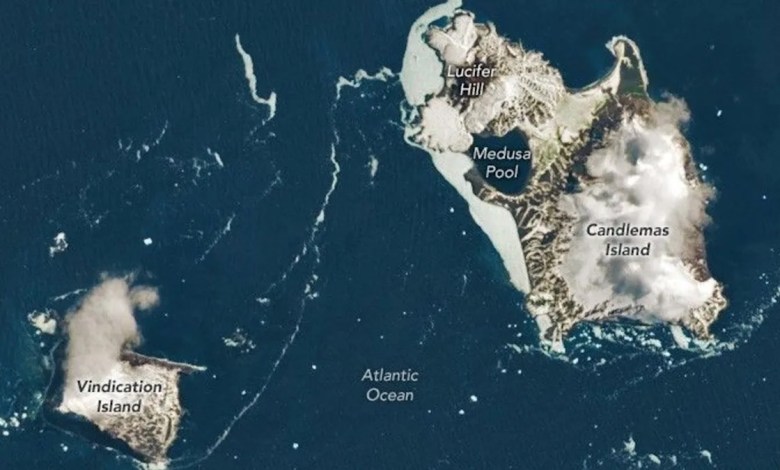
Justification and Candlemas Island are seen from space. . | Credit: NASA Earth Observatory image by Wanmei Liang, using Landsat data from the US Geological Survey.
Far from shipping lanes, cities, and even most scientific outposts lie the South Sandwich Islands, one of the most isolated island chains on the planet. Stretching in a thin arc across the stormy South Atlantic Ocean, these islands lie more than 994 miles (1,600 kilometers) from South and South America. Antarctic. In this satellite image, puffs of low-level clouds drift over Vindication and Candlemas Islands, two of the South Sandwich Islandsblending with rugged volcanic terrain and icy shores. The image was captured by the Operational Land Imager-2 (OLI-2) instrument aboard the Earth observation satellite. Landsat9a collaboration between NASA and the US Geological Survey.
Such scenes are rare in satellite records from this region, where clouds often obscure the surface.
What is this?
Since Captain James Cook first reported two islands close together in 1775 – later named Chandeleur and Vindication – the region remained largely inaccessible. Persistent cloud cover, rough seas and extreme weather conditions make direct observation rare. Therefore, satellites have become the primary way scientists study these islands, monitoring volcanic activity, glaciation, erosion and atmospheric behavior in one of the most undisturbed environments on Earth.
With fewer clouds, the satellite was able to observe some features of Candlemas Island, including Lucifer Hill and Medusa Pool.
Where is he?
The image was taken over the Chandeleur and Vindication islands in the South Atlantic Ocean.

These two islands are difficult to access and experts rely on satellite technology to study them. | Credit: NASA Earth Observatory image by Wanmei Liang, using Landsat data from the US Geological Survey.
Why is this amazing?
Using satellite images like this, scientists can understand how volcanic islands evolve in extreme climates. Candlemas Island itself began as two separate islands that merged centuries ago. Its southeastern part is an older, heavily eroded stratovolcano, now covered in ice, while its northwest side is home to younger lava flows radiating from cinder cones like Lucifer Hill. Historical accounts describe eruptions and steam clouds as recently as the 20th century, suggesting that volcanic heat and glacial ice have long coexisted here in tension.
The image also highlights the dominant role of erosion. Vindication Island shows no evidence of recent volcanism. Instead, steep cliffs and reduced surface area bear witness to the power of waves, freezing temperatures and storms, forces that slowly dismantle volcanic edifices once the tectonic energy subsides.
The clouds themselves are also part of the story. The South Sandwich Islands are renowned for producing striking wave clouds, created when strong winds are pushed upwards by steep terrain. These atmospheric patterns, sometimes visible from space, provide insight into air flow and stability in remote ocean environments, data useful for weather and climate studies.

The image shows the temperature difference between the top and bottom of a hurricane.

The images reveal the incredible power of the storm and offer essential information about the formation of these hurricanes.

A powerful geomagnetic storm recently created a series of brilliant auroras for observers across North America.
Want to know more?
You can learn more about Earth observation satellites And climate change.


