NASA says it’s a ‘go’ for fresh Artemis II moon launch attempt but admits risks remain


March 12, 2026
3 min reading
 Add us on GoogleAdd SciAm
NASA says teams are ready to cool down Artemis II attempt to launch to the Moon but admits risks remain
NASA plans to relaunch its lunar mission rocket later this month, with a target launch date of April 1.
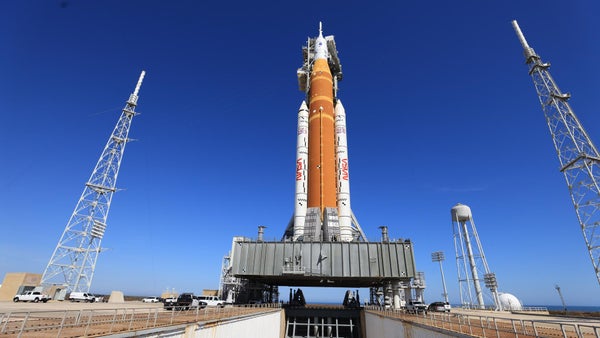
NASA is working on launching its Artemis II mission to the Moon as early as April 1, Lori Glaze, one of the agency’s acting associate administrators, said at a news conference Thursday. The mission has been delayed several times, including twice already this year, the latest due to a safety issue with the rocket.
“I’m comfortable and the agency is comfortable with targeting April 1 as our first opportunity,” she said, noting that the date is subject to change depending on the amount of work needed to prepare the spacecraft for flight. “As always, we will always be guided by what the hardware tells us, and we will launch when we are ready.”
Artemis II will carry four astronauts – NASA’s Christina Koch, Reid Wiseman and Victor Glover, as well as Canadian astronaut Jeremy Hansen – on a record-breaking trip around the Moon. Launched into space by the Space Launch System (SLS) rocket, NASA’s Orion capsule will take these astronauts further from Earth than any human has before.
On supporting science journalism
If you enjoy this article, please consider supporting our award-winning journalism by subscription. By purchasing a subscription, you are helping to ensure the future of impactful stories about the discoveries and ideas shaping our world today.
NASA officials at the conference stressed that astronaut safety guided their decisions. But John Honeycutt, chairman of the Artemis II mission management team, admitted that the data indicates that the likelihood of Artemis II going exactly as planned is just a little better than a coin toss.
“If you look at the data over time, over the lifespan of building new rockets, the data will show you that one out of every two rockets is successful. You’re only successful 50 percent of the time,” Honeycutt said. “I think we’re in a much better position than that.”
Astronaut safety was at the heart of a recent Office of Inspector General report released last week, which found that NASA could still improve risk reduction in its ambitions to return humans to the Moon using the Human Landing System (the agency’s plan to move astronauts from the lunar surface to orbit) and particularly for crew survival.
Glaze and Honeycutt pointed out that Artemis II will do something no other mission has done before – and that brings unknown risks.
If NASA is heading for liftoff on April 1, the target time is 6:24 p.m. EDT, Glaze said. If that fails for some reason, the agency could also target an April 2 launch at 7:22 p.m. EDT, she added. This addition means the agency will have a total of six potential launch dates in early April. Glaze also said the agency would likely not attempt another “dress rehearsal” — a critical test for launch readiness that involves filling the rocket with fuel and repeating the countdown that in the past has raised many problems with Artemis II.
NASA’s next mission has encountered numerous problems, ranging from hardware problems to schedule delays to budget overruns. Last month, NASA canceled the rocket’s March launch date and moved it from the launch pad after the SLS experienced helium flow problems during a wet dress rehearsal. It had already experienced hydrogen leaks and other problems in an earlier wet dress that had already caused its launch target to slip once this year. Similar problems delayed its predecessor, Artemis I, by several months.
Shawn Quinn, NASA’s Exploration Ground Systems program manager, said the helium problem stemmed from a seal blocking the flow of helium and that it had been fixed. Artemis II it will likely return to the launch pad at Cape Canaveral, Fla., by March 19, he added.
And all these delays have compounded the agency’s plans to return astronauts to the Moon. Last month, NASA Administrator Jared Isaacman announced that Artemis III, initially envisioned as a crewed moon landing, would in reality be limited to another trip into orbit. The agency is now targeting 2028 and Artemis IV landing astronauts on the Moon for the first time in over half a century.
It’s time to defend science
If you enjoyed this article, I would like to ask for your support. Scientific American has been defending science and industry for 180 years, and we are currently experiencing perhaps the most critical moment in these two centuries of history.
I was a Scientific American subscriber since the age of 12, and it helped shape the way I see the world. SciAm always educates and delights me, and inspires a sense of respect for our vast and beautiful universe. I hope this is the case for you too.
If you subscribe to Scientific Americanyou help ensure our coverage centers on meaningful research and discoveries; that we have the resources to account for decisions that threaten laboratories across the United States; and that we support budding and working scientists at a time when the value of science itself too often goes unrecognized.
In exchange, you receive essential information, captivating podcasts, brilliant infographics, newsletters not to be missed, unmissable videos, stimulating games and the best writings and reports from the scientific world. You can even offer a subscription to someone.
There has never been a more important time for us to stand up and show why science matters. I hope you will support us in this mission.


