NASA to push ahead with ‘wet’ dress rehearsal for Artemis II moon mission


January 27, 2026
2 min reading
 Add us on GoogleAdd SciAm
NASA continues its “wet” dress rehearsal for Artemis II lunar mission
A crucial test of NASA’s next crewed flight to the Moon is expected to take place as early as Saturday, the agency said.
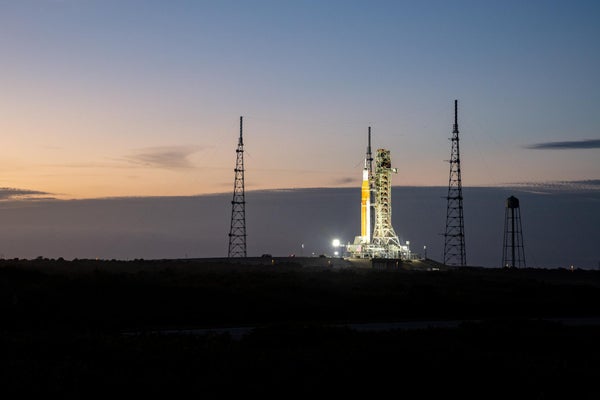
from NASA Artemis II The Space Launch System (SLS) rocket and Orion spacecraft are illuminated by lights at Launch Complex 39B on January 17, 2026, at NASA’s Kennedy Space Center in Florida.
NASA prepares for launch Artemis II, the agency’s highly anticipated first crewed mission to the Moon in more than half a century. A crucial step is Artemis IIThe “wet” dress rehearsal for , a major test of the Space Launch System (SLS) rocket and the Orion capsule that will house the mission’s four astronauts. At Florida’s Kennedy Space Center, engineers will attempt to fuel the rocket and simulate a countdown to its launch as early as Jan. 31, the agency said in an update Monday.
If all goes well, the agency’s plan to launch four astronauts around the Moon and back to Earth will continue, with a launch date as early as the first week of February.
The dress rehearsal will see NASA technicians load the uncrewed spacecraft rocket with more than 700,000 gallons of cryogenic fuel, specifically liquid oxygen and liquid hydrogen, before beginning a countdown to launch.
On supporting science journalism
If you enjoy this article, please consider supporting our award-winning journalism by subscription. By purchasing a subscription, you are helping to ensure the future of impactful stories about the discoveries and ideas shaping our world today.
The test could, however, result in the SLS and Orion being removed from the launch pad for additional DIY work. That’s what happened in 2022, when the uncrewed Artemis I mission caused multiple liquid hydrogen leaks on the launch pad and during testing – a recurring problem that significantly delayed its launch.
Apart Artemis IIAs the wet dress rehearsal approaches, NASA is also testing the water systems aboard Orion to ensure its water is safe to drink. “Early samples showed higher levels of total organic carbon than expected,” the agency said in the same update Monday. Authorities also made adjustments to the parking area’s emergency exit system. The system is made up of a series of gondola-shaped baskets intended to transport the crew and launch pad personnel to safety, in the event of a problem.
Weather conditions could also affect the timing of Artemis IIthe launch. Temperatures at the Space Center reached 40 degrees Fahrenheit on Tuesday, but are expected to rise through the weekend. The agency is taking steps to prepare for colder-than-usual temperatures, NASA said in the same statement.
It’s time to defend science
If you enjoyed this article, I would like to ask for your support. Scientific American has been defending science and industry for 180 years, and we are currently experiencing perhaps the most critical moment in these two centuries of history.
I was a Scientific American subscriber since the age of 12, and it helped shape the way I see the world. SciAm always educates and delights me, and inspires a sense of respect for our vast and beautiful universe. I hope this is the case for you too.
If you subscribe to Scientific Americanyou help ensure our coverage centers on meaningful research and discoveries; that we have the resources to account for decisions that threaten laboratories across the United States; and that we support budding and working scientists at a time when the value of science itself too often goes unrecognized.
In exchange, you receive essential information, captivating podcasts, brilliant infographics, newsletters not to be missed, unmissable videos, stimulating games and the best writings and reports from the scientific world. You can even offer a subscription to someone.
There has never been a more important time for us to stand up and show why science matters. I hope you will support us in this mission.


