NASA Webb Looks at Earth-Sized, Habitable-Zone Exoplanet TRAPPIST-1 e


Scientists are observing the exoplanet Trappist-1 e with the James Webb space telescope of NASA. A careful analysis of the results present so far several potential scenarios for what the atmosphere and the surface of the planet can resemble, because the scientific missions of NASA throw key bases to answer the question: “Are we alone in the universe?”
“The webb infrared instruments give us more details than we have never had access before, and the first four observations we have made of the planet E show us with which we will have to work when the rest of the information will arrive,” said the research team on space telescopes. Two scientific articles detailing the first results of the team are published in the magazine Astrophysique Letters.
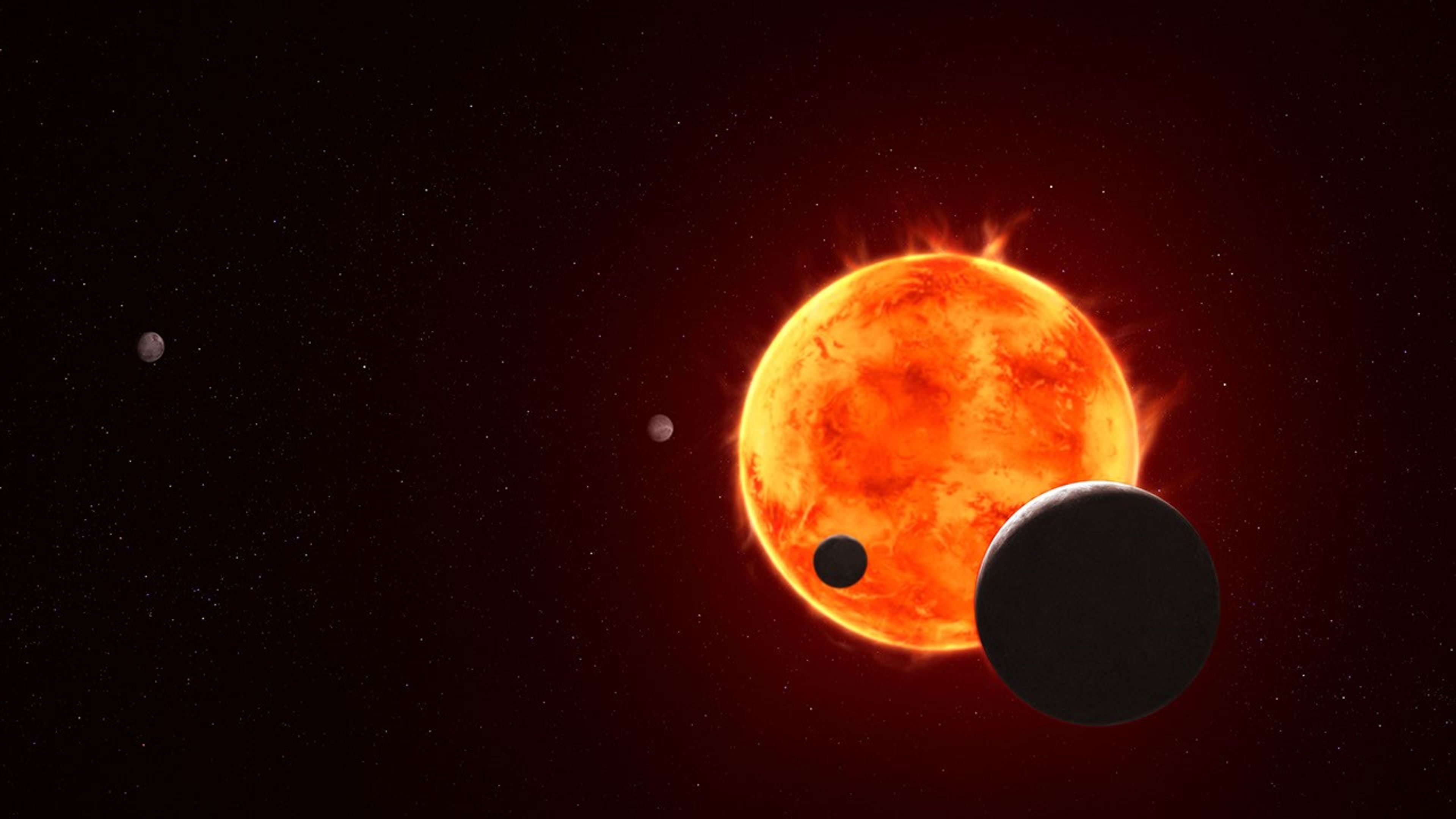
This concept of this deactivation shows the Red Volatile Dwarf Star Trappist-1 and its four most closely orbit planets, which were all observed by the James Webb space telescope of NASA. Webb found no final sign of an atmosphere around one of these worlds.
Work of art: NASA, ESA, CSA, STSCI, Joseph Olmsted (STSCI)
Among the seven worlds of the size of the earth orbiting around the Red Dwarf Star Trappist -1, the planet E is particularly interesting because it orbits the star at a distance where the water on the surface is theoretically possible – not too hot, not too cold – but only if the planet has an atmosphere. This is where webb comes into play. The researchers targeted the powerful Nirspect instrument (near infrared spectrograph) of the system during the planet and passed in front, its star. The light of the stars crossing the atmosphere of the planet, if there is one, will be partially absorbed, and the corresponding hollows of the light spectrum which will reach WebB will say to astronomers which chemicals are there. With each additional transit, atmospheric content becomes clearer as more data is collected.
Although multiple possibilities remain open to the planet E, because only four transits have been analyzed so far, researchers are convinced that the planet still has no main or original atmosphere. Trappist-1 is a very active star, with frequent rockets, it is therefore not surprising for researchers that any atmosphere of hydrogen-helium with which the planet could have been formed would have been removed by stellar radiation. However, many planets, including the earth, accumulate a heavier secondary atmosphere after losing their main atmosphere. It is possible that the planet E has never been able to do it and has no secondary atmosphere. However, the researchers say that there is an equal chance that there is an atmosphere, and the team has developed new approaches to work with webb data to determine the potential atmospheres and the surface environments of the planet E.
The researchers say that it is unlikely that the atmosphere of Trappist-13 will be dominated by carbon dioxide, analogous to the thick atmosphere of Venus and the thin atmosphere of Mars. However, researchers also take care that there are no direct parallels with our solar system.
“Trappist-1 is a star very different from our sun, and therefore the planetary system that surrounds it is also very different, which questions our observational and theoretical hypotheses,” said Nikole Lewis, deputy member of astronomy at Cornell University.
If there is liquid water on Trappist-13, the researchers say that it would be accompanied by a greenhouse effect, in which various gases, in particular carbon dioxide, keep the atmosphere stable and the planet hot.
“A small greenhouse effect goes very far,” said Lewis, and the measurements do not exclude adequate carbon dioxide to maintain water on the surface. Depending on the analysis of the team, the water could take the form of a global ocean or cover a smaller area on the planet where the star is perpetual lunch, surrounded by ice. This would be possible because, due to the size of the Trappist-1 planets and the orbits closed to their star, we think they are all locked, with a side always facing the star and a side always in darkness.

This graph compares the data collected by Nirspec de WebB (near infrared spectrograph) with IT models from Exoplanet Trappist-1 e with (blue) and without (orange) an atmosphere. Narrow strips show the most likely locations of data points for each model.
Illustration: NASA, ESA, CSA, STSCI, Joseph Olmsted (STSCI)
Espinoza and the co-prunitator Natalie Allen of Johns Hopkins University run a team that currently makes 15 additional observations from the planet E, with an innovative turn. Scientists hold the observations so that webb grabs planets B and E passing the star just after the other. After the previous webb observations on planet B, the planet in orbit around the Trappist-1, scientists are quite confident that he is a naked rock without atmosphere. This means that the signals detected during the transit of planet B can be attributed only to the star, and because the planet E transits almost at the same time, there will be fewer complications of the variability of the star. Scientists plan to compare the data of the two planets, and all the indications of chemicals that appear only in the spectrum of the planet E can be attributed to its atmosphere.
“We are really in the early stages of learning the type of incredible science that we can do with webb. It is incredible to measure the details of Starlight around the planets of the size of the earth at 40 light years and to learn what it could be, if life could be possible there, “said Ana Glidden, a post-doctoral researcher at Massachetts Institute of Technology for the Plate for Astromy E. “We are in a new era of exploration which is very exciting to be a part,” she said.
The four Transits of Trappist-13 analyzed in the new articles published today were collected by the dreams of the team of scientists of the JWST telescope (deep recognition of exoplanet atmospheres using multi-instrument spectroscopy).
The James Webb space telescope is the world’s leading world science observatory. Webb solves mysteries in our solar system, looking beyond the distant worlds around other stars, and probe the mysterious structures and origins of our universe and our place. Webb is an international program led by NASA with its partners, ESA (European Space Agency) and CSA (Canadian Space Agency).
To find out more on webb, visit:
https://science.nasa.gov/webb
Webb blog: Recognition of potentially habitable worlds with NASA webb
Video: How to study exoplanets
Video: How do we learn on the atmosphere of a planet?
See more On exoplanets
No more webb news
More webb images
Webb scientific themes
Webb mission page
What is the webb telescope?
Espople for children
EN ESPAñol
Ciencia de la Nasa
NASA in Español
Place de l’Espace Para Niños


