
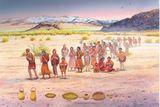
The Uspallata Valley in modern-day Argentina was an outlier in South America. The area at the southern tip of the Andes adopted farming practices much later than other regions. A new study in Nature has revealed the region’s history over 2,000 years using a variety of analytical techniques.
The study’s findings reveal much about how ancient communities relied on kinship and social support to survive amid a harsh climate and large-scale migrations.
A long-standing debate in the study of human history is how agriculture became practiced so widely across the globe. Did migrating farmers spread their practices, or did hunter-gatherer communities switch to agriculture via cultural transmission?
Read More: By Taming South American Floodwaters, Neolithic Farmers Engineered Stable Community
Studying Ancient DNA
The new analysis of Uspallata involved ancient DNA from 46 individuals who lived in the area, including hunter-gatherers and farmers. Even though the hunter-gatherers lived more than 1,000 years before some of the farmers analyzed, the two groups had remarkably similar genomes. Some of the genetics have been preserved to the present day.
“The persistence of this ancestral genetic component in populations today has important implications, since it argues against narratives claiming the extinction of indigenous descendants in the region since the establishment and growth of the Argentine state-nation,” said Pierre Luisi, a geneticist at Argentina’s CONICET science agency and co-author of the new study, in a statement.
The team didn’t only analyze DNA. They also examined stable isotopes, chemical signals preserved in samples such as bones and teeth. These signals can reveal details about what a person who lived long ago ate and the area where they lived.
Adopting Farming Practices
In Uspallata, maize consumption varied over time. This suggests that communities in the area didn’t throw themselves into farming practices, but flexibly adopted them when needed. But this wasn’t the case in samples taken from a cemetery called Potrero Las Colonias. This data showed that a group of people who lived in the area between 600 and 800 years ago were heavily reliant on maize. Further chemical analysis suggested members of the group were migrants to the area. Who were they?
Analysis showed that these migrants had a difficult life in Uspallata. Their bones showed marks of nutritional stress and tuberculosis, and their population declined over generations. Many of the migrants were closely related, but were buried at different times, suggesting that migration into the area was sustained and transgenerational. There’s no evidence that the migrants died violently, and locals and migrants were even found buried together, suggesting good relations between the groups.
The authors say their findings suggest the migrants were forced to migrate during a climatically unstable period in the area, and that their close family bonds helped them navigate the crisis.
Members of the local Huarpe community were closely involved in the research and co-authored the study.
“Archaeology and paleogenomics are not neutral when they involve the ancestors of living people,” said Nicolás Rascovan, a paleogenomicist at Institut Pasteur and study co-author, in a statement. “Working with communities changes how we do science: it shapes the questions we ask, how we interpret evidence, and how we communicate what we can — and cannot — conclude.”
Read More: Early Farming Societies Forged Bonds with Ancient Dogs in the Americas
Article Sources
Our writers at Discovermagazine.com use peer-reviewed studies and high-quality sources for our articles, and our editors review for scientific accuracy and editorial standards. Review the sources used below for this article:


