Food banks are getting into the carbon credit business


Eight to 10% of global greenhouse gas emissions come from food wasted somewhere throughout his farm trip to the table. When this biological waste is found in a discharge, it issues methaneA powerful greenhouse gases, such as it decomposes slowly.
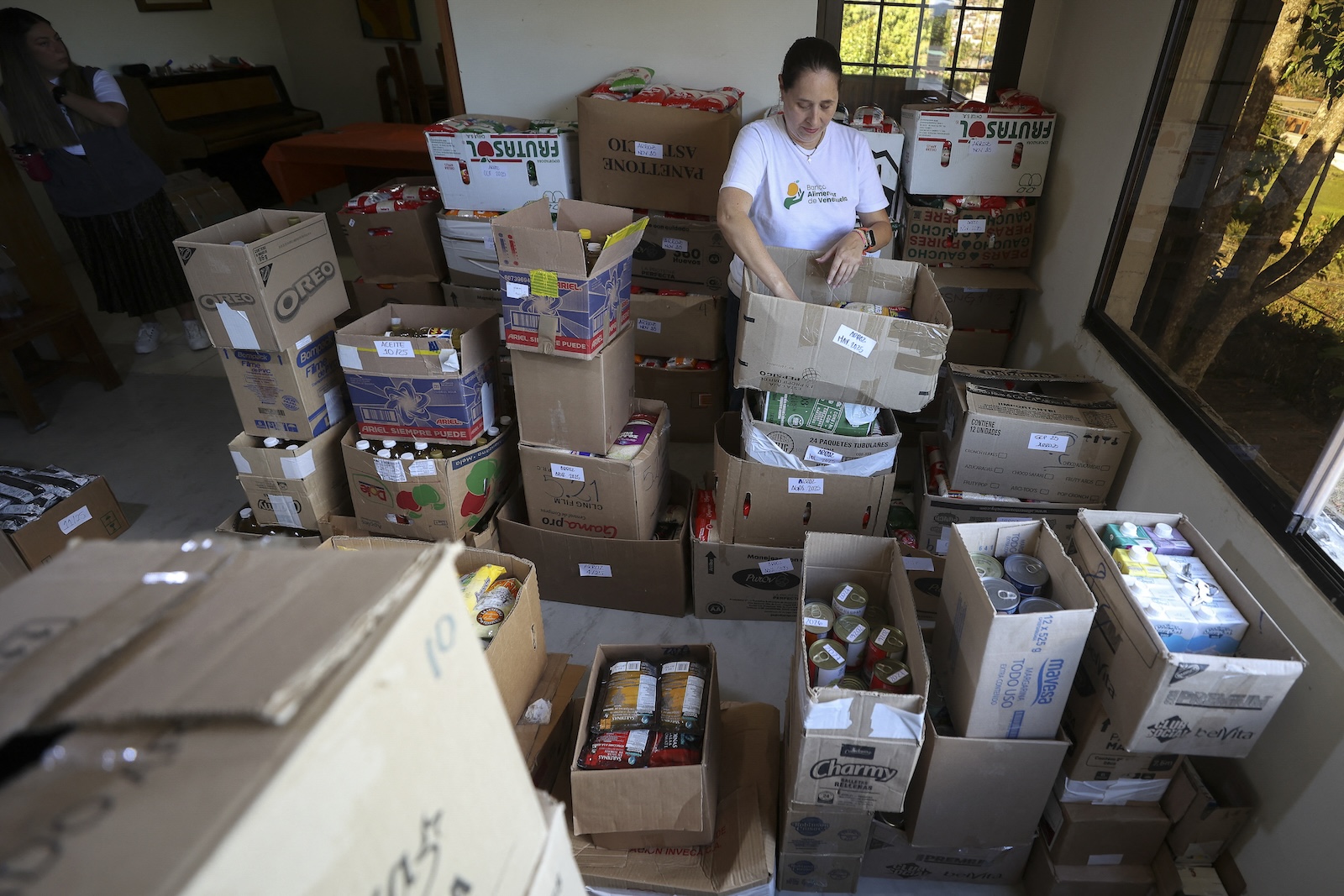
Food banks can help prevent food waste from occurring, saving unsold food from grocers and retailers and redistributing it to families and individuals in need. Now, a small number of food banks worldwide have recently started to follow their operations and quantify the number of emissions they avoid – in order to use this data to better help decaruration efforts, as well as to sell carbon credits.
These carbon credits could help open new ways to collect food banks at a time when other sources of funding, such as the foreign aid of the wealthy to developing countries, are threatened, according to the Global Foodbanking Network, or GFN. The non -profit organization has piloted this carbon credit program in Mexico and Ecuador and works to bring food banks to 12 other countries on board.
But the carbon markets where such credits are exchanged have been strongly criticized for creeping fraud; The hardest critics say that the purchase of credits representing programs avoided is equivalent to greenwashing emissions. The deployment of the GFN program to calculate the carbon footprint of food banks raises the question of whether non -profit organizations with social and environmental missions should use these controversial accounting instruments to stay afloat and continue their impact.
Carbon markets are marketed as a means for major polluters (think: airlines, large companies, even national governments) to minimize their impact on the environment without fundamentally changing their functioning. In theory, buyers can emit carbon in the atmosphere, then buy credits – which represent emission reductions – to compensate for this, allowing them to claim that their operations are neutral carbon.
The problem is that, without standards and rigorous verification to show that credits represent additional and permanent cuts in emissions, the analysis has shown that most of these credits are essentially devoid of meaning. Among other problems, sellers and certification organizations have struggled to comply with the standard of additionality by proving that if a buyer had not bought the credits, the reduction of emissions would not have occurred.
Socially motivated non -profit organizations concerned with the environment have experienced the sale of carbon credits. For example, conservation programs have long been compensation on carbon markets based on the idea that ecosystems protected by sequestration emissions, said Khaled Diab, communications director at Carbon Market Watch, a non -profit surveillance organization that studies various carbon programs. These groups may be victims of overestimating how their work reduces emissions: for example, a Bloomberg survey in 2020 on the preservancy forest carbon credits have revealed that many of its emission discounts were probably praise. The Conservancy nature has not stopped selling credits, but launched an examination of its own practices and canceled a project that the organization declared did not meet its newly developed internal criteria.

Andrew Lichtenstein / Corbis via Getty Images
In April, Carbon Market Watch published a report on programs that give gas or electric stoves to families in poor countries that would otherwise cut and burn wood to cook food. These programs have sold carbon credits according to the reduction of emissions from families who went from burning wood to the use of a cleaner source of fuel. “We have found that the climate impact is significantly overestimated,” said Diab, partly due to the hypotheses of the programs made when the emissions are measured.
In the process of developing food recovery to avoid methane emissions, or manager, the methodology, GFN was aware of these problems, said Ana Catalina Suarez Peña, head of strategy and innovation for the organization.
“All scandals around carbon voluntary markets are associated with the rigor of surveillance, report and verification schemes” that underlie them, she said. If carbon credit sales are increasing and global temperatures also continue to increase, then “something is not correct,” said Suarez Peña.
Thus, when GFN was looking for how to quantify the number of emissions it saves by diverting food for discharges, the organization focused on “what we point out is real,” said Suarez Peña. The methodology is in the process of being certified by the OR stallion, an organization of the display which checks the credits sold via carbon voluntary markets, according to GFN.
This involved becoming precise on what matters as a program avoided. In this case, participating food banks compare the emissions they run by transporting rescued food, refrigerating them and potentially losing edible food to deterioration in a scenario where grocers and retailers have their food in a way that does not end up nourishing people.
The methodology of the framework only looks at the food intended for human consumption which would arrive differently with one of these destinations but which is then diverted by the food banks and given to the people who eat it. It also looks only on the foods given to food banks, rather than purchased by them.
But some experts say that this framework is imperfect. On the one hand, this assumes that if the stores do not give the remains of food, then the food will inevitably end up waste, said Marc Roston, principal researcher at the Stanford Doerr School of Sustainability. This ignores a scenario where stores could get rid of food left by selling it at a reduced price – perhaps even directly at the food bank. “The food bank buys food at low cost: no credits. The grocery store gives food to the food bank: credits issued. It is not a good carbon accounting, “said Roston.
Pedro Mattey / AFP via Getty Images
In order for carbon credits to represent a legitimate discrepancy in emissions, they must also reflect new or additional work to reduce climate pollution. The idea is that by selling credits, organizations can prevent even more carbon emissions than they would prevent it before. GFN’s food banks have long diverted food at risk of being wasted – but according to GFN, its carbon credits program represents additional work in the sense that the funds generated by selling credits allow food banks to expand their ability to save food. Suarez Peña said that members’ food banks ensure that they capture specific data by following the emissions linked to real -time operations and submitting quarterly reports to GFN.
Most food banks within GFN operate with a budget of $ 1 million or less, depending on the organization – which means that even relatively low funding losses can have a significant impact on its ability to remain open. While the Trump administration retracts billions of dollars in foreign aid in the United States, European countries also reconcile the amount of money they spend abroad. This means that food banks in the world South, whose budgets generally depend on receiving the financing of richer nations, are newly interested in exploring other sources of financing.
The Mexican Food Banking Network, or BAMX, which previously sold carbon credits under a separate methodology, participated in the pilot to test the frame system. Asked about what Bamx learned from the experience, the head of Bamx Mariana Jiménez said in an interview in Spanish that the organization had a greater awareness of its environmental impact. According to Suarez Peña, the Food Bank of Quito, in Ecuador, which participated in the Frame Pilot used the data it has collected to have conversations with representatives of the national government on the decarbonization platform of the equator.
But criticisms like Roston argue that, unless the credits represent the real carbon withdrawn from the atmosphere – for example, by transforming the leftover food into biochar, then using biochar to store carbon – they probably do not represent real reductions in permanent emissions. “I think there are probably better financial tools to finance food banks than carbon voluntary markets,” said Diab, Carbon Market Watch.
Suarez Peña, however, sees the value of food banks auditing their own operations and sharing this data extending far beyond the carbon markets. “I think that in the years to come, having better, precise and robust data will be the way to demonstrate how everyone contributes to climatic targets,” she said. While countries are preparing to report on their climatic progress at the United Nations Annual Climate Summit later this year, data on food waste will be extremely precious, she argued-even if the accounting methods of most countries do not yet make the link between food waste and emissions. Suarez Peña hopes that food banks can help “connect both in a single conversation”.


