Nearly half of L.A County’s pavement may be unnecessary, new map finds

Los Angeles is often described as a concrete jungle, a city shaped by asphalt, parking lots and other harsh landscapes. Now, for the first time, researchers have mapped this concrete in detail, and they say much of it doesn’t need to be there.
A new analysis finds that about 44 percent of Los Angeles County’s 312,000 acres of roadway may not be essential for roads, sidewalks or parking, and could be reconsidered.
The report, DepaveLA, is the first parcel-level analysis to map all paved surfaces in Los Angeles County and distinguish between streets, sidewalks, private properties and other areas. The researchers divided all roadways into “core” and “non-core” uses. A street, for example, is central. They then combined this map with data on heat, flooding and tree cover, creating what they intend to be a new framework for understanding where removing concrete and asphalt could make the biggest difference to people’s health and the climate.

Principal Brad Rumble visits an area where students are restoring natural habitat at Esperanza Elementary School.
(Allen J. Schaben / Los Angeles Times)
Paved surfaces become warmer than those with plantings, absorbing and radiating the sun’s energy rather than converting it to plant growth, which creates shade. Warmer areas also create more ozone smog. Greener areas are also known to bring psychological relief to people.
The authors are the nonprofit Accelerate Resilience LA, founded by Andy Lipkis, who also founded TreePeople, the Los Angeles tree planting organization, and Hyphae Design Laboratory, a nonprofit that works to bridge health and the built environment.
What surprised them most, said Hyphae founder Brent Bucknum, was seeing where the roadway was concentrated. Nearly 70 percent of what they consider nonessential roadways are on private property.
Rather than radically removing the roadway, the report highlights small changes that could add up.
The most potential they found was in parking areas, particularly on large private commercial and industrial lots. Redesigning 90-degree parking to angled parking could remove up to 1,600 acres, creating space for trees and stormwater capture, without reducing the number of parking spaces.
Parking lots, Bucknum said, are one of the clearest examples of how excess pavement has become accepted, even as it makes residents’ daily lives worse.

Aerial view of the hardscpe area inside Pershing Square in Los Angeles.
(Allen J. Schaben/Los Angeles Times)
“I’m often amazed: I go into a parking lot and there’s traffic beeping, bumper to bumper, you’re in this sweltering heat trying to get out of the grocery store,” he said. “And the reality is we can make it much nicer with more thoughtful design.”
Ben Stapleton, executive director of the U.S. Green Building Council California, pointed to parking requirements that have long tied the number of spaces to the size and use of a building.
“The natural solution was to just asphalt things, because it’s cheaper, it requires less maintenance,” he said. “It’s not very expensive, especially asphalt.”
Residential real estate, including apartment complexes, is another place with potential.
If every residential parcel dug a 6-by-6-foot tree well in its patio, Bucknum said, that would amount to 1,530 acres of sidewalk removed, while only reducing patio space by an average of 3 percent.
Emily Tyrer, director of green infrastructure at TreePeople, said pavement is growing in residential yards.
“What we’re seeing is that a lot of residential lots are becoming more paved and less grassed,” she said. “Rather than replacing it with shade trees, native plantings and water-efficient plants, they pay.”
In many cases, she said, homeowners are responding to messages of drought and rising water costs.

A person walks her dog past native plants and flowers planted along the Merced Avenue Greenway in South El Monte, where she is rethinking how urban infrastructure can simultaneously serve pedestrians, cyclists and motorists while providing critical environmental benefits.
(Allen J. Schaben/Los Angeles Times)
“Paving actually reduces water usage and can reduce people’s water bills,” Tyrer said. “But that involves compromises.”
The report also identifies schools as places where there could be less concrete or asphalt. On average, Los Angeles County school campuses are approximately 40% covered with pavement, leaving students exposed to extreme heat.
At Esperanza Elementary School near downtown Los Angeles, the campus was “just a sea of asphalt,” said Tori Kjer, executive director of the Los Angeles Neighborhood Land Trust, which is overseeing the school’s transformation. The children ran on asphalt roads that could reach more than 120 degrees in hot weather.
It will soon feature new California native plants and shade trees, stormwater catchment features, a grassy lawn, natural play features, outdoor classrooms and much more.
Many school families live in small apartments.
“People don’t have open space,” Kjer said. “They leave their homes and basically end up on concrete streets and sidewalks.” Once the asphalt is removed, the trees planted and the rainwater drained, it will be a “place for quiet, imaginative play and active play.”
The idea for the Depave report came from years of work on tree planting and green infrastructure projects that repeatedly ran into the same obstacles.

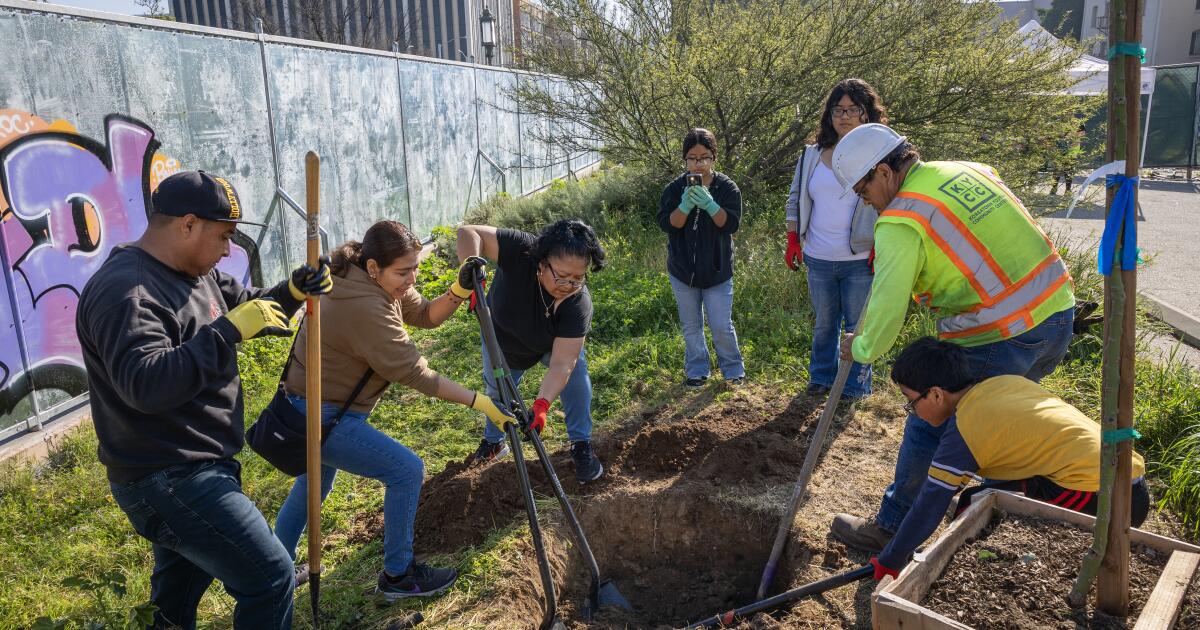
Installation of natural landscaping is currently underway at Esperanza Elementary School in Los Angeles.
(Allen J. Schaben / Los Angeles Times)
On project after project, the roadway emerged as the central problem, according to Bucknum. “We were trying to plant trees, but a lot of the city is paved and there was nowhere to put them,” he said.
The team realized they needed better data to understand the problem, at the block and neighborhood scale. Something more sophisticated than what the sidewalk is and what the trees are.
“This is a first step,” said Devon Provo, senior manager of program planning and alignment at Accelerate Resilience LA. “This is an opportunity assessment, not a prescriptive plan for what should be 100% removed.”
Olivier Sommerhalder, global head of sustainability at design and planning firm Gensler, pointed out that companies that have shelled out money to build something would need an edge to replace it.
“There is no incentive for landowners to reduce hard development,” Sommerhalder said. “The municipality does not encourage the elimination of parking to alleviate urban heat hotspots. »
Sommerhalder said sustainability is increasingly part of design conversations with clients, particularly when tenants ask about comfort and environmental performance. But without political or financial incentives, he said, surface parking often remains untouched until redevelopment.

This innovative 1.1-mile greenway in south El Monte not only provides safe and accessible trails for walking and biking, but also provides a sustainable approach to managing stormwater, restoring habitats and reducing urban heat.
(Allen J. Schaben / Los Angeles Times)
As for what an incentive might look like, “we think a really good analogy is the lawn replacement program,” Bucknum said, referring to the rebate programs that helped move Southern California away from water-intensive turf. “People didn’t know there were other options until there was education and financial support.”
It’s important to consider what’s under the sidewalk, said Carlos Moran, executive director of North East Trees, especially in areas with an industrial past.
In some neighborhoods, he said, the roadway covers contaminated soil that cannot be safely disturbed. “We can’t just rip it out.”
But he acknowledged there was too much sidewalk. “The hottest neighborhoods in Los Angeles aren’t just lacking trees,” he said. “They’re covered in asphalt.”
The goal of the report, Provo said, is to give Angelenos and policymakers a common starting point for the conversation.
“This data is relevant to anyone who wants to have a say in reimagining the future of Los Angeles to be cooler, healthier and more vibrant,” Provo said.
“I hope this will open the eyes of people who are building projects who may have never thought of the roadway in this way,” Stapleton said. “Once you learn something, you don’t unlearn it.”
By reframing pavement as a design choice rather than a default choice, Stapleton believes the analysis could prompt developers and property owners to rethink how much concrete their projects actually need and what they could gain by replacing it.


