Nebra Sky Disc: The world’s oldest depiction of astronomical phenomena — and it may depict the Pleiades


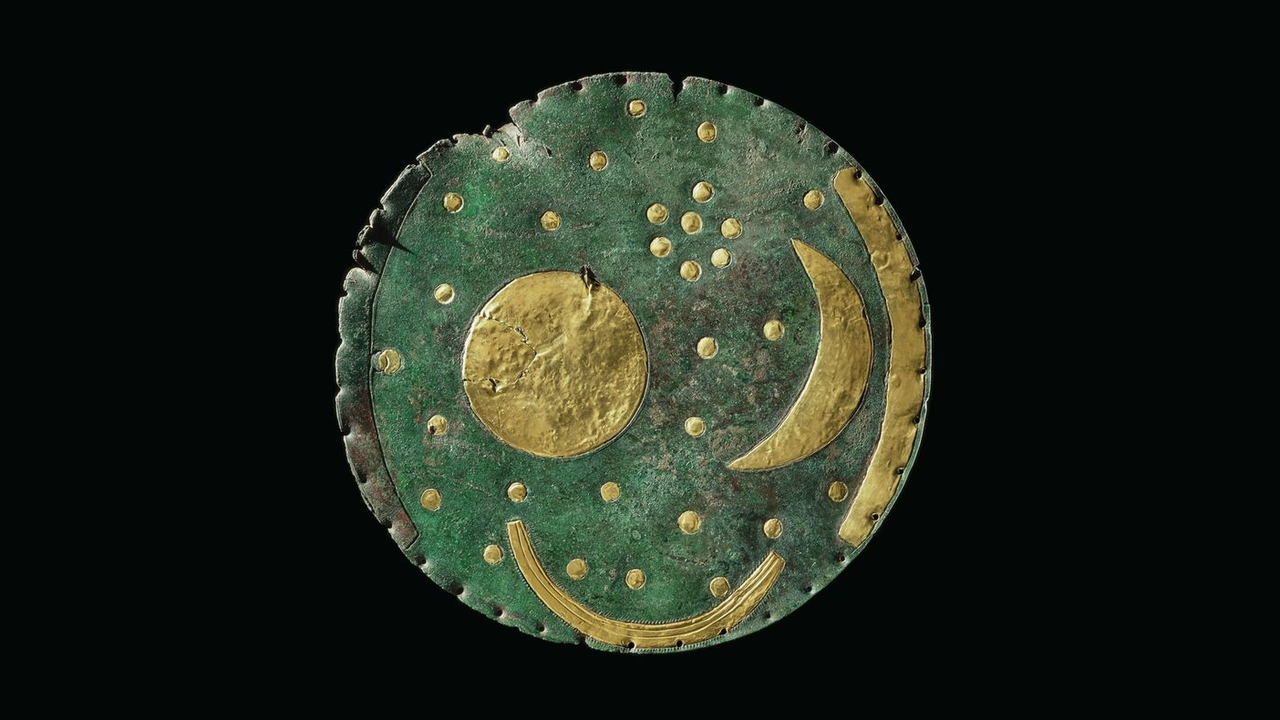
QUICK FACTS
Name: Nebra Sky Disc
What is this : A bronze disc with gold accents
Where does it come from: Nebra, Germany
When it was made: Around 1800 to 1600 BC
The Nebra Sky Disc was discovered in a trove of artifacts in 1999, when metal detectors illegally unearthed it from an ancient religious site on a hill near Nebra, a town in the German state of Saxony-Anhalt. After police recovered the disk in 2002, archaeologists studied the unique object, revealing it to be up to 3,800 years old and the world’s oldest depiction of astronomical phenomena. (The next oldest is a star map on the ceiling of an ancient Egyptian tomb from about 3,500 years ago.)
Based on the style of the axes and the carbon-14 dating of the wood of the sword hilts recovered with the disk of the metal treasurethink the experts the Sky Disc was buried around 1600 BC, at the beginning of the Bronze Age, but it may have been created two centuries earlier.
Some research has questioned the authenticity of the discsaying it probably did not come from Nebra and was about 1,000 years younger, based on soil and chemical analysis of the artifact. A later study refuted these claims and found that the the disc was authentic and from Nebra but that it was done in several stages.
Close examination of the disc revealed that it was made in at least five phases. Initially, the bronze disk included the full moon or sun, the crescent moon and 32 stars. Then two arcs were placed on either side of the disk. A third arch, perhaps representing a boat, was then added to the bottom. During the fourth phase, the edge of the disk was perforated, suggesting that it may have been attached to a support, such as a ceremonial pole. Eventually the left bow was removed before the disk was buried with the metal treasure. But experts don’t know exactly when the disk was made or how much time passed between decoration phases.
The Nebra Sky Disc appears to depict the night sky, with several stars forming the Pleiadesor “Seven Sisters”, star clusters. The golden arcs on either side of the disk may represent the horizons, marking the summer and winter solstices, and the boat may be a mythical boat that carried the sun across the sky from east to west during the day and night.
By aligning the Sky Disc with the Mittelberg hill plateau, where it was foundthe arc of the western horizon aligns with the Brocken, a high mountain behind which the sun disappears into the horizon. summer solstice. This suggests that the Sky Disc may have been used to track important astronomical dates in prehistory.
MORE AMAZING ARTIFACTS
But who used the Sky Disc and who buried it remains a mystery, in part because it was recovered by treasure hunters and not during a scientific dig. Treasure hunters damaged the golden sun or full moon, scratched the surface and cleaned it poorly. However, given the many well-furnished burial mounds of important people that dotted the landscape of central Germany as early as 2000 BC, the celestial disk may once have belonged to a Bronze Age leader.
For more stunning archaeological discoveries, check out our Amazing artifacts archives.


