Neuroscientists Identify Five Major Epochs of Brain Structure over Course of Human Life


Neuroscientists have detected five major phases of brain structure in the average human life, divided into four crucial turning points between birth and death as our brains reconfigure themselves. The topology of the childhood brain extends from birth until a turning point at age nine, when it transitions into the adolescent phase – an era that lasts until the age of 32 on average. In your early 30s, the brain’s neural wiring shifts into adult mode; this is the longest period, lasting more than three decades. A third turning point around age 66 marks the start of a phase of early aging of brain architecture. Finally, the late-aging brain takes shape around age 83.
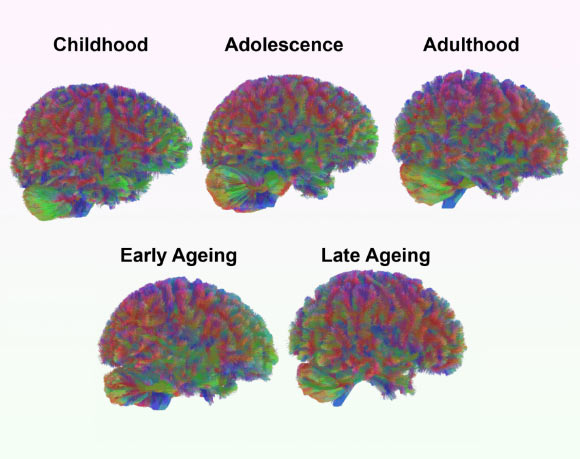
Mousley and others. compared the brains of 3,802 people ages zero to ninety using diffusion MRI datasets, which map neuronal connections by tracking how water molecules move through brain tissue. Image credit: Mousley and others., doi: 10.1038/s41467-025-65974-8.
“We know that the brain’s wiring is crucial for our development, but we don’t have a comprehensive idea of how it changes over the course of our lives and why,” said Dr Alexa Mousley, a researcher at the University of Cambridge.
“This study is the first to identify the main phases of brain wiring throughout the human lifespan.”
“These eras provide important context for what our brains might be best or most vulnerable to at different stages of our lives.”
“This could help us understand why some brains develop differently at key times in life, whether it’s learning difficulties in childhood or dementia in our later years.”
From infancy to childhood, our brains are defined by the consolidation of networks, as the wealth of synapses – the connectors between neurons – overproduced in a baby’s brain are reduced, with the most active surviving.
Throughout the brain, connections reconnect in the same pattern from birth until around age nine.
During this time, gray matter and white matter grow rapidly in volume, so that cortical thickness – the distance between outer gray matter and inner white matter – peaks and cortical folding, the characteristic ridges of the outer brain, stabilizes.
From the first turning point, at age nine, the brain experiences a dramatic change in its cognitive capacity, as well as an increased risk of mental health disorders.
The second era of brain structure, the era of adolescence, sees white matter continue to grow in volume, so that the organization of the brain’s communication networks becomes increasingly refined, as measured by the diffusion of water in scanners.
This epoch is defined by the efficiency of connections both within specific regions as well as rapid communication throughout the brain, which is linked to improved cognitive performance.
“Neural efficiency is, as you might imagine, well connected by short pathways, and the adolescent era is the only era in which this efficiency increases,” Dr. Mousley said.
“These developments peak on average in the early thirties, which constitutes the most important topological turning point in all of life.”
“Around age 32 is when we see the most directional changes and the largest overall trajectory change, relative to all other turning points.”
“While puberty is a clear beginning, the end of adolescence is much more difficult to define scientifically.”
“Based solely on neural architecture, we found that adolescence-like changes in brain structure end around the early 30s.”
At age 32, the longest era begins, that of adulthood. Brain architecture is stabilizing compared to previous phases – without a major turning point for thirty years. This corresponds to a “plateau of intelligence and personality” based on other studies.
Researchers also found that “segregation” is more visible around this time, as regions slowly begin to become more compartmentalized.
The turning point at 66 is much gentler and is not defined by any major structural changes, although scientists have still seen significant changes in the configuration of brain networks on average around this age.
“The data suggest that a progressive reorganization of brain networks peaks in the mid-sixties,” Dr. Mousley said.
“This is likely related to aging, with connectivity further reduced as white matter begins to degenerate.”
“This is an age when people face an increased risk of developing various health problems that can affect the brain, such as hypertension.”
The final turning point occurs around age 83, and the final epoch of brain structure has entered.
Although data are limited for this era, the defining feature is a shift from global to local, as whole-brain connectivity declines further, with increased reliance on certain regions.
“Looking back, many of us feel that our lives have been characterized by different phases,” said Professor Duncan Astle of the University of Cambridge.
“It turns out that brains go through these eras, too.”
“Many neurodevelopmental, mental health and neurological conditions are linked to how the brain is wired. »
“Indeed, differences in brain wiring predict difficulties with attention, language, memory and a whole host of different behaviors.”
“Understanding that the brain’s structural journey is not a matter of constant progression, but rather one of a few major turning points, will help us identify when and how its wiring is vulnerable to disruption.”
An article describing this research was published November 25 in the journal Natural communications.
_____
A. Mousley and others. 2025. Topological turning points throughout human life. Nat Common 16, 10055; doi: 10.1038/s41467-025-65974-8


