Nevada does its bit to help boost record energy storage in 2025

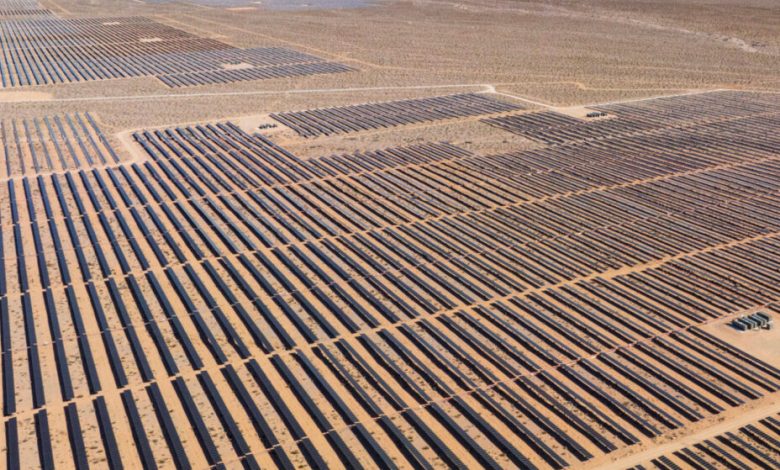

The Primergy Gemini solar/storage project helped increase Nevada’s total energy storage capacity to 6.3 gigawatt hours, fourth largest in the United States (Photo: Primergy)
Utility-scale energy storage installations and capacity reached a record high in the United States last year and are expected to grow at an even faster rate over the rest of the decade.
The energy storage industry added a record 58 gigawatt hours of new storage capacity in 2025, a 30% increase from the previous year, with strong growth in Texas and Arizona, according to a new report from the Solar Energy Industries Association.
Nevada deployed an additional 1.4 gigawatt hours of battery storage in 2025 with the completion of Primergy’s Gemini Solar project, increasing the state’s total battery capacity to more than 6.3 gigawatt hours. Nevada’s battery storage capacity now ranks fourth nationally, behind California, Texas and Arizona.
In Nevada, one gigawatt hour is enough to power about 600,000 to 750,000 homes based on typical energy consumption, according to NV Energy.
Red states have driven the growth of battery storage in the United States over the past five years, and that trend has continued into 2025. Two-thirds of all large-scale battery storage systems installed in 2025 were built in states won by President Donald Trump in the 2024 election.
Texas is on track to overtake California in 2026 as the nation’s largest energy storage market, driven by the state’s need for grid reliability amid growing data center demand.
According to the report, growth in commercial and industrial battery storage projects was largely driven by two Tesla Megapack installations at xAI’s Colossus facility in Memphis, Tennessee. The project is an example of energy-hungry data centers using battery storage systems to bridge a connection to the grid.
As data centers expand in the coming years, the commercial and industrial battery storage segment is expected to reach one-fifth of all battery storage by 2030, according to the report.
By 2025, the United States had installed a total of 137 gigawatt hours of utility-scale storage, in addition to 19 gigawatt hours of commercial and industrial storage and 9 gigawatt hours of residential storage.
Analysts expect growth to accelerate. More than 600 gigawatt hours of energy storage are expected to be installed across the country by 2030, even as the Trump administration’s policies aim to foster fossil fuel development and have discouraged clean energy industries.
Utility-scale energy storage installations saw the greatest growth in Texas and Arizona in 2025, increasing 67% and 129%, respectively.
California, on the other hand, saw the deployment of large-scale energy storage installations decrease by 24% compared to 2024.
Like Nevada, New Mexico, Idaho, Oklahoma and Wisconsin have all deployed more than a gigawatt hour of battery storage in 2025, largely thanks to increased solar development.


