A Cold Earth 146 Lightyears Away Could Be Habitable


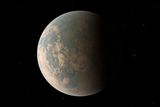
Astronomers found evidence of a potentially habitable planet and named the space rock “HD 137010 b.” It was described in Letters from the astrophysical journal.
Although it is still technically listed as a “candidate” planet, the discovery is particularly intriguing because its positioning means it could be the first Earth-like exoplanet that is both close enough and bright enough for astronomers to track in future observations.
“This is an important addition to the small sample of cool, Earth-sized exoplanets and is a small step in the search for Earth-like exoplanets around stars near the Sun,” the researchers wrote in the study.
Learn more: Strange lemon-shaped exoplanet discovered orbiting bizarre star
What do we know about the HD 137010 B?
HD 137010 b may be 146 light years from Earth, but it appears to share strange similarities with our own planet. Estimated to last 355 days, its orbital period – the number of times it takes to travel back and forth from its star – is about a year. Meanwhile, its radius is only slightly larger. According to the researchers’ calculations, this is equivalent to approximately 1.06 Earths.
There’s a catch: it might not be that hospitable. Indeed, this particular exoplanet lies at the edge of the habitable zone of its planetary system, receiving less than a third of the light that Earth receives from the Sun.
The fact that HD 137010 b’s star (an orange dwarf) is cooler and dimmer than ours (a yellow dwarf) means that its surface can reach a maximum temperature of minus 90 degrees Fahrenheit (minus 68 degrees Celsius). That’s colder than the average temperature inside Antarctica and on Mars, where the average surface temperature is minus 85 degrees Fahrenheit (68 degrees Celsius), according to the Australian Antarctic Program.
This does not completely rule out habitability. Much depends on the composition of its atmosphere. An atmosphere moderately rich in carbon dioxide could result in the formation of liquid water, while an atmosphere naturally low in carbon dioxide, like Earth’s, “could instead result in a frozen ‘snowball’ climate,” the authors write in the study.
In total, the researchers estimate that there is a 40 percent chance that it falls in a more conservative habitable zone, a 51 percent chance that it lies in an optimistic habitable zone, and about a 50 percent chance that it falls outside the habitable zone entirely.
What makes a planet habitable?
A planet can be habitable if it exists in the Goldilocks zone. This means that it is neither too cold nor too hot and can hold liquid water on its surface. It also helps to be terrestrial, like Earth, rather than gaseous, like Saturn or Jupiter.
Another factor may be the host star herself. Many believe that K dwarf stars (or orange dwarf stars) like those in the HD 137010 planetary system are more suitable for life than G dwarf stars (or yellow dwarf stars) in ours. According to NASA, their longer lifespans provide longer time frames for life to form. Plus, there are simply more of them in our galaxy.
As for the number of habitable planets, a study carried out in The astronomical journal It has been discovered that there could be as many as 300 million in the Milky Way.
What happens next for the HD 137010 b?
For now, HD 137010 b is classified as a “candidate” planet. Indeed, the evidence so far is based on a single 10-hour transit captured during Kepler’s second mission. It was detected as it passed above the surface of its host star and caused the star’s light to dim. Additional observations must take place for its status as a true exoplanet to be confirmed.
“To our knowledge, this is the smallest planet candidate detected in a single transit around a Sun-like star,” the study authors wrote. It may also be “one of the coolest Earth-sized transiting planets ever discovered orbiting a sun-like star.”
Learn more: Kepler 452b and several exoplanets are similar to Earth, but there is no exact twin
Article sources
Our Discovermagazine.com editors use peer-reviewed research and high-quality sources for our articles, and our editors review the articles for scientific accuracy and editorial standards. See the sources used below for this article:


