New experiments show Earth’s core may hold vast ‘oceans’ of an essential element for life

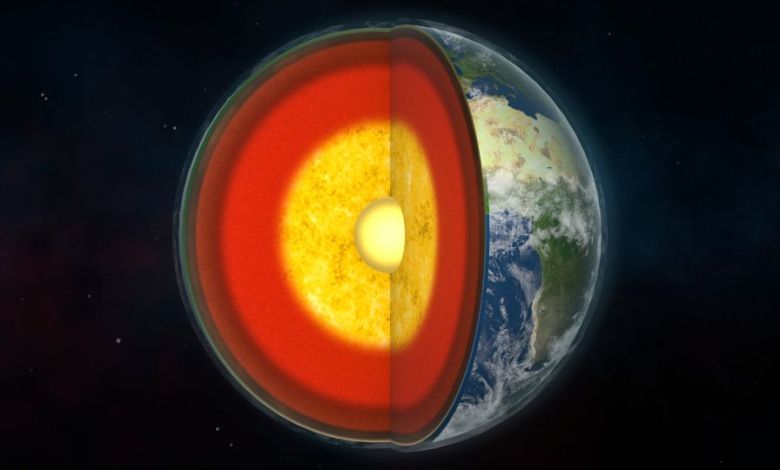
Imagine all of Earth’s oceans, which cover about 70% of the planet and are mostly made of hydrogen. Now multiply that by nine. This could be the amount of hydrogen present in the Earth’s core, making it perhaps the largest reservoir of hydrogen on the planet, researchers recently estimated.
And nine “oceans” of hydrogen constitute the bottom of the scale of their calculation; there could be up to 45 oceans of hydrogen locked in the core. In other words, hydrogen could make up about 0.36 to 0.7 percent of the total weight of the Earth’s core, scientists reported Tuesday in the journal Nature Communications. This suggests that Earth acquired most of its water — the planet’s main source of hydrogen — at the time of the planet’s formation, rather than later through comet impacts that would have left water on the planet’s surface as some scientists have suggested, said the study’s lead author, Dongyang Huang, an assistant professor at Peking University’s School of Earth and Space Sciences.
“The Earth’s core would store most of the water during the first million years of Earth’s history,” Huang told CNN in an email. The mantle and crust then come in abundance of water. “The surface – where life resides – contains the least of it,” he said.
More than 4.6 billion years ago, rocks, gas and dust around our sun collided to form a young planet. Over time, these collisions shaped the Earth’s core, mantle and crust. Deep within the Earth and under enormous pressure, a dense, hot, fluid metallic core began to stir. Composed mainly of iron and nickel, it powers the Earth’s protective magnetic field.
“Hydrogen can only enter the metallic liquid forming the core if it was available during major phases of Earth’s growth and participated in the formation of the core,” said Rajdeep Dasgupta, professor of Earth systems science in the department of Earth, environmental and planetary sciences at Rice University in Texas. Dasgupta was not involved in the new research.
The study of the origin and distribution of hydrogen is essential to understanding planetary formation and the evolution of life on Earth. Scientists have long wondered how much hydrogen might be buried in Earth’s molten metal engine and have analyzed chemical interactions in iron to try to estimate the hydrogen reservoir of the metal core. But the core is too deep for direct observation and its high pressure conditions are difficult to reproduce in the laboratory.
In general, hydrogen is difficult to quantify “because it is the lightest and smallest element, which means its quantification is beyond the capabilities of routine analytical methods,” Huang said.
The low density in the core suggested an abundance of hydrogen, although it was difficult for scientists to determine how much compared to other known elements in the core that were somewhat easier to measure, such as silicon and oxygen. Previous research has inferred the amount of hydrogen in the core by using X-ray diffraction to examine the lattice structure of iron crystals, which expands more when hydrogen is present. But these interpretations varied widely, from 10 parts per million by weight to 10,000 parts per million (or 0.1 ocean to more than 120 oceans), according to the study.
Atomic-scale observations
“The technique is fundamentally different from previous methods,” Huang said. The researchers sharpen the samples into needle-like shapes with a diameter of about 20 nanometers (0.0000007874 inches), then place them under finely controlled high voltage. Then the atoms in the samples are ionized and counted one by one, he explained.
To create this new estimate, scientists conducted experiments replicating the temperatures and pressures of the core, using iron as a substitute for the liquid metal core. They melted the iron with lasers in a high-pressure device called a diamond anvil cell, then directly observed hydrogen and other core elements using atom probe tomography, which captures 3D images and measures chemical composition on the atomic scale.
This approach relies on assumptions about how atoms are arranged in the Earth’s core and how silicon, oxygen and hydrogen disperse there, Huang explained. Their experiments revealed how hydrogen interacted with silicon and oxygen in the nanostructures as the metal cooled, with the ratio of hydrogen to silicon being approximately 1 to 1. By combining observations of these ratios in the samples with previous estimates of the core’s silicon, the researchers were then able to approximate the amount of hydrogen in the core.
Weighing uncertainties
The interaction they observed between silicon, oxygen and hydrogen in the iron nanostructures offers clues as to how heat may have been released from the core to the mantle to begin the process of building Earth’s magnetic field, “which is essential to making Earth a habitable place,” Huang said.
However, the scientists cautioned that additional work will be needed to confirm and refine this estimate, as this indirect approach includes uncertainties and does not take into account other chemical interactions that could affect core hydrogen calculations.
Indeed, the amount of hydrogen in the core could be much higher than the new estimate suggests, said Kei Hirose, a professor at the University of Tokyo’s School of Science who studies the composition of Earth’s core but was not involved in the new research.
One area of uncertainty concerns how much hydrogen in the iron samples escaped during decompression; this loss has been documented in other studies but was not included in the new calculations. Hirose’s work previously estimated that hydrogen makes up 0.2 to 0.6 percent of the weight of the Earth’s core, “more than this new paper proposes,” he told CNN in an email.
If the authors’ measurements and hypotheses prove true, “it will suggest that hydrogen was delivered throughout Earth’s growth,” Dasgupta said. Gas from nebulae as well as water from comets and asteroids may also have been a source of terrestrial hydrogen, Hirose added.
Hydrogen is an essential element for life on Earth, “along with carbon, nitrogen, oxygen, sulfur and phosphorus,” said Dasgupta, whose research focuses on the role these volatile elements played in Earth’s formation. “The new paper will certainly inform our future syntheses and discussions on this topic.”
Mindy Weisberger is a science writer and media producer whose work has appeared in Live Science, Scientific American, and How It Works magazines. She is the author of “Rise of the Zombie Bugs: The Surprising Science of Parasitic Mind-Control” (Hopkins Press).
Sign up for CNN’s Wonder Theory science newsletter. Explore the universe with information on fascinating discoveries, scientific advances and much more.
For more CNN news and newsletters, create an account at CNN.com


