New Form of Ice Discovered: Ice XXI


Scientists have demonstrated that supercompressed water transforms into VI ice at room temperature through multiple freeze-melt pathways, which occur via a previously unknown form of metastable ice, called XXI ice.
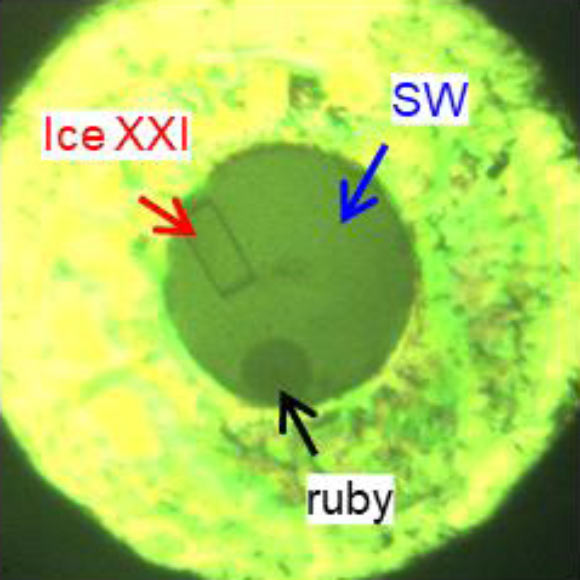
A small XXI ice crystal formed by nucleation and slow melting processes. Image credit: Lee and others., doi: 10.1038/s41563-025-02364-x.
Water, composed of only two elements, forms numerous polymorphic phases ranging from ice Ih to ice XX and four amorphous phases.
Understanding the formation and transition pathways of the various phases of water has been of interest for a century to high pressure physics and the search for life in space and on icy moons.
“Water exhibits remarkable complexity in its solid state,” said Dr. Geun Woo Lee, a researcher at the Korea Standards and Science Research Institute and the University of Science and Technology.
“The majority of phases are observed at high pressures and low temperatures.”
“The rapid compression of water allows it to remain liquid until higher pressures, where it should have already crystallized into ice VI.”
“Ice VI is a particularly intriguing phase, thought to be present inside icy moons such as Titan and Ganymede.”
“Its highly deformed structure may enable complex transition pathways leading to metastable ice phases.”
“As most ice variants only exist in extreme conditions, we created high-pressure conditions using diamond anvil cells.”
“The sample – in this case, water – is placed between two diamonds, which can be used to create very high pressure due to their hardness.”
“The water was examined at pressures of up to two gigapascals, or about 20,000 times normal atmospheric pressure.”
“This causes ice to form even at room temperature, but the molecules are much tighter than in normal ice.”
To observe ice formation under different pressure conditions, the researchers first generated a high pressure of two gigapascals in 10 milliseconds.
They then released the cell from the anvil over a period of one second and then repeated the process.
During these cycles, scientists used the European XFEL’s X-ray flashes to capture images of the sample every microsecond.
With its extremely high rate of X-ray pulses, they could make films of the formation of ice structure.
Then, using PETRA III’s P02.2 beamline, the authors determined that Ice XXI has a tetragonal crystal structure made up of surprisingly large repeating units, called unit cells.
“Using the unique X-ray pulses from the European XFEL, we discovered multiple crystallization pathways in water that was rapidly compressed and decompressed more than 1,000 times using a dynamic diamond anvil cell,” said Dr Lee.
“In this special pressure cell, samples are pressed between the tips of two opposing diamond anvils and can be compressed along a predefined pressure path,” said Dr. Cornelius Strohm, researcher at Deutsches Elektronen-Synchrotron.
“The structure in which liquid water crystallizes depends on the degree to which the liquid is overcompressed,” Dr. Lee said.
“Our results suggest that there may be a larger number of high-temperature metastable ice phases and their associated transition pathways, potentially offering new insights into the composition of icy moons,” said Dr Rachel Husband, also from Deutsches Elektronen-Synchrotron.
The results were published October 10 in the journal Natural materials.
_____
YH. Lee and others. Multiple freezing-melting pathways of high-density ice through ice phase XXI at room temperature. Nat. Materpublished online October 10, 2025; doi: 10.1038/s41563-025-02364-x



:max_bytes(150000):strip_icc()/Health-GettyImages-DrinksForGutHealth-e0c1f46d4d5543f2b0da68f4dba39d24.jpg?w=390&resize=390,220&ssl=1 "9 Drinks That Can Improve Your Gut Health, According To Nutritionists")