New Species of Carnivorous Dinosaur Discovered with Crocodile in Its Teeth


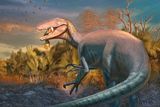
Paleontologists have discovered a new species of carnivorous dinosaur, Joaquinaptor Casali. The predator Apex was held about 22 feet high, the overwhelming clutches possessed and, perhaps the most surprising of all, were found with a piece of ancient crocodile trapped between his teeth.
Researchers writing in Nature communications Describe the latest addition to a group of dinosaurs known under the name of megaraptorans, a mysterious and misunderstanding of carnivorous theropods characterized by their elongated skulls and their powerful previous members, each equipped with huge claws.
The oldest known examples – Phuwiangvenator yaemniyomi And Vayuraptor nongbualamphuensis – were found in Thailand and dates back to the end of the Valalanginian Hauterivian stages of the early Cretaceous Cretaceous, about 130 million years ago. The remains of other species have been found dispersed in various parts of the world – in particular in Asia, Australia and South America, where they seem to have been particularly abundant. This last specimen could be the youngest to date.
Dinosaurs
A team of paleontologists led by Lucio Ibirici at the Patagonian Institute of Geology and Paleontology discovered the remains in the rocky formation of Lago Colhué Huapi in the province of Chubut, in the center of Patagonia, in Argentina. The fossils – which include remains of arms, legs and tail bones as well as parts of the skull and jaw of the dinosaur – were buried a few meters below the surface of the rock, placing it at the very end of the Cretaceous period (66 to 70 million years).
The remains, although incomplete, are remarkably intact for a dinosaur of this type and offer an intriguing overview of the prehistoric world of the giant predator. While researchers think that the specimen was only 19 years old when he died and, as such, was not yet fully cultivated, an adult of this species would have reached (and perhaps even exceeded) 7 meters (23 feet) and weights of 1,000 kilograms (2,200 pounds).
But perhaps the most curious of all was the fossil housed between his jaws, which turned out to be a bone of the front leg of a crocodyliform – a group of reptiles which includes the ancient ancestors of today’s crocodiles. The simplest explanation is that this unhappy fang was the prey of dinosaur, and the Joquinaptor was fossilized in the middle of dinner.
However, researchers point to other possible explanations – the crocodyliform was killed in the middle of the fight, for example, or the water currents have serentiously placed the bone in the dinosaur jaws at a later point.
Learn more: This 100 million year old microraptor defeated his arms during the race
Fill the whites
The discovery adds more depth to our understanding of megaraptorans in general, which, thanks to a small fragmentary fossil file, remain poorly understood. He supports the conviction that the species of Megaraptoridae which has migrated to what is now South America during the period of the Center-Crétace has undergone growth of growth, increasing in terms of size (from 16 to 23 feet) and body weight (660 pounds to 2204 pounds).
This also suggests that megaraptorides were versatile creatures capable of surviving a range of habitats, especially in the southern areas of what is now South America, where they would have dominated the Apex predator in the region. THE JoquinaptorFor example, was found in a place characterized by heat, humidity and proximity to the sea, an environment very different from semi-arid climates and the interior location where other megaraptorid fossils have been found.
What is in a name?
The new species (Joaquinraptor Casali) was appointed after the son of Ibirici, Joaquín, and in tribute, Dr. Gabriel Andrés Casal, an expert renowned in paleontology of Cretaceous and the geology of central Patagonia. The word “raptor” is Latin for the thief.
Learn more: 5 fossils of massive dinosaurs and where they were found
Article Sources
Our writers at Discovermagazine.com Use studies evaluated by high quality peers and sources for our articles, and our publishers examine scientific precision and editorial standards. Review the sources used below for this article:


