New Species of Carnivorous Dinosaur Identified in Argentina


A new member of the family of Megaraptoran dinosaurs was discovered by a team of Argentina and the United States.
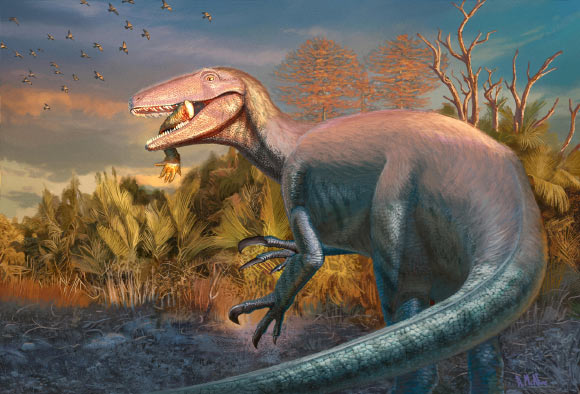
Joaquinraptor Casali. Image credit: Andrew McAfee, Carnegie Museum of Natural History.
The new species of dinosaur lived in what is now Patagonia, Argentina, in the last part of the Cretaceous, between 70 and 67 million years.
Double Joaquinraptor CasaliThe former predator was a higher predator in the region.
It belonged to Megaraptora, a group of carnivorous carnivorous dinosaurs with wide distribution of Cretaceous deposits in Asia, Australia, and in particular in South America.
“The megaraptorans were carnivorous theropod dinosaurs with elongated skulls and powerful forearms with large claws found through Asia, Australia and South America,” said Dr. Lucio Ibirici, paleontologist at the Instituto Patagónico de Geología y Paleontolog and Patagonia San Juan Bosco, and Collagues.
“However, our understanding of this group is hampered by the lack of complete fossils.”
A well -preserved and partially articulated skeleton Joaquinraptor Casali An individual was found in the formation of Lago Colhué Huapi of the province of the Center-Sud de Chubut in the center of Patagonia, Argentina.
The specimen included a large part of the skull of the dinosaur, previous and posterior lights, ribs and vertebrae.
Based on the bone microstructure, paleontologists suggest that the sample is an adult, but perhaps not completely cultivated.
Extrapolating other megaraptran remains, they believe that Joaquinraptor Casali Can have a length of about 7 m and weigh more than 1,000 kg.
The sedimentary evidence indicates that this dinosaur lived in a hot, humid flood plain environment.
“The presence of a fossilized crocodile leg in a hurry against the lower jaws of Joaquinraptor Casali Gives clues to his food behavior and suggests that he may have been an Apex predator in the region, “said the researchers.
“However, additional research is necessary to provide additional information on its behavior and ecological role.”
According to scientists, Joaquinraptor Casali And other megaraptorans have survived as dominant predators in this region of South America before extinguishing at the end of the Cretaceous with other non -avian dinosaurs.
“South American megaraptorides seem to have reached larger body sizes (7 m or more in total body length) than their generally older parents in Australia (5-6 m),” they said.
“Patagonian megaraptorides may have continued to increase in size through the rest of their scalable history – perhaps stimulated at least in part by the extinction of carcharodontosaurides during the Turonian – with a few last forms in the Cretaceous potentially reaching corps lengths of 9 m or more.”
“Among other advantages, this may have allowed megaraptorides to occupy the Apex predator niches in their respective habitats.”
“In addition, and as evidenced by the stratigraphic occurrence of Maastrichtian (probably late Maastrichtian) of Joaquinraptor CasaliThese theropods may well have survived the border of Cretaceous-Paléogenic, to finally perish alongside all the other non-avian dinosaurs. »»
The discovery of Joaquinraptor Casali is described in an article published in the journal Nature communications.
_____
LM IBIRICU and al. 2025. The last dinosaur of the megaraptoride theropod of Cretaceous highlights the evolution and the paleobiology of the megarapto. Nat common 16, 8298; DOI: 10.1038 / S41467-025-63793-5


