New Species of Steamer Duck Discovered in Chile


In the cold, wave-battered channels off southern Chile, scientists have identified what they say is a new species of the steam duck genus. Tachyerasa group of notoriously aggressive, often flightless waterfowl found only in South America.
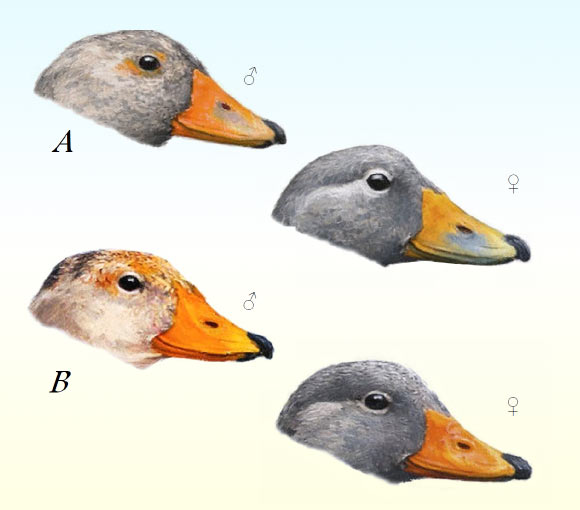
Detail of the color pattern of the bill in adult specimens of the Chiloé steamer duck (A) and the Magellanic steamer duck (B). Image credit: Bernabé López-Lanús and Mariano Costa.
Tachyeras is a small genus of ducks in the waterfowl family Anatidae.
These birds are known for their unusual biology. Most species are flightless and propel themselves through the water by flapping their wings like paddles, which gives them their name.
They are also known to be territorial, capable of violently defending their range against other birds.
“The natural history of Tachyeras is accompanied by a long description of certainties and errors interspersed over time,” wrote Argentine ornithologists Bernabé López-Lanús and Mariano Costa in their article.
A few Tachyeras species can include both flying and non-flying individuals within the same population, blurring distinctions once thought to define separate species. This ambiguity weakened the usefulness of the traits for classification.
In response, the study authors turned to bioacoustics; They analyzed the vocalizations of all known species of steam ducks, combining field recordings, archived audio databases, and spectrogram analyses.
They found that although some calls – particularly the rapid “ticking” sounds used in territorial displays – were broadly similar across species, another type of call proved decisive.
Known as the “hoarse growl,” this contact call showed consistent, species-specific patterns in acoustic structure.
“This call is generally emitted in isolation, or before the vocalization of a territorial proclamation,” the researchers explained.
“Its description goes beyond the strict behavioral sense of the call – just like the territorial announcement vocalization – but it constitutes another form of vocalization in Tachyerasanalogous in each taxon.
Males of the newly identified species produced calls with a distinctive “dome”-shaped frequency profile, different from the “scalene triangle” pattern typical of a very similar species, the Magellanic steam duck (Ptenerous tachyera).
Named the Chiloé steam duck (Ketru Tachyeras), the new bird is endemic to the Chiloé and Aysén region of Chile, with an area of occurrence extending from approximately 40 degrees south latitude — from Valdivia and the northern tip of the Chiloé region — to the Taitao Peninsula (in the south).
The species occupies protected coastal environments (bays and inland channels rich in macroalgae), while the Magellanic steamer duck is associated with more exposed and wave-swept coasts further south.
“Reproductive adults compete for sites offering optimal feeding conditions: the canopy of underwater forests of brown macroalgae Macrocystis pyrifera (“kelp”),” the scientists wrote in the journal.
“This habitat is characterized by dense refuges with a great diversity of small invertebrates (amphipods, gastropods, polychaetes, juvenile fish), which individuals of this taxon access by diving, as is typical of Tachyeras.”
This discovery highlights the growing role of sound in modern taxonomy and highlights how even well-studied species can conceal hidden diversity, particularly in remote or complex environments.
“Cases like the discovery of Ketru Tachyeras allow us to conclude that bioacoustics is an essential tool for understanding the taxonomy of cryptic species, even with a limited sample size,” the authors conclude.
Their article appears online in the journal Audiornis.
_____
Bernabé López-Lanús and Mariano Costa. 2026. A new species of Steamerduck (Anatidae: Tachyeras) from the Chiloé region, Chile, eventually confirmed as a taxon distinct from Ptenerous tachyera. Audiornis 5:2-65


