New Trump tariffs pose another hurdle for the housing market


Danielle KayeEconomic journalist

 Antoine Cabrera
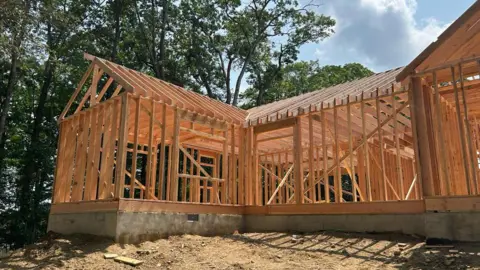
Anthony Cabrera breathed a sigh of relief when, three weeks ago, he purchased the last big items – sofas – for his newly built home in Hopatcong, New Jersey.
Mr. Cabrera, who began working with a contractor in March to build the three-bedroom house, was eager to anticipate a new round of tariffs on major building materials and household items that took effect earlier this week.
Mr. Cabrera had already seen his initial budget of about $300,000 balloon to $450,000 as prices for a range of products, such as cabinets from Asia, began to rise since the spring.
Earlier this week, new U.S. tariffs were imposed on items needed to renovate your home, including imported kitchen cabinets, lumber and wooden furniture.
“The rates were definitely on my mind throughout the whole process,” said Mr. Cabrera, who managed to finish his construction before the new rates but still noticed rising prices as they approached.
“It was a worry every morning looking at prices, trying to figure out how to control the budget that kept increasing,” he said.
Mr. Cabrera’s experience is one that many buyers, builders and remodelers struggle with.
While the White House says the tariffs will boost domestic manufacturing and protect national security, economists say they could intensify the U.S. housing market’s woes by adding to President Donald Trump’s previous tariffs and slowing construction.
“We’re in a pretty weak position in the real estate market to begin with,” said Peter Harrell, a visiting scholar at Georgetown Law School. “The last thing an already modest new construction market needs is higher production costs.”
He added: “This comes on top of an industry that has already seen its share of tariff increases.”
Other levies imposed by Trump this year include a 50% tariff on steel and a 50% duty on copper imports, which have raised the costs of construction materials such as copper pipes.
 Antoine Cabrera
Affordability Concerns Rise
The levies are the latest in a series of measures that economists say could continue to drive up prices for U.S. citizens.
A recent report from Goldman Sachs reveals that American consumers will bear up to 55% of the cost of Trump’s tariffs this year. It takes time to raise prices on consumers, economists note, and U.S. companies will increasingly pass on the costs in the months to come.
Even before the new tariffs took effect this week, furniture makers had been warning about the consequences of the tariffs. In April, the chief executive of RH, formerly known as Restoration Hardware, reacted with an expletive as he watched his company’s shares fall, in response to a major tariff announcement from the White House.
RH said in September that it would face $30 million in new tariff costs in the second half of this year. The company also delayed releasing a design catalog, citing uncertainty over pricing due to tariffs.
And executives at furniture retailer IKEA, known for its budget-consciousness, warned this week that tariffs could force the company to raise prices. It imports most of the products it sells in the United States.
 Danielle Kaye
Jean Lin, founder of a furniture design and interior design gallery, said she was less exposed to tariffs than some other businesses in her industry. Most of the furniture it sells, in partnership with independent designers, is made in the United States.
But his Manhattan-based cooperative, called Colony, is still feeling the effects of the tariffs since this spring. Homeowners and interior designers cut back on purchases and projects due to pricing uncertainty, which took a toll on its sales.
“It’s really difficult to invest in anything when there are unknowns, especially in high-value works or works that will stay in your home for a long time,” Ms. Lin said.
Material costs had also been rising, even before the latest round of tariffs. Ms Lin said a US-based factory worker, with whom she is collaborating on an interior design project, imports her materials – and these continue to become more and more expensive.
This could lead to higher prices for consumers down the road.
“The next project he does, whether it’s ours or someone else’s, he’ll quote accordingly,” she said. “If construction costs go up, if material costs go up, your architect’s fees and your interior designer’s fees are going to go up as well.”
At Stillfried Design in Lower Manhattan, prices for furniture made in Germany and Austria rose nearly 15 percent this summer to account for widespread tariffs on European imports and tariffs on steel.
Michael Trubrig, who co-owns the company with his wife, said: “We had to raise prices because we couldn’t reduce the margin.” He does not expect new tariffs on furniture to affect him, due to a trade deal capping tariffs on the European Union at 15%.
But the broader pricing landscape continues to pose a barrier.
“It doesn’t end business, but it’s not healthy either,” Mr. Trubrig said.
“Another unwanted thing”
High mortgage rates have weighed on new home sales in recent years.
The new tariffs on imported lumber, kitchen cabinets and furniture “will create additional headwinds for an already struggling housing market by further increasing construction and renovation costs,” Buddy Hughes, president of the National Association of Home Builders, said in a statement.
Affordable housing construction could be particularly hard hit, said Elena Patel, co-director of the Urban-Brookings Tax Policy Center. She said as material costs rise, so will the cost of developing new housing, which could prompt developers to rethink low-margin affordable housing projects.
Matthew Walsh, housing economist at Moody’s Analytics, said cost uncertainty will be the most immediate effect of this week’s housebuilding rates, especially as levies are set to rise again in January.
Some economists say the tariffs on furniture and lumber, alone, are unlikely to spell disaster for builders and single-handedly destroy the homebuilding market.
“It’s not a disaster for homebuilders,” said Jake Krimmel, senior economist at Realtor.com. “This is yet another unwanted thing they have to deal with now.”
But, he noted, “these things add up.”


