Newly-Discovered Trans-Neptunian Object is Moving in Rhythm with Neptune, Astronomers Say


Discovered by the survey on distant objects with large inclination (LIDO) and designated 2020 VN40, this trans-neptunian object is the first confirmed body which orbit the sun once for 10 orbits that Neptune is finished. This discovery, reported in paper in the Journal of planetary sciencesHelp scientists understand how objects of the external solar system behave and how they got there. He supports the idea that many distant objects are temporarily “captured” in the gravity of Neptune while they derive in space.
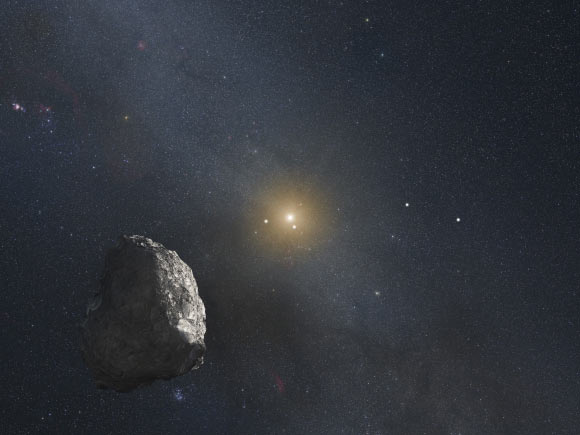
The impression of an artist of a trans-neptunian object. Image credit: NASA / ESA / G. Bacon, STSCI.
“This is a big step in understanding the external solar system,” said Dr. Rosemary Pike, astronomer of the Harvard & Smithsonian’s Center for Astrophysics.
“This shows that even very distant regions influenced by Neptune can contain objects, and this gives us new clues to the way the solar system has evolved.”
“This is only the start,” said Dr. Kathryn Volk, astronomer at the Planetary Science Institute.
“We open a new window on the past of the solar system.”
2020 VN40 was discovered by the Lido survey, which sought unusual objects in the external solar system.
This survey used the Canada-France-Hawaii telescope for the main survey operations, and the Gemini Observatory and the Magellan Baad for additional observations.
The investigation was designed to search for bodies with orbits that extend well above and below the plane of the terrestrial orbit around the sun, part of the external solar system which has not been well studied.
“It was fascinating to learn how many small bodies of the solar system exist on these very large very inclined orbits,” said Dr. Samantha Lawler, astronomer of the University of Regina and member of the Lido team.
2020 The average distance of VN40 is approximately 139.5 times further from the sun than the earth and follows a very tilted path around the solar system.
What makes the object even more interesting is how it moves in relation to Neptune.
Most objects with a simple relationship of the duration of their orbit compared to the duration of the Neptune orbit are always closer to the sun when Neptune is far away.
On the other hand, 2020 VN40 is closest to the sun when Neptune is very close, if you look at their positions above the solar system.
The inclination of the object orbit means that objects are not really close, because 2020 VN40 is actually well below the solar system – they only appear when they are flattened on a map.
All other trans-neptunian objects known in orbit so that they avoid this alignment with their approach closest to the sun, even in the flattened view.
“This new movement is like finding a hidden rhythm in a song that we thought we knew,” said Dr. Ruth Murray-Clay, astronomer at the University of California in Santa Cruz.
“This could change the way we think about how distant objects move.”
_____
Rosemary E. Pike and al. 2025. Lido: Discovery of a 10: 1 resonator with a new library state. Planet. SCI. J 6, 156; DOI: 10.3847 / PSJ / ADDD22


