News Analysis: How the Saudi crown prince went from pariah to feted White House guest

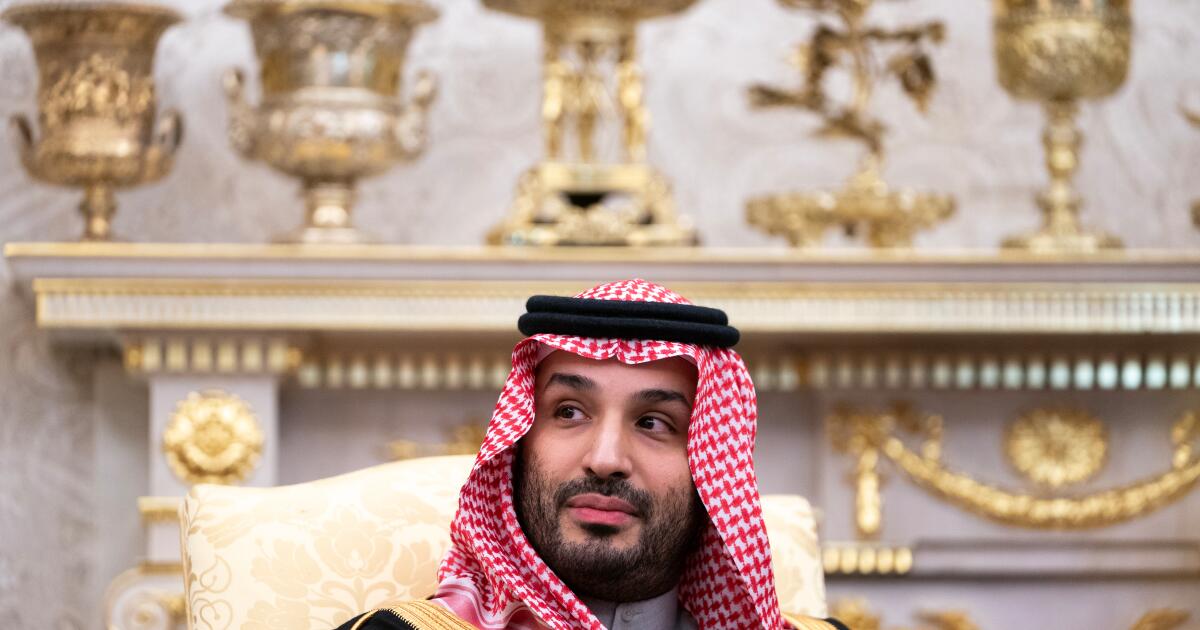
BEIRUT — Seven years ago, he was virtually persona non grata, with any connection to him considered kryptonite among America’s political and business elite for his alleged role in the assassination of a Washington Post columnist and Saudi critic.
But when Crown Prince Mohammed bin Salman came to Washington this week, he cemented a remarkable comeback, positioning himself as the linchpin of a new regional order in the Middle East and his country as a critical partner in America’s AI-driven future.
During what amounted to a state visit, the crown prince – Saudi Arabia’s de facto leader – was literally given the red carpet: a Navy band, flag-bearing horsemen and a squadron of F-35s in the sky; a black-tie dinner attended by many business leaders in honor of the prince; a US-Saudi investment forum at the Kennedy Center the next day.
Throughout, Bin Salman (or MBS, as many call him) has proven himself a keen practitioner of the transactional politics favored by President Trump.

President Trump and Crown Prince Mohammed bin Salman walk down the colonnade en route to the Oval Office of the White House on Tuesday.
(Brendan Smialowski/AFP via Getty Images)
He responded to Trump’s demand, first made in May at the Riyadh edition of the US-Saudi Forum, to increase the kingdom’s US investment commitments from $600 million to nearly $1 trillion.
And the prince managed to appease Trump in his oft-repeated call for Saudi Arabia to rejoin the Abraham Accords, the normalization pacts with Israel negotiated during the president’s first term, even though he did not change his long-held position: that establishing ties with Israel be accompanied by steps toward a Palestinian state — an outcome that many in the Israeli political class reject.
“We think having good relations with all the countries in the Middle East is a good thing and we want to be part of the Abraham Accords. But we also want to make sure we have a clear path forward. [to a] two-state solution,” said Bin Salman.
“We want peace with the Israelis. We want peace with the Palestinians, we want them to coexist peacefully,” he added.

President Trump welcomes Crown Prince Mohammed bin Salman, the de facto ruler of Saudi Arabia, to the White House on Tuesday.
(Andrew Caballero-Reynolds/AFP via Getty Images)
In Saudi Arabia, the trip was presented as an unequivocal triumph for the prince. Saudi state media has touted the country’s emergence as a major U.S. ally outside NATO and the signing of a so-called strategic defense agreement, demonstrating Riyadh’s central role in American strategic thinking.
These boasts occurred despite little clarity on what this deal actually entails: its text has not been published, and it was only mentioned in passing in a White House “fact sheet” that emphasized that Saudi Arabia would “buy American” with major purchases of tanks, missiles and F-35s; it would be the first time that America’s most advanced jet would be sold to an Arab country.
Saudi Arabia will also have access to top-notch AI chips, allowing it to tap abundant land and energy resources to build data centers while “protecting American technology from foreign influence,” according to the White House.
Negotiations over Riyadh’s civilian nuclear program, stalled for a decade due to concerns from previous administrations, have resulted in a framework that theoretically allows Saudi Arabia to build a nuclear power plant. Uranium enrichment, which would theoretically enable weaponization, is not part of the deal, US officials say.

Saudi Arabia’s Crown Prince Mohammed bin Salman and President Trump watch a flyby of F-15 and F-35 fighter jets before meeting at the White House.
(Brendan Smialowski/AFP via Getty Images)
On the regional policy front, Bin Salman obtained a commitment from Trump to help end the war in Sudan.
The visit capped Bin Salman’s astonishing redemption arc from the lowest point of his reputation seven years ago.
At the time, his image as a fearless reformer – overturning the ban on women driving, sterilizing the country’s notorious religious police – was already crumbling after he sought to silence not only foreign opponents, but also anyone at home who questioned Vision 2030, his far-reaching (and hugely expensive) plan to transform Saudi Arabia.
Then came the strangulation and dismemberment in Türkiye in 2018 of Jamal Khashoggi, a Saudi insider turned moderate critic and Washington Post columnist.

Crown Prince Mohammed bin Salman is seen inside a vehicle as he leaves the White House after a meeting in the Oval Office with President Trump.
(Andrew Caballero-Reynolds/AFP via Getty Images)
Trump seemed more inclined to side with the prince, who has denied any involvement in the killing, but the CIA said in a leaked report that it was highly convinced the prince ordered Khashoggi’s assassination.
The association with Bin Salman, once Washington’s darling in the Middle East, has become toxic. International companies rushed to withdraw from the kingdom. Politicians made it clear he was not welcome. Then-candidate Joe Biden pledged to make the Saudi government “a pariah.”
Over time, the prince backed away from his more pugilistic policies, while geopolitics, energy concerns and a turbulent Middle East forced Biden to moderate his rejectionist stance.
In 2022, Biden visited the prince – giving him a lukewarm punch – to urge him to lower energy prices.
The same year, Riyadh helped negotiate a prisoner exchange between Russia and Ukraine. Later, a Chinese-brokered deal allowed the prince to calm stormy diplomatic relations between his country and Iran. Last month, he reportedly worked behind the scenes to push through a ceasefire between Israel and Hamas.
His visit to the White House appears to cement his return, but little of what was promised is a done deal.
First, whether Saudi Arabia will be able to amass $1 trillion – a figure that is equivalent to 80% of its annual GDP and more than double its foreign exchange reserves – remains an open question.
Above all, the prince did not specify when the money would be invested.
While the investment commitment is significant, “the amount and duration of that investment remains completely unclear,” said Tim Callen, an economist and former International Monetary Fund mission chief to Saudi Arabia.
Saudi Arabia is also cutting public spending as falling oil prices force it to scale back many of its gigantic projects, Callen added.
“The pool of money available to carry out all these projects and investments has decreased compared to 2022 and 2023,” he said.
“My view is that things will progress, both on the investment side and on the commercial side. [between the U.S. and Saudi Arabia] “This is because there are mutual economic interests between the two countries,” he said. But in the short term, he added, $1 trillion “is too high a number for Saudi Arabia’s economy.”
As for the F-35s, it will probably take years to see them on Saudi runways. Congress must approve the F-35 sales, and some opposition could arise if they appear to undermine Israel’s qualitative military advantage.
Israel, the only country in the F-35 program authorized to use certain specialized technologies, would expect Saudi Arabia to receive “reduced caliber aircraft,” Trump said Tuesday, with the prince at his side.
“I don’t think that makes you very happy,” he said to the prince.
“As far as I’m concerned,” Trump added, “I think [Israel and Saudi Arabia] are both at a level where they should reach the top.
But the biggest obstacle could be Saudi Arabia’s ties to China, said Richard Aboulafia, managing director of AeroDynamic Advisory and an aviation analyst.

Saudi security forces stand at attention under a portrait of Saudi Arabia’s Crown Prince Mohammed bin Salman during a military parade as pilgrims arrive for the annual pilgrimage to the holy city of Mecca on May 31.
(AFP via Getty Images)
In recent years, Saudi Arabia has held military exercises with the Chinese navy and deployed Chinese-made weapons in its armed forces. Ensuring it doesn’t examine the aircraft’s capabilities presents “a different set of challenges,” Aboulafia said. Similar concerns derailed the UAE’s attempts to acquire the plane, he added.
Another problem is that a delay in delivering the planes means another recipient would have to give up its production slots in favor of Saudi Arabia.
Trump’s treatment in the White House also played a key role in bin Salman’s return to full U.S. support.
When a reporter asked the prince about Khashoggi’s murder, it was Trump who offered a vehement defense and called Khashoggi “extremely controversial.”
“A lot of people didn’t like this gentleman that you’re talking about. Whether you like him or not, things happen, but he didn’t know anything about it,” Trump said, pointing to the crown prince.

President Trump, right, and Mohammed bin Salman, Crown Prince of Saudi Arabia, shake hands during their meeting in the Oval Office.
(Nathan Howard/Bloomberg via Getty Images)
Trump also attacked Biden’s punchline, engaging in an awkward game of handholding with Bin Salman.
“I grabbed that hand,” Trump said. “I don’t care where that hand was.”


