The Pilgrims Were Doomsday Cultists


Company
/
November 26, 2025
The settlers who arrived in Plymouth did not escape religious persecution. They left on Mayflower establish a theocracy in the Americas.
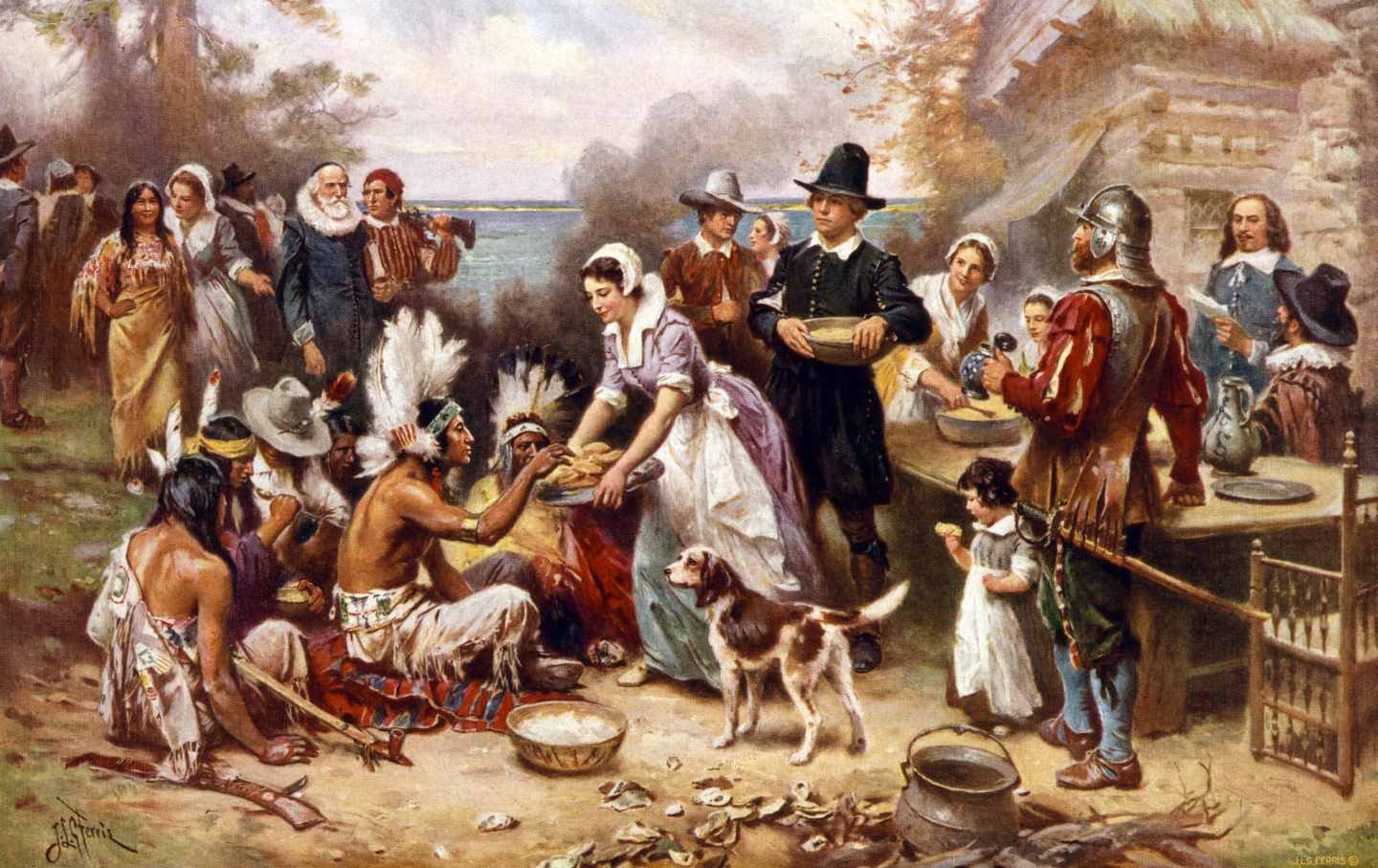
The first Thanksgiving, 1621by Jean Léon Gérôme Ferris (1863–1930).
(Universal History Archives/Universal Images Group via Getty Images)
In October 1621, when those we now call the Pilgrims gathered for what we now call Thanksgiving, they were no doubt eager to continue building their patriarchal theocracy in the hopes that Jesus would soon return. In 1630, in the north, the first of those we now call Puritans arrived on the Arabella in what became the Commonwealth of Massachusetts. The Pilgrims and Puritans were high-control radical Protestant apocalyptic groups. If they existed today, most Americans would identify them as cults.
Although they were two different groups with different investors and colonial structures, they were all “hotline Protestants,” as these radicals were called in England. They believed that the end of the world, as prophesied in the New Testament book of Revelation, was imminent. Massachusetts Bay Premier John Cotton believed the apocalypse would come sometime after 1655. Cotton’s son-in-law Increase Mather, reluctant to set a particular date, simply stated that the cosmic battle would take place within the next few years. Augmentation’s son, Cotton Mather, another important minister in Puritan history, thought it would be 1697.
“The Day of Doom,” a long poem published in 1662 about the return of a vengeful Jesus, was so popular in New England that it is known as the first American bestseller.
Radical Protestants believed, as apocalyptic thinkers always have, that the world contained forces of good and evil, that eradication was the sole goal of both, and that each supernatural side had been pursuing it since the dawn of time. These early New Englanders wanted to hasten the apocalypse by erasing everything that didn’t fit their ever-shrinking vision of justice. Whoever was not with them was against them. UCLA historian Carla Gardina Pestana says Pilgrim Governor William Bradford “believed that anyone hostile to Plymouth itself risked the wrath of God.”
Current number

These groups did not come to the New World seeking religious freedom. The Pilgrims, in particular, already enjoyed religious freedom in Holland, where they lived for 12 years after fleeing England. Besides economic motivations, they came to America because they did not want to raise their children in a liberal society. They wanted theocracy. They wanted to be able to expel nonconformists and exercise total control over the culture.
The Puritans wanted the same thing – which is why they hanged Quakers, banished dissenters, and ultimately ended the practice of questions and comments after sermons, because, as Cotton Mather wrote, it was “an occasion of much contention, vexation, and folly.” Church attendance was compulsory. They made it illegal to disagree with ministers.
The punishment for transgressions was extreme and designed to humiliate, just as it is in cults. Punishment was also a source of entertainment. On trial days, Plymouth taverns opened early. The ear markings and cutting often occurred immediately after sentencing. Some convicts were tied to the back of a cart that took them around town while they were whipped.
Chatting, flirting, swearing, smoking, playing ball sports, and doing almost anything on the Sabbath were crimes. Absent from church or criticizing the pastor were also punishable. Residents were encouraged to learn about each other. It was even a crime to interrupt the preacher. Blasphemy required the death penalty.
At the time, discipline in England was also brutal, but comparatively, there was virtually no crime in New England. In Pilgrim and Puritan communities, there was not only a culture of punishment; there was a culture of compliance. They were high control groupsmeaning that group leaders used community pressure and threats of punishment, ostracism, and damnation to regulate residents’ behavior, thoughts, and information intake.
Some of the Puritans’ controlling doctrine and behavior began early on, but much of it developed from the 1640s and 1650s, when the founders and elders became firmly committed to retaining what they had built and developed, that is, when they were corrupted by power and refused to give it up. For example, as more and more members of the community developed an inner conviction that they were saved, ministers feared that their leaders were losing their authority. In response, they began to preach uncertaintyclaiming that in reality, God was hardly saving anyone and so the locals were unlikely to be among the so-called chosen ones. This change in doctrine made it almost impossible to enter the Church, a particularly difficult reality for adolescents whose entire identity had been constructed around entry.
Cults and high-control groups are usually the most destructive to the children raised in them. In addition to uncertainty about their status among the saved, New England children were subject to fear-based indoctrination and extreme discipline. Additionally, parents were advised against showing affection to their children, lest it lead them into wickedness. Researchers who looked at the diaries kept by the Puritans found that the second and third generations showed a significant increase in melancholy, pathological abnormalities, nervous breakdowns, suicide, and insanity during adolescence.
Nevertheless, in the mid-to-late 1800s, the Pilgrims and Puritans became avatars of America’s founding, partly because of their associations with the new Thanksgiving holiday and partly, as some scholars have argued, because the nation struggled to define its identity and to separate its origins from the slave trade.
I am passionate about painting an accurate portrait of our New England ancestors, as I do in my recent book, Cults like us: why apocalyptic thinking drives Americanot only because of their dedication to historical accuracy, but also because of the implications of their culture and belief systems in today’s United States, which remain largely unknown.
Their radical apocalyptic ideology has not disappeared. It became the foundation of American culture. From these remarkably successful colonies, we inherited our instinctive anti-intellectualism, our obsession with introspection, our tendency to worship the rich, and our desire to see a strong man lead us out of the crisis. It’s no surprise that the country has one of the highest incarceration rates in the world. This latent influence has also made us a nation of gullible marks for con artists, cult leaders, and demagogues, who tempt us to behave in ways that serve them by pushing the buttons of our unconscious indoctrination. The result is division and extremism, which is currently plaguing our country.
Popular
“Swipe left below to see more authors”Swipe →
Americans today often wonder “how we got here” as a nation. My answer: the Mayflower And Arabella.
Sectarian thinking is not unique to the United States, but it is more prevalent there for three reasons: our aforementioned ideological heritage of the Pilgrims and Puritans; the first and second Great Awakenings (at the beginning of the 18th century and the turn of the 19th century respectively), which broke down the hierarchy of the Church and allowed each to gain a charismatic following; and the First Amendment, which effectively protects a number of crooks, a necessary evil in exchange for religious freedom.
Of course, sectarian thinking is not always in vogue. Sociologists say it increases in times of technological revolution, social upheaval and crisis. Recently, Americans have seen social media break down traditional communities and are bracing for mass layoffs due to AI. We are facing one of the greatest crises in our nation’s history: the chronic precariousness of a majority of Americans.
Between 1975 and 2020, $50 trillion went from the bottom 90% of Americans to the richest 1%; This figure is estimated to be as high as $60 trillion today, a staggering and intentional redistribution of wealth. Through ever-increasing lobbying, influence, and campaign donations, our nation’s wealthiest members have, since the Reagan administration, wooed the government to cut taxes on the wealthy and corporations, repeal regulations protecting the public from risky corporate behavior, neutralize unions that empower workers to thwart exploitation, and allow corporations to move overseas and leave American workers behind.
People in crisis, like broke and desperate Americans, turn to cult-like thinking. We have been and will continue to be easily manipulated. If we are to mitigate our national flirtation with autocracy and extremism that is ravaging America, we must ensure stability—for example, by guaranteeing health care, shelter, food, and social security—to all Americans. And we must turn towards each other rather than away from each other. This Thanksgiving is the perfect time to start coming to terms with the country’s radical sectarian origins. The consequences are ongoing and we are all in this together. There is no return possible. THE Mayflower And Arabella do not offer return tickets.


