Wallace Nagedzi Watts had been going to Seahawks games for almost three decades when a historical discovery helped supercharge his fandom – and deepened his connection to his indigenous roots.
“It kind of changed my whole life,” says Watts, a prominent fan of the American football team who goes by the name Captain Seahawk.
Advertisement
“Because of the Seattle Seahawks I started getting back into my culture.”
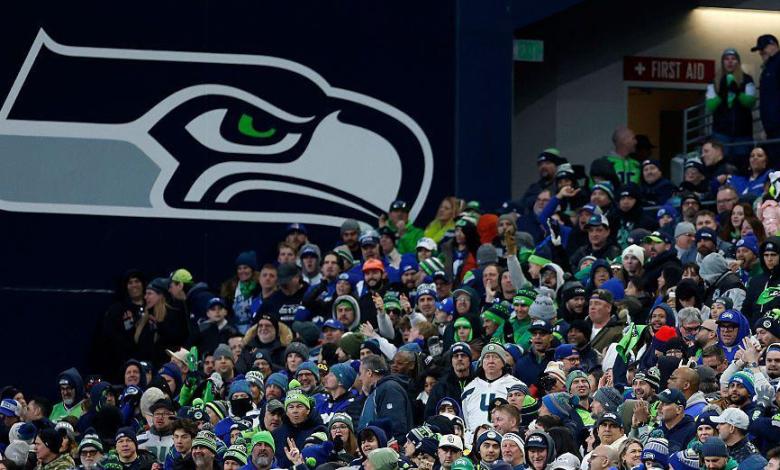
Speaking to the BBC while driving down to attend the Super Bowl game in Santa Clara, California, where the Seahawks are due to take on the New England Patriots, Watts says “it’s been my life’s mission for the last 12 years to notify everyone that the Seahawks logo was copied from the Kwakwaka’wakw tribe on Vancouver Island”.
The discovery was made during the Seahawks last Super Bowl sting – coincidentally also against the Patriots – in 2014.
Amid city-wide excitement, the Burke Museum in Seattle decided to investigate the origins of the Seahawks logo, which was chosen by the team’s manager in the mid-1970s. A black-and-white photo of a ceremonial mask in an old art book revealed the inspiration behind the design, which was then traced to a collection at the Hudson Museum in Maine.
Advertisement
The museum sent the mask to Seattle on loan, where a ceremony was held featuring both tribal members and team representatives.

The mask has been repainted in the years since leaving western Canada. [Burke Museum of Natural History and Culture]
The mask, which was created in the late 1800s and was carved from cedar, had been in private collections since leaving Vancouver Island, British Columbia, where it was created by members of the Kwakwaka’wakw Nation, says Katie Bunn-Marcuse, the curator of Northwest Native Art at the Burke Museum.
The carving, which is known as a “transformational mask” and depicts the ancestral origins of one’s family, was created around the time that Canada introduced a ban on many indigenous practices, in a move which decimated many tribes in western Canada.
Advertisement
Using the mask for its intended purpose, at large gatherings called potlaches, became a crime. Many people went to jail for their cultural practices, however, the Kwakwaka’wakw people continued to hold underground potlaches.
“The Indian Act banned people gathering and performing their songs,” says Bunn-Marcuse, adding, that “the potlatch was the economic and legal system of the coast”. The ban was lifted in 1951, and in 2015 Canada’s Truth and Reconciliation Commission found that it was part of a “cultural genocide”, which also included the notorious residential school programme, which separated families and erased local languages.

Watts had been going to games for decades before discovering his own tribal connection to the team. [Getty Images]
Watts grew up on a reservation in Port Alberni on the west side of Vancouver Island, in his father’s tribal community. But after the discovery of the logo’s Kwakwaka’wakw origins, he decided to look into his mother’s family history on the other side of the island.
Advertisement
Travelling back to Vancouver Island, he set out on a series of tribal canoe journeys, where he reconnected with Kwakwaka’wakw family members and learned more about their cultural practices.
During one trip, he was invited to take place in a ritual in which he was declared a “warrior”, or guardian of the tribe’s culture.
“I had to dance half-naked in front of a thousand people, and then I came back in warriors clothing. To me it’s like being baptised as a Christian. It really changed my life.”

The ‘transformational’ mask opens to show a human inside. [Burke Museum of Natural History and Culture]
Bruce Alfred, an artist living in Alert Bay, British Columbia, recalls when his cousin started showing up, inspired by his commitment to the Seahawks and his cultural heritage. He says that Watts is not the only person who has been inspired by the NFL team to look into their family history.
Advertisement
Alfred was part of the Burke team that surveyed the mask, and confirmed that it was indeed Kwakwaka’wakw, and had been used in spiritual ceremonies before going into a private collection.
“After the potlatch ban they took everything away from our people,” he says, adding that the goal of the government and missionaries was to “annihilate and assimilate us – either one”.
The Seahawks are popular throughout Canada’s western coast, where no other NFL team exists. Alfred says that many people in his village are Seahawks supporters, and that more people have been inspired to look into their heritage after discovering the team’s connection. It comes amid a larger tribal movement to reconnect with the past.
“There is a resurgence of our people that are stepping up and they’re learning the language, the culture, their own identity,” he says.

Alfred, and other indigenous people who spoke to the BBC, say that unlike other major league sports teams, the Seahawks logo has not sparked backlash because it respectfully borrows from indigenous culture, rather than plays in to racist stereotypes.
Advertisement
The display of indigenous cultural materials as artworks has been criticised by some tribal people, who see these as sacred tools for worship.
At the Kwakwaka’wakw exhibit at the University of British Columbia’s Museum of Anthropology in Vancouver, one mask is kept under a sheet to symbolically show how some believe these objects should not be displayed, and only taken out for important occasions.
The debate is always ongoing for museums that display indigenous relics, says Bunn-Marcuse.
“In community, many of these masks are not brought out until the moment that they are needed,” she says.
Advertisement
“Whenever we do our exhibits we do them collaboratively with input and advising by community members. So there are some masks that we no longer show because community has said those are not appropriate to be shown ever outside of their ceremonial context.”
Others have critiqued the artwork for originating from a tribe that is hundreds of miles from Seattle, halfway to Alaska. The artwork of local peoples such as the Coast Salish could be used instead, they argue.

The logo has been redrawn by local Washington artists, including this one by Qwalsius-Shaun Peterson, in their own indigenous styles. [Qwalsius-Shaun Peterson]
Qwalsius-Shaun Peterson, a Coast Salish artist from the Puyallup Tribe near Tacoma, Washington, is among many indigenous artists who have redesigned unofficial Seahawks logos in the style of their own local culture.
Advertisement
“People within the tribal communities are just really excited about native iconography of any kind,” he says.
“Nobody takes offense” to the official logo, he adds, adding that it is not a “misrepresentation” and instead “borrows from” indigenous art.
Watts, who proudly boasts that he’s the first person to arrive at games and the last to leave, is using his celebrity status as a superfan to fund raise for multiple charities.
He also cooks at a food bank, and mentors Native American youths in prison.
“I really had a different outlook on my entire life” after connecting with the roots of the logo, Watts says.
Advertisement
“We’re supposed to be the guardians of our tribe. We protect and provide.”