How a Small Winter Flower Has Attracted Droves of Admirers—and Offers a Symbol of Resilience

/https://tf-cmsv2-smithsonianmag-media.s3.amazonaws.com/filer_public/f1/e7/f1e74dce-f258-494f-8951-8099c6f1f1d7/img_7803.jpg?w=780&resize=780,470&ssl=1 "How a Small Winter Flower Has Attracted Droves of Admirers—and Offers a Symbol of Resilience")
The snowdrop, or Galanthus, blooms when the world is still frozen. Gardeners enamored with the plant gather each year in Pennsylvania to celebrate its subtleties and endurance
:focal(2016x1517:2017x1518)/https://tf-cmsv2-smithsonianmag-media.s3.amazonaws.com/filer_public/f1/e7/f1e74dce-f258-494f-8951-8099c6f1f1d7/img_7803.jpg)
Snowdrops can push through snow and icy ground to bloom in winter, bringing their blossoms to the largely dormant landscape.
Andrew Hart
On a late February morning, as patches of lingering snow melt under the winter sun, a 220-year-old Quaker meetinghouse in Downingtown, Pennsylvania, fills with revelers who’ve traveled from all over the United States and abroad to celebrate a tiny flower.
People grasp hands and hug like they’re at a family reunion. Many wear hats, sweaters, scarves or earrings adorned with the likeness of little white blossoms bowing toward the earth. Steps away, in an old schoolhouse, an artistic display of the plants decorates a table in the center of the room, like a miniature forest. Some blooms have opened fully, showing inner petals scalloped like lace and outer petals that look like rabbit ears or the blades of a toy helicopter, just inches above the ground. The flower is the snowdrop, and this is the Galanthus Gala, an annual gathering of its ardent admirers.
Vendors sell potted snowdrop cultivars with quirky names—Heffalump, Walrus, Narwhal—each featuring subtle variations in colors, markings or size. David Culp, the founder of the gala—Galanthus is the botanical name for snowdrops—says it’s the only plant that, if you have a cultivar named after you, you are called an “immortal,” a nod to snowdrop culture’s tradition of honoring the people who are part of its history.
David Culp, founder of the Galanthus Gala, has been organizing the event since 2017. Matthew Ross/https://tf-cmsv2-smithsonianmag-media.s3.amazonaws.com/filer_public/f8/64/f86477fb-4a61-47b7-ad77-2241671136df/davidculp.jpeg)
Culp is a kind-faced man with a gentle voice who is a Galanthus immortal. He grows hundreds of varieties with his partner, Michael Alderfer, at their home and two-acre garden, Brandywine Cottage. Culp organized the first American Galanthus Gala in 2017 as an invitation-only event for galanthophiles—the term for snowdrop enthusiasts. As interest grew, the gala became public, and its in-person tickets—limited to 150 due to the meetinghouse’s capacity—have sold out every year. Many more attend virtually, and others come to shop a variety of unusual plants. But the gala, which occurred this year on February 27 and 28, is more than a gathering of gardeners honoring a flower; it celebrates how a tiny living thing can alter one’s sense of the world.
Snowdrops, Culp says, inspire us to look closer. And he’s right: If you peek inside the petals of certain varieties, you’ll find a tiny, upside-down green heart. It looks hand-painted. To see it, you have to kneel down as if you are praying or proposing. Some snowdrops have faces instead of hearts, and others have delicate green or gold designs, like china patterns or modern art.
Appreciating the subtleties of snowdrops “slows you down,” says Jimi Blake, a gala speaker and the creator of Hunting Brook Gardens in Ireland. “You have to slow down, or you won’t get anything from it.” He adds that the flowers—which can stay in bloom for weeks, through hard frosts and snows—changed his experience of winter and gave him a reason to love being at home during the cold, often isolating season.
“I see them as a companion through the darkest times,” says Tom Coward, the head gardener at Gravetye Manor in Sussex, England. “This contrast of it being so delicate and so resilient is a beautiful thing.”
The science and symbolism of snowdrops
Snowdrops of the Wendy’s Gold cultivar, which feature yellow-green markings, grow at Gravetye Manor in England. Sam Fry/https://tf-cmsv2-smithsonianmag-media.s3.amazonaws.com/filer_public/6d/b0/6db0dc07-42d7-4edd-b052-32292d4ee63d/image00011_1.jpeg)
The snowdrop’s resilience isn’t only symbolic; it’s built into the plant itself. Their sharp, hardened leaf tips are able to push through snow and frozen soil; the French word for the snowdrop, perce-neige, translates to “snow-piercer.” And to combat frigid temperatures, they produce antifreeze proteins that bind to any ice crystals that may form in the plants’ tissues, preventing the crystals from growing and damaging the plant.
Native to central and southern Europe and parts of western Asia, snowdrops have naturalized widely across the United Kingdom, northern Europe and parts of North America, thriving in regions with cooler temperatures. Even in their non-native habitats, they offer food for pollinators—they blossom when much of the landscape is dormant. “Some of our native flies, our native bees and non-native bees, like the honeybee, will come and utilize snowdrops, crocus, winter aconite, all those early bulbs,” says Carol Long, garden manager at Winterthur Museum, Garden and Library in Delaware, which has one of the country’s largest displays of snowdrops in a public garden. “It’s wonderful to hear the humming.” Long says that as climate change drives increasingly erratic weather patterns, it’s even more important for these hardy plants to provide food for pollinators.
Fun fact: Snowdrops and medical innovation
- Eating snowdrops or their bulbs would be poisonous to humans, but the flowers contain a chemical with useful medical applications.
- Called galantamine, the compound is used to treat Alzheimer’s disease for its ability to slow the breakdown of acetylcholine, a chemical that helps the brain function.
Snowdrops are good at “naturalizing,” or multiplying on their own, spreading every year into wider clumps that look, from a distance, like mist settling on the forest floor. In a sunny woodland, the ground seems sugared with light.
“There is nothing nicer than going to late snow patches in the mountains … the whole thing is glistening with moisture because the snow’s melting … and then suddenly you come across bands of snowdrops,” says British botanist Andy Byfield, a gala speaker who has explored snowdrops extensively in their native habitats and grows his own. “It’s just magic.”
The magic of the snowdrop community
Magic is a word that comes up often among galanthophiles. And that sense of awe comes just as much from knowing the people in the community as it does from the plant. For Matthew Ross, executive director of the Botanic Garden at Historic Barns Park in Traverse City, Michigan, and a member of the Galanthus Gala committee, his introduction to galanthophilia came from watching the horticulturist Yoko Arakawa gently place sticks around snowdrops to protect them from mowers and pedestrians. “Having her guide me through the process of looking at the intricacies of each flower and having that almost spiritual, religious experience to be down on your knees … it was magical.” That kind of experience is often passed from one galanthophile to another.
Snowdrops in bloom at Winterthur Museum, Garden and Library reveal the green markings on the flowers’ inner groups of petals. Andrew Hart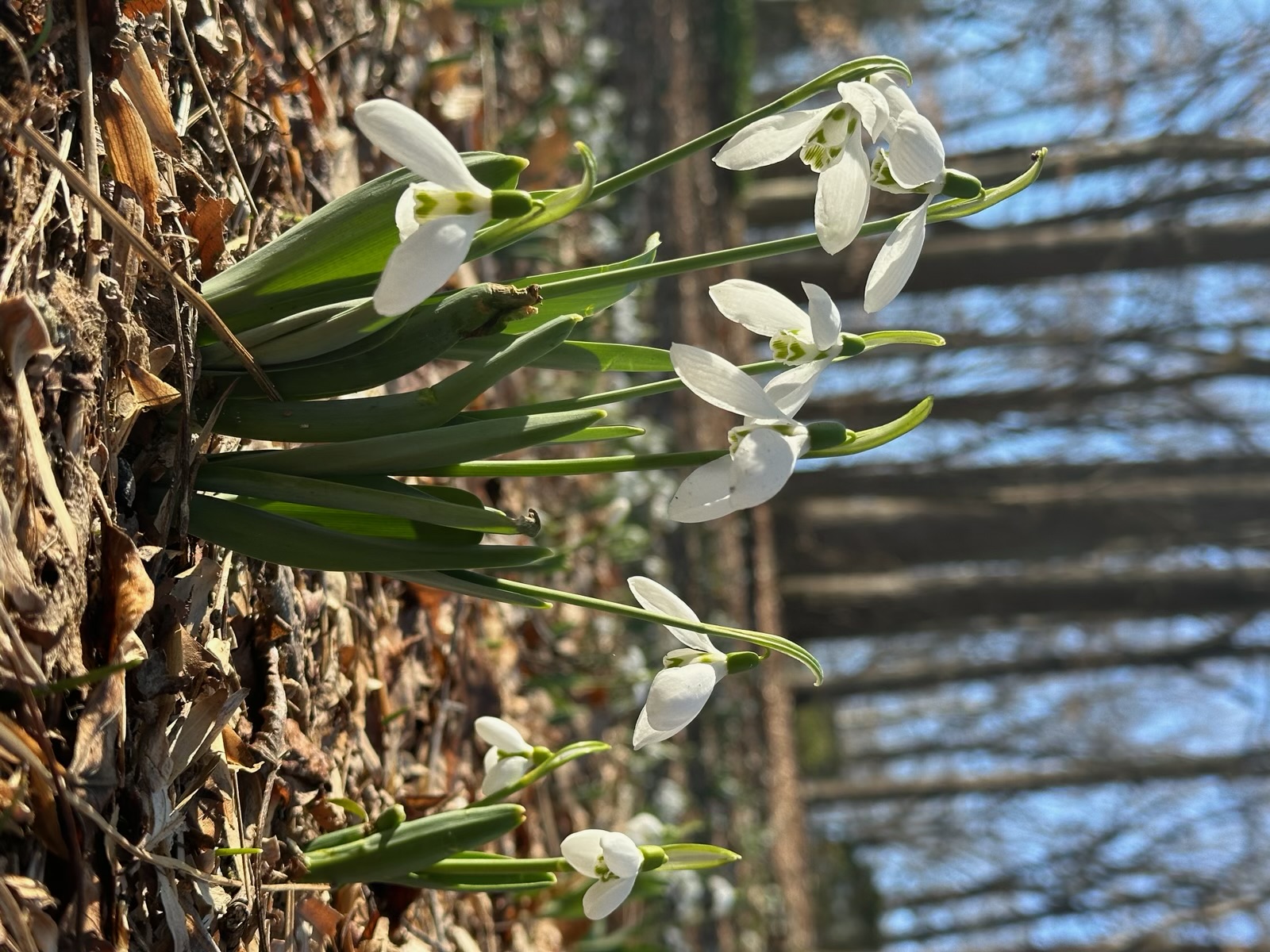
“With plant societies, I find that it’s people who understand me and I understand them,” says Sam Fry, who gardens with Coward at Gravetye. “We joke in the garden that most visitors are Muggles who are looking at the surface of a pretty garden, but when there’s someone who gets it and has that passion, too, it’s something very special. … It’s almost like a secret handshake.”
At the gala, that feeling is everywhere. There is an air of warmth and friendliness, and at lunchtime, guests spill onto the schoolhouse’s stone steps, talking about gardens and life. People wander between the schoolhouse and meetinghouse, gently carrying their leafy plants as if they’re newborns. Generosity abounds, too—the first time I attended, in 2023, I met a woman named Deborah who invited me to her nearby home so that she could dig up a clump of snowdrops and clip a pink pussywillow cutting for me to plant in my garden.
Galanthomania
White snowdrops coat the ground in the March Bank area at Winterthur Museum, Garden and Library. Courtesy of Winterthur Museum, Garden & Library/https://tf-cmsv2-smithsonianmag-media.s3.amazonaws.com/filer_public/9d/79/9d79abe4-047f-4fdf-a73e-5f39f5119367/img_20240212_141822871_hdr_1.jpg)
Many galanthophiles channel their passion for the flower into selecting, propagating and sometimes creating new cultivars, which are varieties singled out for their markings, colors, bloom size, leaves or other traits. The genus Galanthus contains roughly 20 species, which are naturally occurring, along with over 2,500 named cultivars. Many are the result of bee-pollinated crosses that gardeners noticed as distinctive; others are discovered as mutations. A small number of growers breed snowdrops by transferring pollen from one variety to another by hand, sowing the seed that results and waiting to see what blooms.
Some of these varieties are extremely rare, and demand among collectors has driven up their prices. This galanthomania has been likened to the tulipmania of the 1630s, when some Dutch tulip bulbs cost as much as a house. In 2015, a rare snowdrop bulb called Golden Fleece sold for about $1,900, and Golden Tears fetched nearly $2,500 in 2022. Some gardens see theft of the rare varieties, and snowdrops are sometimes sold on the black market. Janet Benjafield, snowdrop section editor of the Royal Horticultural Society’s Daffodil, Snowdrop and Tulip Yearbook, points out that these rare varieties were the results of many years of hard work—Joe Sharman of Cambridgeshire, England, spent 18 years creating Golden Fleece. Though prices for rare snowdrops can skyrocket, the common snowdrop, Galanthus nivalis, can be purchased for less than a dollar a bulb.
At the gala, the self-awareness of the occasional absurdity of this passion gives the event a sense of humor and delight. “The snowdrop induces a kind of madness amongst us,” Hester Forde—gardener, nursery owner and organizer of the Irish Snowdrop Gala—tells the crowd, to laughter. The uninitiated might miss the nuances of each cultivar—during one lecture, as photos of snowdrop after snowdrop graced the screen, someone a few rows behind me mumbled, “But they all look the same!” to some mirth.
However, watching a slideshow of photos is not at all like discovering unusual varieties in real life. The feeling of treasure-hunting outside across a snowdrop-filled landscape, searching for surprising new colorations and mutations, is part of the pleasure—as is the astonishment in finding the hidden variations. “I don’t know of another flower that’s as simple and as highly nuanced as the snowdrop,” Culp says.
The immortality of snowdrops
Collin Hadsell, who gardens with Long at Winterthur in Delaware, says the ability of snowdrops to thrive with little tending is a large part of their appeal. In the right climate and conditions, many varieties are easy to grow and naturalize. Winterthur had some snowdrops growing by 1895, but its collection greatly expanded from 1910 to 1926, when H.F. du Pont, the primary creator of its garden, ordered more than 20,000 Galanthus bulbs. The snowdrops have now naturalized so well that Hadsell estimates the garden has millions. Planting flowers benefits future generations, Hadsell says—he thinks of people like his 1-year-old daughter and, much later, her grandchildren, seeing the snowdrops someday. He hopes they’ll say, “‘I am so glad someone did this for us.’”
Snowdrops grow in front of a gravestone in the cemetery at the Downingtown Meetinghouse. Margo Rabb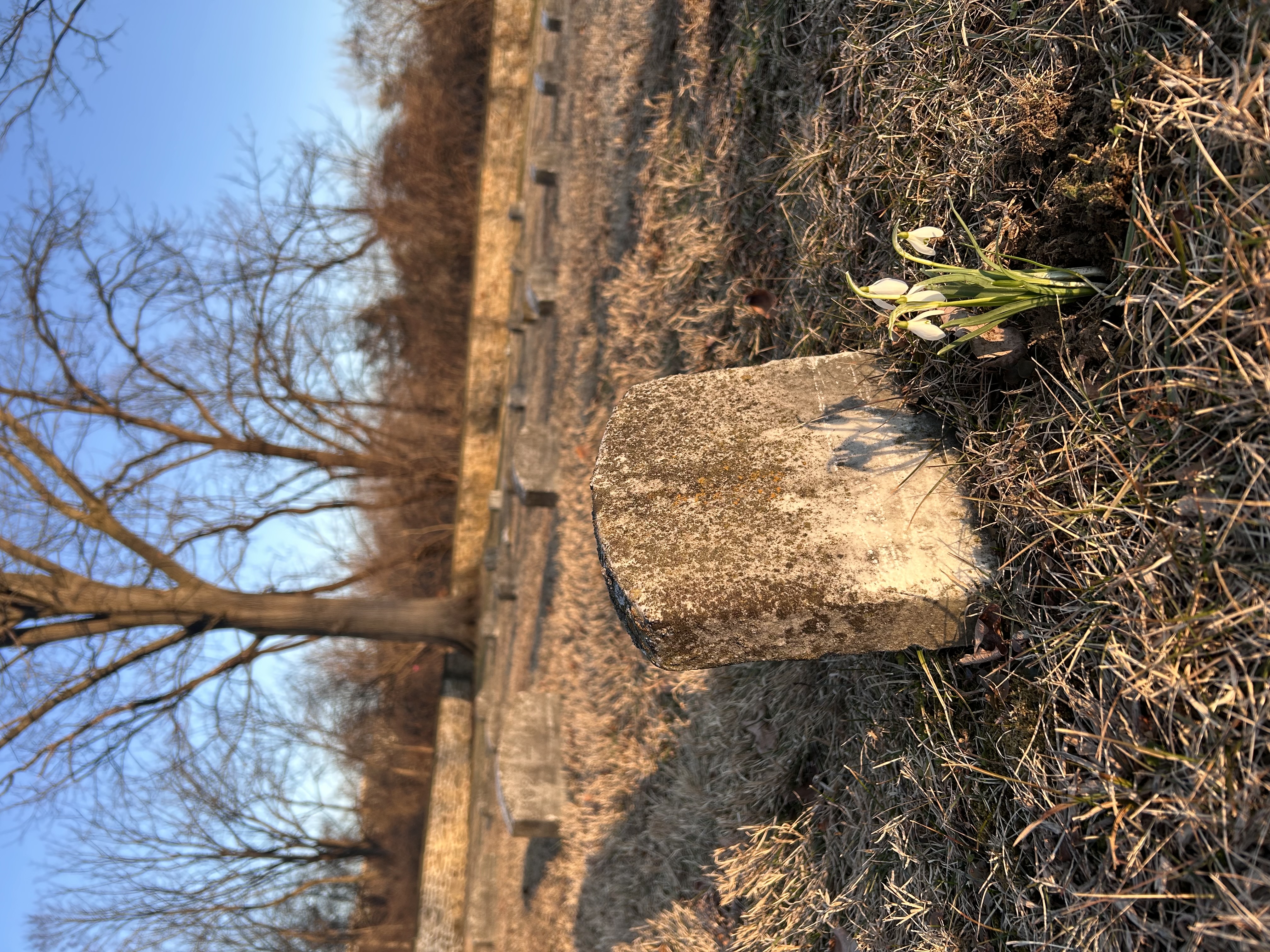
Humans have attached feelings and meanings to flowers for centuries—many Victorians used them to convey a hidden language—and the contrast of the simple white flower amid a dead and dormant landscape can evoke profound emotions. A tradition at the Galanthus Gala is to plant snowdrops among the graves at the meetinghouse’s adjoining cemetery. In England, snowdrops were commonly planted in churchyards and graveyards, and they appear on sympathy cards as well. The flower “‘has long been a symbol of hope and promise, of darkness giving place to light,’” says Coward, reading an 1886 quote from James Allen, known as the snowdrop king. “‘It is a dove sent out of the ark of winter by nature, to test the possibility of reclothing the Earth with beauty.’”
To see acres of snowdrops blooming on a February morning is to sense their immortality, to think of those who tucked their bulbs into the soil in backyards, parks, cemeteries, public gardens and estates, hoping that something beautiful might grow.
“We have to all do our part to make the world a little bit better, however we interpret that. Whether it be through a plant or a gathering like this,” Culp says. He points toward the wooden benches of the meetinghouse, worn like driftwood from centuries of people gathering through long winters, sorrows and wars, seeking comfort, friendship and meaning. Soon, more gardens will be filled with the small, often-overlooked, fierce and delicate flowers that others will experience during their dark and lonely seasons. “Like a snowdrop,” Culp says, “we’re going to make it through.”


