NTSB opens investigative hearing on DCA midair collision : NPR

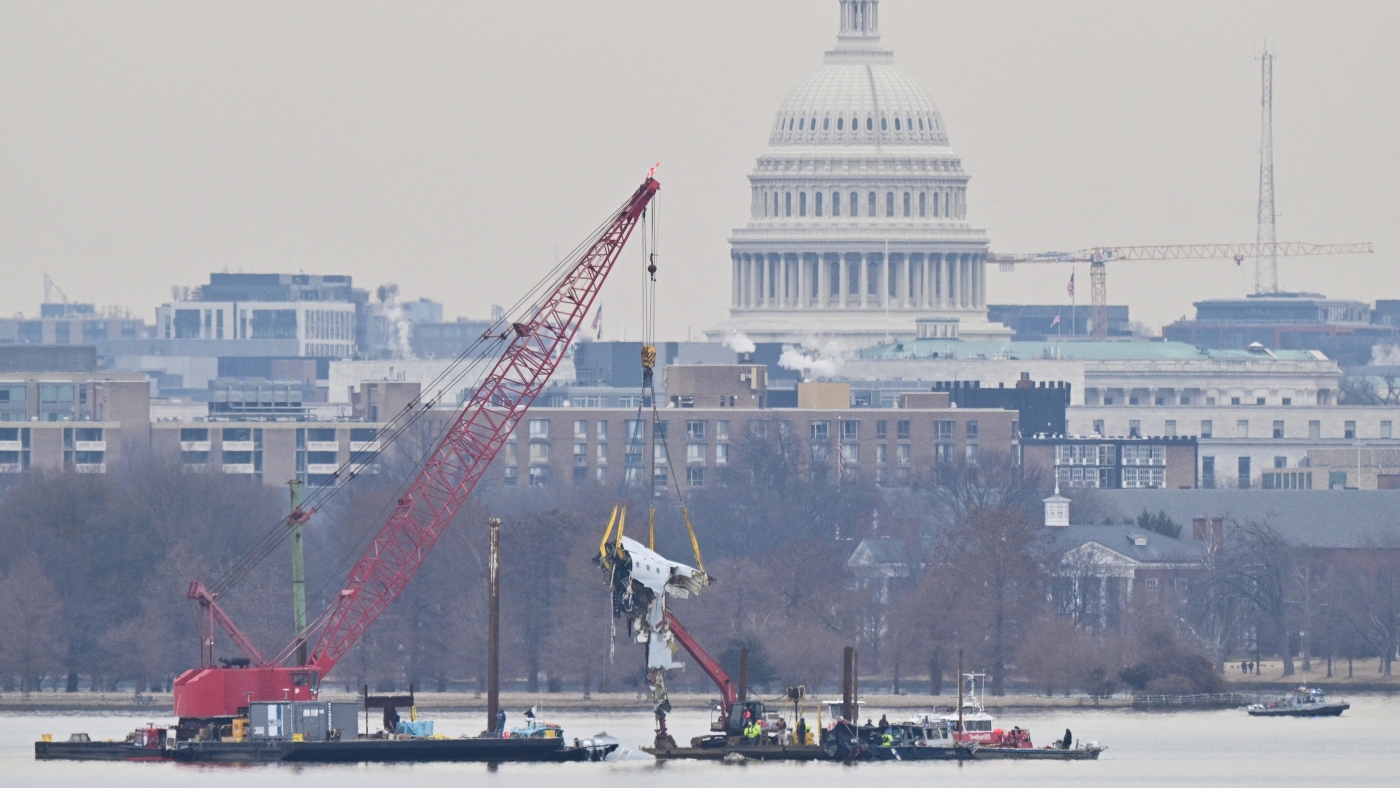

On February 3, a crane removed the Potomac river wreckage, where the American Airlines 5342 flight collided with a Black Hawk helicopter from the American army near Ronald Reagan Washington National Airport in Virginia. The 67 people on the two planes died during the collision while the jet tried to land.
Roberto Schmidt / AFP via Getty Images
hide
tilting legend
Roberto Schmidt / AFP via Getty Images
Washington – It has been six months since an American Airlines regional plane and a US Army Black Hawk helicopter collided in the air near Washington, DC, killing the 67 people on the two planes.

The accident has been investigated by the National Transportation Safety Board, which is expected to start a three -day investigation audience this week to share new information on the deadliest American aviation accident in decades.
The January air disaster has renewed concerns about the security of American aviation and has raised questions about crowded air space in the national capital, shared by commercial, military and government planes.
Here’s what you need to know before the NTSB audience from Wednesday.
This is the deadliest American aviation accident since 2001
The accident of January 29 occurred while the PSA Airlines flight outside Wichita, Kan., Approached Ronald Reagan Washington National Airport (DCA) in Arlington, Virginia, for landing. Two pilots, two on -board agents and 60 passengers were on board the regional jet of American Airlines.
Above the same time, an army helicopter traced a way to the south along the Potomac river on a training mission. There were a crew of three people.
The plane and the helicopter collided around 8:48 p.m. local time, sending the two planes to the icy river below. It was the most deadly American aviation incident since 2001.
DCA airspace was known to be a problem
The aeronautical industry has long warned of the congested air space around DCA.

The president of the NTSB, Jennifer Homendy, said in March that the flight models around the airport just outside Washington, DC, had created an “intolerable risk”. She noted that an NTSB analysis had found at least one “close call” per month between a helicopter and a flying commercial aircraft across the DCA from 2011 to 2024.
This year, the NTSB recommended – and the American transport secretary Sean Duffy accepted – two new policies in the light of the accident: definitively restricting non -essential helicopter operations around the DCA and eliminating the mixed helicopter and the fixed sail traffic.
Didn’t Black Hawk altimeters work properly?
The investigators said that the instruments saying to the helicopter pilots at what height they flew – the altimeters – may not work as planned.
A radio altitude reading showed that the accident occurred at 278 feet, but the helicopter should not have fly over 200 feet.

Mumendy said that the Black Hawk crew may have seen a different reading inside the helicopter and that NTSB investigators found “contradictory information in data”.
There are other factors before the collision that the NTSB examines. The Board of Directors noted that at least one radio transmission of DCA air traffic control may have been “walked” and not heard by the helicopter crew.
Investigators also noted that the three helicopter crew members probably wore night vision glasses throughout the flight, which could have affected their ability to see all around them.
The hearing concerns the search for facts, without blaming
The objective of the NTSB investigation hearings, like the one that begins this week, is to help the Council obtain “the information necessary to determine the facts and circumstances” of an accident.

Subjects on the agenda include helicopter data systems, complicated DCA airspace and training and advice given to DCA air traffic controllers.
Although the members of the Board of Directors of the NTSB can determine the probable cause of the accident, the board of directors does not blame the collision. Rather, he will offer a series of recommendations and proposals to the Federal Aviation Administration to try to prevent an accident similar to reproduce.
The full NTTSB survey report is expected to be completed at the start of next year.


