Nvidia’s Earth-2 models, including ‘climate in a bottle’, want to change weather forecasting for everyone across the world


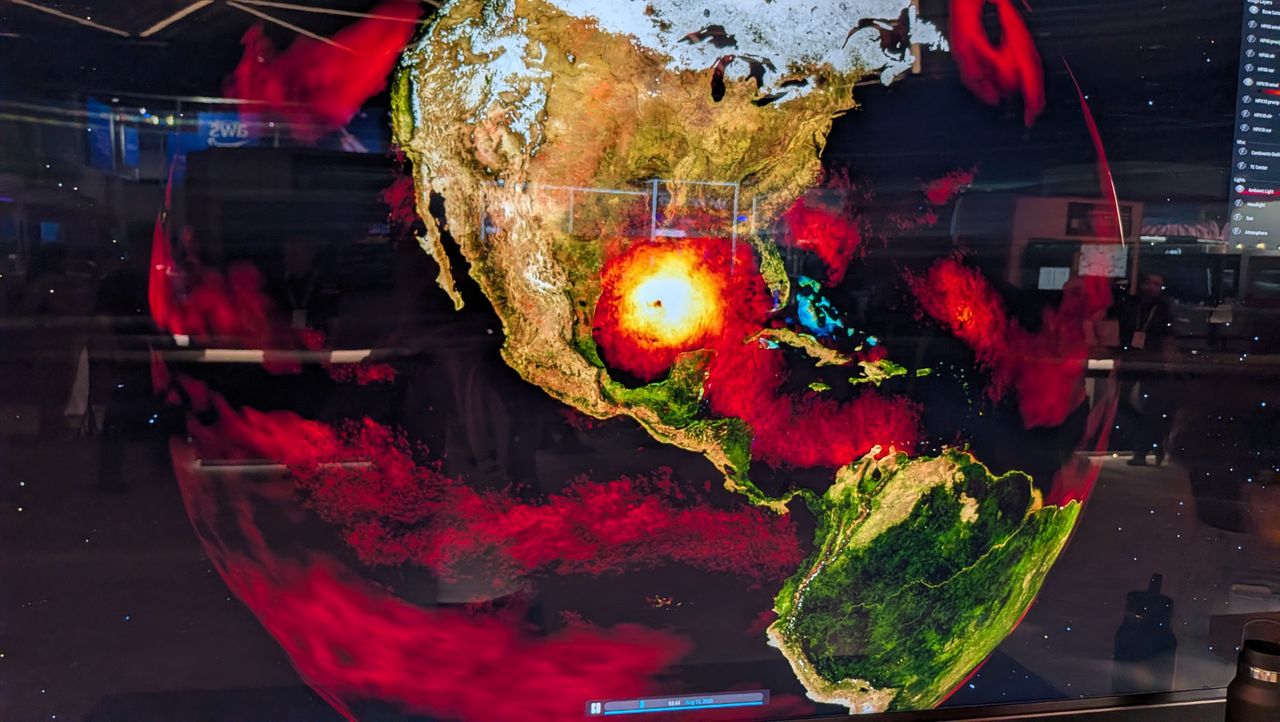
Nvidia unveiled new models for its Earth-2 digital twin platform in January 2026, promising advancements in training and fine-tuning AI models across a range of use cases such as weather forecasting and climate prediction as we know it.
The models bring together high-resolution data from satellites, radars and weather stations to provide continuous estimates of atmospheric conditions, enabling greater precision and information than ever before.
Article continues below
Faster and more precise
The demos we saw included a model that could take a range of different weather observations from satellites, weather balloons and weather stations, bringing them all together to give a coherent representation of the atmosphere at any given time.
This process used to take hours, but can now be condensed into just seconds.
Developed with NOAA (National Oceanic and Atmospheric Administration) and MITER, another model we’ve seen can use these initial observations to provide a global forecast of up to 14 days, predicting wind speed and direction, or even regional-scale weather forecasts of up to six hours on storms.
Another demonstration, brilliantly titled “Climate in a Bottle,” can use 50 years of weather observations, condensed into a few gigabytes, to create synthetic scenarios – weather simulations that can be useful for government planning or financial modeling, and even for estimating how solar power can be more efficient.
We are shown how any day from the last 50 years can be zeroed out, in this example by looking at ocean temperatures, which can then be extended with a variety of parameters, for example specific weather conditions, to form a forecast of the future.
The models can all run on a single machine, in this case powered by a dual Nvidia RTX Pro 6000 – one for inference and the other for visualizations, meaning there’s no need for off-site computing.
“The goal would be to get to a point where people could run thousands of predictions like this,” Steve Levay, product marketing manager for AI physics at Nvidia, told us, “finding the outliers and then hardening their infrastructure.”
“We also want to make all these models open source, so that people around the world, especially in the Global South, can conduct these types of prediction operations without depending on other institutions. »
“We’re saying that compared to a traditional numerical weather forecast, which is basically running a big solver around the world, it’s a thousand times faster to do it with AI…and you can also get better accuracy, and it’s faster.”
Precipitation, wind speeds, extreme weather events and more could be easily anticipated and prepared for if these models prove effective, and Nvidia appears ready to lead researchers in finding the answers.
Follow TechRadar on Google News And add us as your favorite source to get our news, reviews and expert opinions in your feeds. Make sure to click the Follow button!
And of course you can too follow TechRadar on TikTok for news, reviews, unboxings in video form and receive regular updates from us on WhatsApp Also.


:max_bytes(150000):strip_icc()/GettyImages-1644727881-73ef3c9679a6447faafc74eb0ff22f1e.jpg?w=390&resize=390,220&ssl=1 "6 Fish That Offer the Most Benefits for Your Heart and Brain")


