Nearly 1,000 Kenyans fighting in Ukraine : NPR

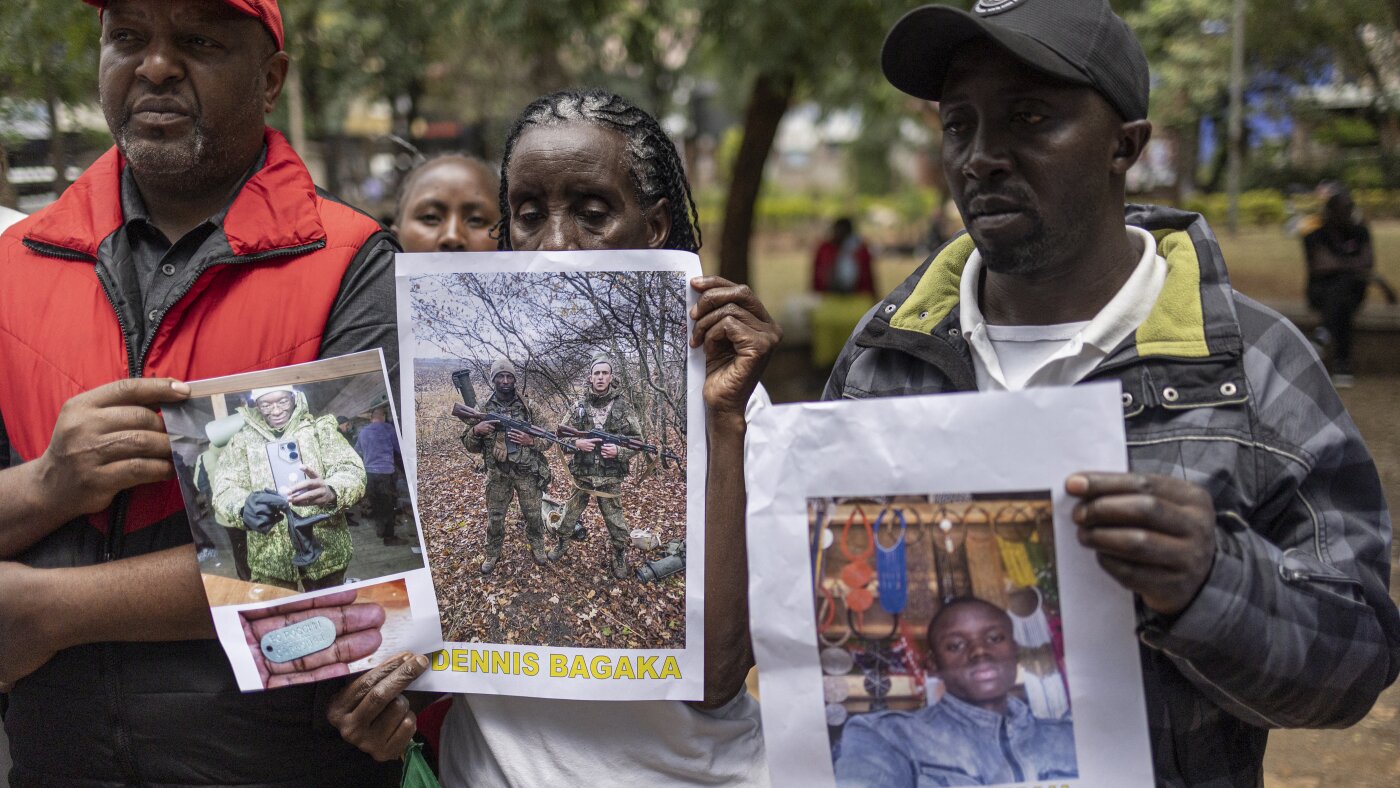

Relatives of Kenyan nationals conscripted by the Russian army in Ukraine pose with photos of their family members during a protest demanding urgent government action to repatriate their loved ones, in Nairobi, February 19, 2026.
Simon Maina/AFP via Getty Images
hide caption
toggle caption
Simon Maina/AFP via Getty Images
NAIROBI, Kenya — In Sikonga village, Kisii County, a mother’s wailing fills the house. Dennis Bagaka Ombwori, 39, the second son of John and Esther Ombwori, is the last Kenyan confirmed dead in the Russia-Ukraine war.
The villagers gather outside, offering what little comfort they can, but Esther Ombwori cannot be comforted. Dennis was working as a security guard in Qatar when recruiters approached him with what appeared to be a better offer. But his family says he never knew what his job really was.
His brother, Alfred Morara, said the news broke the family.
“They weren’t told what job they wanted to do. They were taken to Russia.” » said Morara. “He was recruited as a foreign soldier in Russia. They started fighting for Russia against Ukraine.”
Hundreds of miles away, in Nairobi, the Ogolla family is mourning a similar loss. Oscar Agola Ojiambo, 32, disappeared shortly after joining the Russian army last June. Months later, his family is still waiting for answers – and his body.
“The war front commanders revealed that my son died on August 14, 2025,” says Charles Ojiambo Mutoka, Oscar’s father. “This revelation took place in January this year, but the Russian government did not disclose it to the next of kin.”

Charles Ojiambo Mutoka, 72, stands in front of portraits of his son Oscar, killed in August 2025, during a press conference in Nairobi on January 27, 2026, during which relatives of conscripts called on the government to urgently repatriate their loved ones.
Tony Karumba/AFP via Getty Images
hide caption
toggle caption
Tony Karumba/AFP via Getty Images
For families like the Ombworis and the Ogollas, hope is fading. A report presented to Parliament on Wednesday by the Kenya National Intelligence Service estimates that more than 1,000 Kenyans are currently fighting in Ukraine, a much higher number than previous figures.
The government says it is working to identify and repatriate Kenyans caught up in the conflict, but the scale of the problem is staggering.
According to the intelligence report, 89 Kenyans remain on the front lines, 39 have been hospitalized and 28 are missing.
Since December, at least 30 people have been repatriated after leaving the conflict, many of them reporting difficult conditions on the battlefield. Some of those missing or feared dead are former members of the Kenya Defense Forces.
In Parliament, the report has sparked concern, where lawmakers say they are shocked by the scale of the problem. Majority Leader Kimani Ichung’wah said officials in Nairobi and Moscow played a role in sending Kenyans to the front lines.
“More telling is the collusion between officers of the Russian embassy and the Kenyan embassy in Moscow,” Ichung’wah told parliament. “Our ambassador in Moscow must be able to identify embassy officers who may have colluded with these criminals.”
Opposition MP Joseph Makilap, who insisted that the intelligence report be released, said the scale of recruitment was staggering.
“I am extremely shocked at how Kenyans can be taken all the way to Moscow to fight another sovereign country called Ukraine.”
Dr Korir Sing’Oei, principal secretary at the Ministry of Foreign Affairs, says young Kenyans are victims of unscrupulous recruitment rings.
“Some Kenyans have been irregularly recruited to serve in the context of the ongoing Ukrainian-Russian conflict,” Singoei said. “Unfortunately, in their desire to work abroad, many Kenyans fall victim to unscrupulous groups.”

A poster showing a Kenyan conscripted by the Russian army in Ukraine is displayed during a protest in Nairobi on February 19, 2026. According to an intelligence report presented to Kenya’s parliament, more than 1,000 Kenyans left to fight for Russia, with most apparently tricked into signing military contracts.
Simon Maina/AFP via Getty Images
hide caption
toggle caption
Simon Maina/AFP via Getty Images
Training for recruits is limited, according to Majority Leader Ichung’wah. “No one in the army trains people for three weeks. Some only have nine days of preparation.”
“We basically give them a gun and send them to die,” Ichung’wah told parliament.
The Russian Embassy in Nairobi has rejected the allegations, calling them “dangerous and misleading”, saying its staff had never been involved in “rogue schemes” or any form of illegal recruitment.
In a post on The embassy has also not encouraged any Kenyan citizen to do so. »
According to the Kenyan intelligence report, the recruitment networks involve both Kenyan and foreign actors. Many of those who are conscripted travel via Uganda, South Sudan or South Africa to avoid detection. Others leave secure jobs in the Middle East for contracts promising thousands of dollars and the chance to obtain Russian citizenship after a year on the line.
Recruits are promised a monthly salary of up to 350,000 Kenyan shillings ($2,400), with bonuses ranging from 900,000 to 1.2 million shillings ($6,200 to $8,300).
Across the continent, this situation is far from isolated. In November, Ukrainian Foreign Minister Andrii Sybiha said more than 1,400 Africans from more than 30 countries were fighting for Russia – although Kenya’s figures suggest this may be a conservative estimate.
Young men are promised jobs as drivers or security guards, with salaries ten times what they could earn at home. Instead, many are sent to the front.
Kenya’s foreign minister is set to travel to Russia to push for a deal banning the conscription of Kenyan soldiers – a mission families like the Ogollas are pinning their hopes on.
For the Ogollas and many others, this is more than a political negotiation: it could be a lifeline, offering answers and a path back to the hundreds of young Kenyans still trapped in a war that is not theirs.


