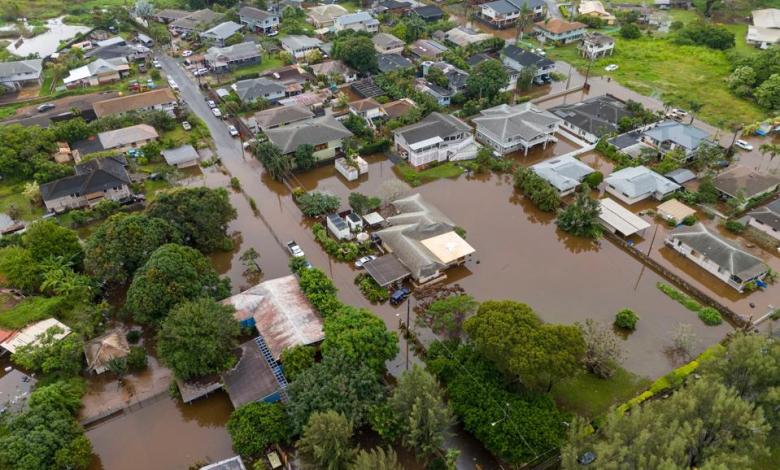
Hawaii’s flood emergency is first and foremost a human story. On Oahu, fast-rising water triggered evacuation orders for about 5,500 people, damaged homes, stranded residents, and forced rescues as heavy rain overwhelmed already saturated ground. Officials warned that the Wahiawa Dam was at risk of imminent failure as the storm intensified. Governor Josh Green called the situation “very serious” and said the damage could top $1 billion.
That immediate danger deserves the public’s full attention. But this is also a story about infrastructure, and about what happens when a hazard collides with systems that are old, stressed, or insufficiently maintained.
The storm itself was severe. AP reported that parts of Oahu received 8 to 12 inches of rain overnight, with nearly 16 inches recorded at Kaala, the island’s highest peak. Officials said this was Hawaii’s most serious flooding since 2004. Yet even as the rainfall explains the flooding, the infrastructure backdrop helps explain why the danger escalated so quickly.
The Wahiawa Dam became the clearest symbol of that vulnerability. According to AP, the earthen dam was built in 1906, reconstructed after a 1921 collapse, and has been the subject of multiple state notices of deficiency since 2009. The state has classified it as having “high hazard potential,” meaning failure could probably result in loss of human life. The legislature authorized acquisition in 2023 and appropriated funds for purchase and repairs, but the transfer had still not been completed as this flood emergency unfolded.
That does not mean the dam alone caused the crisis. It means aging infrastructure can turn a weather emergency into a broader public safety emergency. Roads fail. Evacuation routes become less reliable. Water systems, drainage systems, and traffic controls become more fragile under stress. Risk multiplies.
That lesson is especially important in Hawaii, where many communities are still carrying the trauma and disruption of recent disasters. Maui, and Lahaina in particular, remains in a long recovery process after the 2023 wildfires. County recovery materials show that more than 2,000 properties were damaged or destroyed and that rebuilding, permitting, and long-term recovery infrastructure are still ongoing. Even as Oahu confronts flood damage, the state is still managing the long shadow of another catastrophic event, the Lahaina fires.
Oahu Flooding Exposes America’s Infrastructure Problem
When one disaster follows another, deferred maintenance and incomplete upgrades become more than technical problems. They become compounding liabilities.The American Society of Civil Engineers gave U.S. infrastructure an overall grade of C in its 2025 Report Card, an improvement from C- in 2021. That is real progress, and it suggests recent federal investments are making a difference. But ASCE also warned that the country still faces a $3.7 trillion gap between planned investment and what is needed to bring infrastructure into good working order. Nine infrastructure categories still received grades in the D range, including stormwater and transit.
That gap has practical consequences in disasters. Weak infrastructure does not just break. It raises the cost of response, stretches recovery timelines, increases business interruption, and deepens human harm. The European Infrastructure Simulation and Analysis Centre has argued that the cost of inaction can be far greater than the cost of preparedness, noting that infrastructure failures produce cascading economic losses across communities and supply chains. Its analysis cites the 2021 Texas power crisis as a stark example of what happens when systems are unprepared for foreseeable stress.
Disaster Resilience Is also about Infrastructure resilience
There is also a growing body of resilience research that makes the same point in a more formal way. A 2022 paper in Sustainable and Resilient Infrastructure argues that adaptive resilience planning can help decision-makers quantify the long-term benefits of infrastructure investments under uncertainty, and that those benefits increase over time as risks evolve.
The business case is not theoretical. The World Bank and GFDRR have estimated that resilient infrastructure can generate about $4 in benefits for every $1 invested in low- and middle-income countries. The exact ratio will differ by project and geography, but the broader lesson is widely applicable: resilience spending is not only defensive. It is economically rational.
The Hawaii floods should be covered as an emergency, because it is one. This should also be understood as a warning. In an era of heavier rainfall, climate volatility, and repeated disasters, infrastructure investment is not a secondary policy concern. It is central to resilience and sustainability.
If roads, dams, drainage, water systems, and grids are allowed to age into fragility, then every storm becomes more dangerous and every recovery becomes more expensive. If those systems are modernized with resilience in mind, communities stand a better chance not only of surviving the next disaster, but of recovering faster and being more sustainable and resilient afterwards.


