Families face separation as Haiti TPS scheme ends


 Liam Weir/BBC
Nawal al-Maghafi and Jasmin DyerBBC World Service, Florida
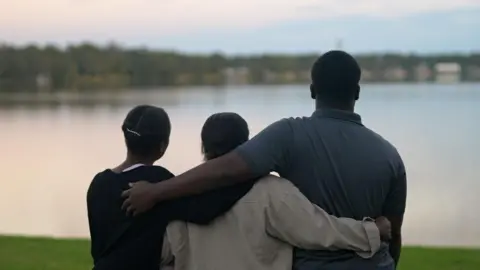
In a waterfront home in the town of Lakeland, Florida, Marven laughs with two women he loves deeply: his sister Rochelle and their biological mother, Guerline.
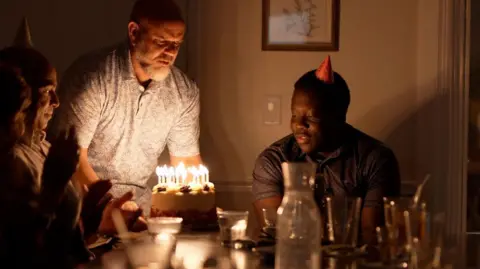
The warmth between them is undeniable as they celebrate his 16th birthday, even though they spent ten years apart. Today, they fear being separated again.
Also celebrating is Stacey Nageli Angulo, who adopted Marven when he was three from Haiti following a devastating earthquake in 2010.
She helped Guerline and Rochelle come to the United States three years ago, reuniting their family, as gang violence sparked a new humanitarian crisis in the Caribbean island nation.
The two Haitian women, whose names we have changed for their safety, live and work legally in the United States under a program called Temporary Protected Status (TPS). It provides protection to people already in the United States from countries hit by war or natural disaster.
But TPS is set to end for 350,000 Haitians in February, part of sweeping changes to U.S. President Donald Trump’s immigration policies.
 Liam Weir/BBC
Rochelle, now 21, applauds as Marven blows out his candles, but Guerline’s smile falters. In just a few months, both women could be deported.
After the earthquake, Guerline lived in Port-au-Prince, Haiti’s capital, struggling to provide for her children. She says putting Marven up for adoption “marked” her, but she “wanted a better life for him.”
Stacey, who now renovates properties after a career in the corporate world, says she felt compelled to adopt a Haitian child in the wake of the disaster and raised Marven alongside her two biological children.
More recently, having heard about the abuse, she began researching legal pathways to the United States for Rochelle and Guerline. When a humanitarian program opened in 2023, they applied immediately. “Three weeks later, they were approved and got on a plane and here with us,” she says.
The two Haitian women moved into a trailer in front of Stacey’s driveway, before renting an apartment there. Guerline now works in a hotel. Rochelle works in a supermarket and in a nursery and dreams of becoming a nurse.
Marven often sleeps in their apartment and loves the Haitian cuisine that Guerline cooks. He says his life “now seems more complete.”
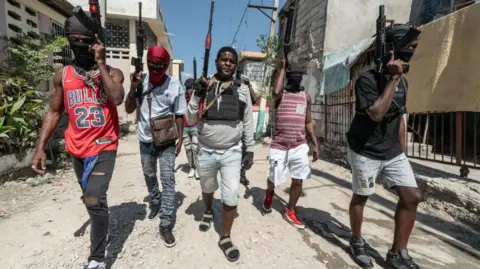
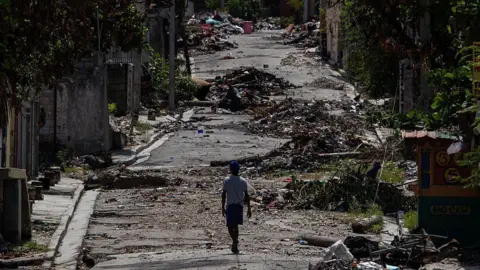
But Rochelle and Guerline are terrified of returning to Haiti. Gang violence has displaced a tenth of the population, according to the UN, with a sharp increase in kidnappings and killings. Rape and arson are commonplace.
 Getty Images
Rochelle, now 21, says her biggest fear in Port-au-Prince was being kidnapped. “I was at school and I saw young girls like me being kidnapped,” she says. “They demanded ransom for them and didn’t get them back,” she said, adding that she believes some kidnapped girls are either raped or killed.
She says she receives harrowing videos every day from friends and relatives in Haiti, including burning bodies and gang shootings: “There’s gun battles all the time. You can’t really get out.”
Stacey voted for President Trump in the last three presidential elections, but is now horrified that Rochelle and Guerline could be fired.
“Do we want to open the borders? Absolutely not. Do we want criminals deported? Absolutely,” she said. “But tearing families like ours apart and deporting people to countries where security is absolutely unsafe… is unthinkable and unconscionable.”
 Reuters
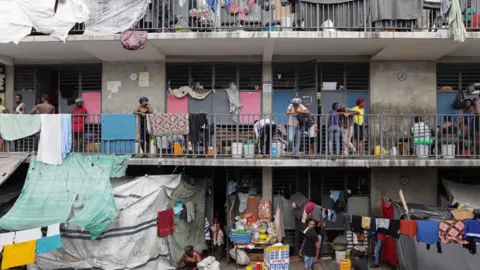
TPS for Haitians has been extended several times since it was first designated in 2010.
But now, the U.S. Department of Homeland Security (DHS) says that “the environmental situation in Haiti has improved enough for Haitian citizens to return home safely.”
The American government, however, advises its citizens not to go there due to “kidnappings, crime, terrorist activities and civil unrest.”
The U.S. Immigration Service says continuing the program for Haitians is not in the U.S. interest, citing difficulties in vetting migrants and obtaining information from Haitian law enforcement, coupled with the “serious threat posed by Haitian gangs.”
A DHS spokesperson also told the BBC in September that TPS had been abused and exploited.
The U.S. administration says those whose TPS ends can leave voluntarily or pursue other immigration options. Lawyers say few will be qualified to stay and many will go underground.
In Miami, another Haitian woman, whom we call Monique, tells us that she has lived in the United States for more than 16 years. Her small house is lined with photos of her husband, son and daughter. She is the only one to be deported: her husband is a permanent resident, her daughter is a US citizen and her son has a green card application in progress.
Monique, who now works as a bus driver, entered legally through a humanitarian program before joining TPS in 2010.
“Yes, it’s called Temporary Protected Status,” she says. “But it’s temporary if your home is safe. Haiti is not safe.”
She wipes away tears, convinced that she will lose everything and possibly die if she returns: “Don’t send us to Haiti… just kill us.” »
 Liam Weir/BBC
More than a million people have TPS in the United States, and people from 20 countries have benefited from this protection since 1990.
This year, the United States ended it for six countries: Afghanistan, Cameroon, Honduras, Nepal, Nicaragua and Venezuela. There have been numerous legal challenges, including one that delayed the end of TPS for Haitians.
In Florida, where 56 percent of voters supported Donald Trump, many Republican supporters, like Stacey, told us they want to see immigration law enforced, but worry about the human cost of current policies.
She believes that the Republican Party is “completely disconnected” from its electoral base when it comes to immigration.
Local businessman Sam Romain, chairman of the Polk County Republicans, is less sympathetic, however: “You knew it was temporary, you built your life on temporary status and now… you’re upset that it’s expiring. We knew what the rules were.”
Asked about the situation in Haiti, he says he is not qualified to assess whether the country is safe enough to return to, but he believes the decision is being made by qualified officials and he trusts their judgment.
 CLARENS SIFFROY/AFP via Getty Images
Mr. Romain says he believes in America as “a nation of law and order” and adds that immigration reform “must happen.”
For Rochelle and Guerline, the future is filled with uncertainty.
“We were told that America was the land of freedom and security,” Rochelle says. “Now I don’t know where we belong.”
“I love my sister very much,” Marven said. “I don’t know what I would do if something happened to him.”
The three pose together for a photo: mother, son and daughter. But within a few months, two of them could disappear.


