One week on, a breakthrough in the Louvre heist that exposed weaknesses and wounded French pride


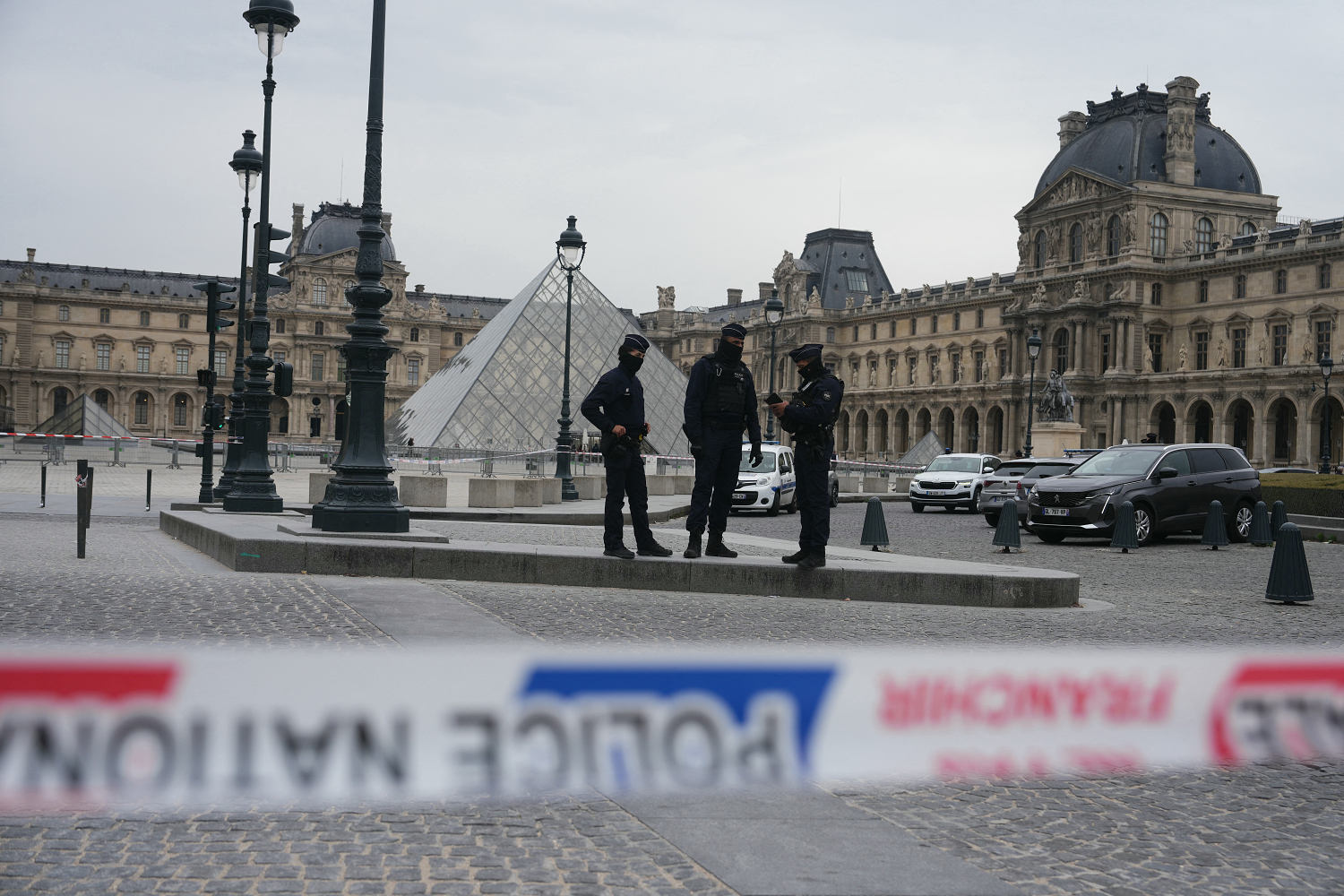
PARIS — A week after four thieves stormed the Louvre in just seven minutes, the first arrests have been made in a case that exposed serious security flaws and hurt French pride.
The thieves arrived early last Sunday with a furniture lift, broke through a window of the Apollo Gallery, threatened guards and smashed two display cases, stealing eight of France’s crown jewels. The four suspects then fled on scooters before police could intervene.
Their pieces — necklaces, tiaras and brooches once worn by France’s long-lost royals and worth an estimated 88 million euros ($102.63 million) — have investigators racing against time to recover the missing pieces before they can be smashed and melted down or sold.
The arrests took place on Saturday, a man having been arrested while he was “preparing to leave the country” from Paris Charles de Gaulle airport, said Paris prosecutor Laure Beccuau. AFP reports that two men were taken into custody on suspicion of organized theft and criminal conspiracy.
But seven days later, the audacious heist that struck at the heart of French national pride still raises uncomfortable questions about how the world’s most visited museum was so easily hacked.
The thieves parked a furniture lift – a truck equipped with a basket lift – and used it to access a second-story balcony, apparently without attracting the attention of police or security.
The presence of such manned vehicles on the streets outside the Louvre is not unusual, museum security officers told NBC News, speaking before the arrests.
“Often, there are window cleaners,” explains Vanessa Michaux Valora, security officer at the museum for 21 years and SUD union delegate. “Now we know they don’t work weekends anymore, but at the time it didn’t seem unusual.”
Julien Dunoyer, a security guard and union representative who also has two decades of experience at the museum, said work was underway in a garden beneath the gallery. So it was “no surprise that there was an elevator ladder.”
“That’s the problem with having a lot of works in different places,” he said.
Valora and Dunoyer said they were working in different parts of the museum at the time of the theft and were unaware a burglary had occurred when they were asked to evacuate people outside.
“We were wondering if it could be an attack and we needed to make sure everyone was safe,” Valera said. “We didn’t expect it to be this catastrophic. It’s extremely shocking. We are really suffering.”
Laurence des Cars, director of the Louvre, told French senators on Wednesday that the theft revealed “weaknesses” in security.
“We didn’t detect the arrival of the thieves early enough,” she said, according to Reuters, attributing this to the fact that there were not enough cameras outside to monitor the museum’s perimeter.
After the Louvre theft, the SUD Culture union pointed out the “destruction of jobs dedicated to security” and the lack of funding for security equipment. Gallery guards, ticket agents and museum security staff staged a brief strike in June, citing chronic understaffing and poor working conditions.
French President Emmanuel Macron announced a six-year renovation of the museum earlier this year, including funds for security improvements.
For a nation whose character is defined by proud displays of history and culture, the incident is seen in some quarters as a national humiliation.
Macron called it “an attack on a heritage that we cherish because it is our history.” He pledged to “recover the works and the authors will be brought to justice”, adding that “everything is being done, everywhere, to achieve this”.
Alexandre Portier, the lawmaker leading the French parliament’s investigation into the theft, said the heist had left a “wound”, with fears growing that the treasures would never be seen again.
“I’m concerned that as we speak, the jewelry has already been taken apart, cut up and is at risk of being tampered with,” Portier told NBC News before the arrests, in which case, “even if we found all the items, we wouldn’t be able to piece together the crowns and necklaces that were stolen.”
The stolen objects “belong to humanity, as part of our common history,” he added, and “they could be lost to all humanity.”


